## Diagram: Synergized Model Architecture for AI Applications
### Overview
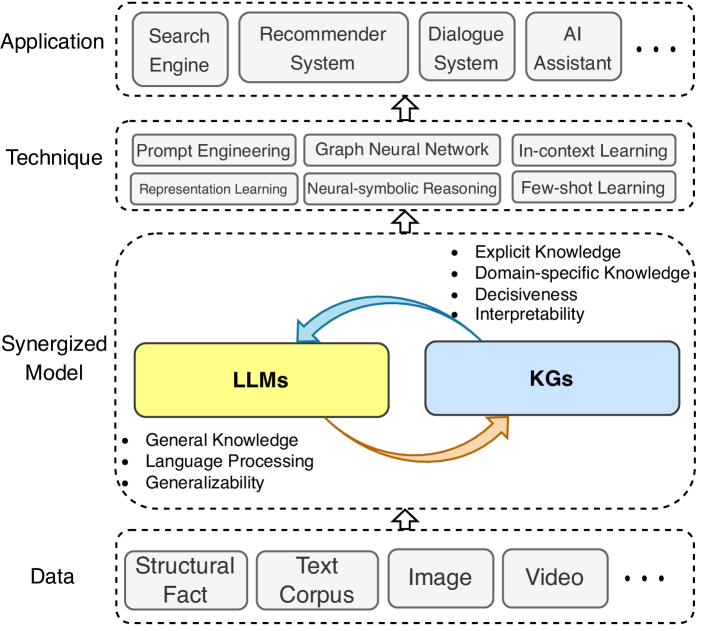
The diagram illustrates a hierarchical framework for AI applications, showing the integration of Large Language Models (LLMs) and Knowledge Graphs (KGs) within a data-driven architecture. It emphasizes bidirectional interactions between components and their roles in enhancing application performance.
### Components/Axes
1. **Application Layer** (Top):
- Search Engine
- Recommender System
- Dialogue System
- AI Assistant
- *... (ellipsis indicates additional unspecified components)*
2. **Technique Layer** (Middle):
- Prompt Engineering
- Graph Neural Network
- In-context Learning
- Representation Learning
- Neural-symbolic Reasoning
- Few-shot Learning
3. **Synergized Model** (Central):
- **LLMs** (Yellow box):
- General Knowledge
- Language Processing
- Generalizability
- **KGs** (Blue box):
- Explicit Knowledge
- Domain-specific Knowledge
- Decisiveness
- Interpretability
- Arrows:
- Orange bidirectional arrow between LLMs and KGs (mutual enhancement)
- Blue arrow from Data Layer to Synergized Model (data input)
4. **Data Layer** (Bottom):
- Structural Fact
- Text Corpus
- Image
- Video
- *... (ellipsis indicates additional data types)*
### Detailed Analysis
- **LLMs** are positioned as the core general knowledge processors, emphasizing their role in language understanding and adaptability.
- **KGs** are highlighted for their structured, domain-specific knowledge and interpretability advantages.
- The bidirectional orange arrow between LLMs and KGs suggests iterative refinement: LLMs provide contextual understanding to KGs, while KGs ground LLMs in factual knowledge.
- Data types (Structural Fact, Text, Image, Video) feed into the model, implying multimodal input capabilities.
- Techniques like Prompt Engineering and Graph Neural Networks are positioned as enabling methods for the Synergized Model.
### Key Observations
1. **Bidirectional Integration**: The orange arrow between LLMs and KGs is the only bidirectional connection, emphasizing their interdependent relationship.
2. **Data Flow**: All data types flow upward into the Synergized Model but not downward, suggesting a unidirectional data pipeline.
3. **Technique Hierarchy**: Techniques are positioned above the Synergized Model, implying they are methodological frameworks rather than direct components.
4. **Application Diversity**: The Application Layer includes both traditional (Search Engine) and emerging (AI Assistant) use cases.
### Interpretation
This architecture demonstrates a knowledge-centric AI paradigm where:
1. **LLMs and KGs Complement Each Other**: LLMs handle linguistic generalization while KGs provide structured domain expertise, creating a hybrid system that mitigates individual limitations (e.g., hallucination in LLMs, rigidity in KGs).
2. **Data Diversity Matters**: The inclusion of multimodal data (text, images, video) suggests the model is designed for cross-modal understanding, though specific fusion mechanisms are not shown.
3. **Technique Specialization**: Different techniques are positioned as specialized tools for different aspects of the model (e.g., Prompt Engineering for LLM optimization, Graph Neural Networks for KG construction).
4. **Application Flexibility**: The ellipsis in both Application and Data Layers implies scalability and adaptability to new use cases and data types.
The diagram positions this synergized approach as a solution to the "knowledge gap" in current AI systems, where general language models lack domain specificity and structured knowledge systems lack contextual adaptability.