\n
## Diagram: Lean Copilot System Architecture
### Overview
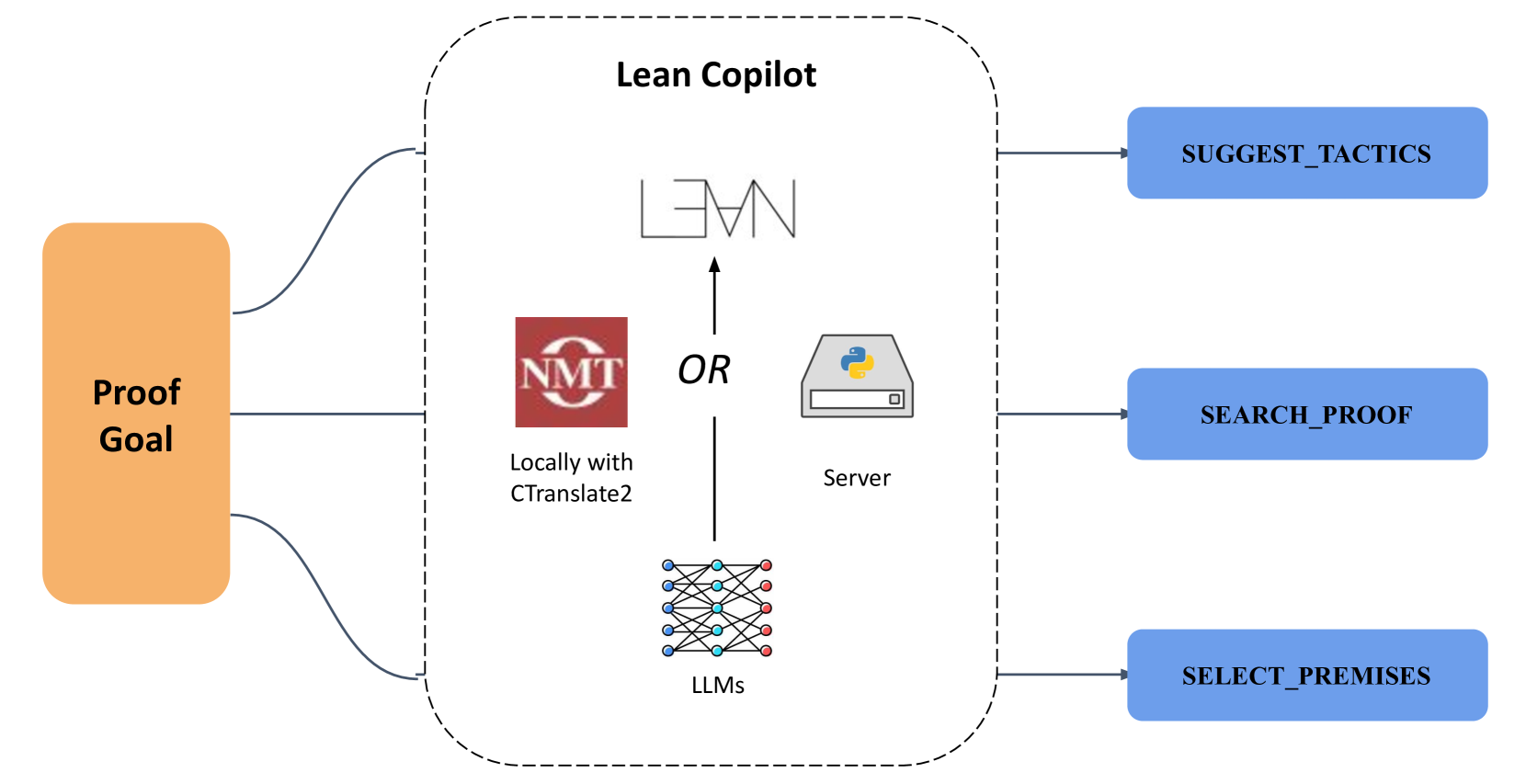
This image is a technical system architecture diagram illustrating the workflow and components of a system called "Lean Copilot." The diagram shows how a "Proof Goal" is processed by the central "Lean Copilot" module, which can utilize different backend technologies, to produce three distinct types of output actions.
### Components/Axes
The diagram is organized into three primary spatial regions:
1. **Left Region (Input):** A single orange, rounded rectangle labeled **"Proof Goal"**.
2. **Central Region (Processing Core):** A large, dashed-border rectangle labeled **"Lean Copilot"** at the top. This box contains the core processing components.
3. **Right Region (Outputs):** Three separate blue, rounded rectangles aligned vertically, representing the system's output functions.
**Connections (Flow):**
* Three curved arrows flow from the right side of the "Proof Goal" box into the left side of the "Lean Copilot" box.
* Three straight arrows flow from the right side of the "Lean Copilot" box to each of the three blue output boxes on the right.
### Detailed Analysis
**Central "Lean Copilot" Box Contents:**
* **Top Center:** The word **"LEAN"** is displayed in a stylized, geometric, outline font.
* **Left Side:** A red square logo containing the white letters **"NMT"**. Below this logo is the text **"Locally with CTranslate2"**.
* **Center:** The word **"OR"** in bold, black text, positioned between the NMT/CTranslate2 component and the Server component.
* **Right Side:** An icon of a computer server tower. The server has a small Python logo (blue and yellow snakes) on its front. Below the icon is the text **"Server"**.
* **Bottom Center:** An icon representing a neural network, labeled **"LLMs"** (Large Language Models). An arrow points upward from this icon to the stylized "LEAN" text above.
**Output Boxes (Right Region, from top to bottom):**
1. **Top Blue Box:** Contains the text **"SUGGEST_TACTICS"**.
2. **Middle Blue Box:** Contains the text **"SEARCH_PROOF"**.
3. **Bottom Blue Box:** Contains the text **"SELECT_PREMISES"**.
### Key Observations
* The diagram presents a clear input-process-output flow.
* The "Lean Copilot" core offers a choice ("OR") between two primary backend execution methods for processing the proof goal: a local Neural Machine Translation (NMT) system using CTranslate2, or a remote Server.
* The server-based approach is explicitly linked to Python (via the logo) and is connected to the LLMs component, suggesting the server hosts or interfaces with Large Language Models.
* The LLMs component has a direct upward connection to the "LEAN" branding, indicating that the LLMs are a core technology powering the Lean Copilot's functionality.
* The system produces three distinct, named outputs related to automated reasoning or proof assistance: suggesting tactics, searching for proofs, and selecting premises.
### Interpretation
This diagram outlines the architecture of an AI-powered assistant ("Copilot") for the Lean theorem prover. The system takes a mathematical or logical "Proof Goal" as input. The core "Lean Copilot" module then processes this goal using one of two computational backends: a locally-run, optimized translation model (NMT with CTranslate2) or a server-based system that leverages Large Language Models (LLMs).
The purpose of the system is to automate or assist in the proof construction process, as evidenced by its three outputs:
1. **SUGGEST_TACTICS:** Recommending next steps or strategies (tactics) within the Lean prover.
2. **SEARCH_PROOF:** Actively searching for a complete proof path.
3. **SELECT_PREMISES:** Identifying relevant axioms, theorems, or lemmas (premises) from a library to use in the proof.
The architecture highlights flexibility in deployment (local vs. server) and indicates that modern LLMs are a key component driving the assistant's intelligence. The flow suggests a tool designed to integrate into a mathematician's or computer scientist's workflow, providing targeted, AI-driven suggestions to overcome proof-writing bottlenecks.