\n
## Text Document: Core Template & Answer Relevancy Prompt
### Overview
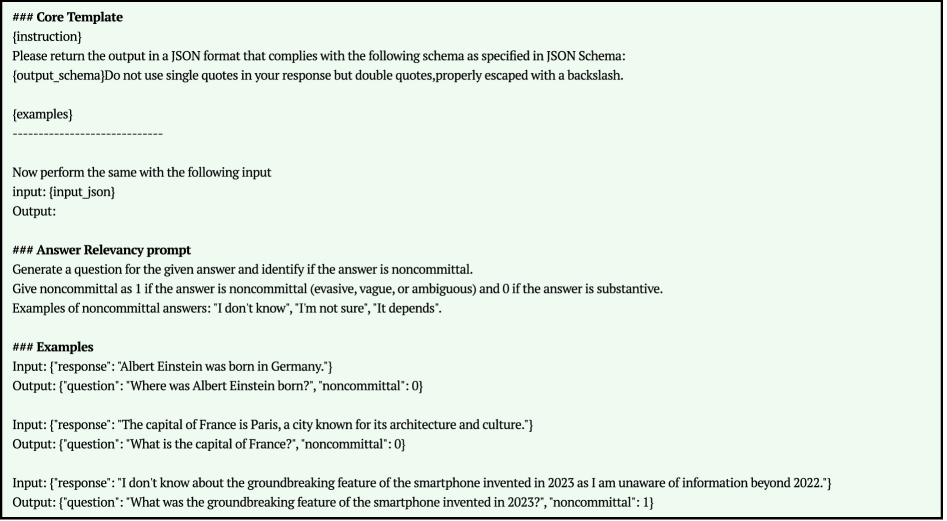
The image presents a text document outlining instructions for generating JSON output based on a given schema and a prompt for assessing answer relevancy. The document is formatted with Markdown headings and includes examples to illustrate the expected behavior.
### Components/Axes
The document is structured into sections denoted by Markdown headings:
* `### Core Template`: Describes the JSON output format requirement.
* `### Answer Relevancy prompt`: Explains the criteria for determining answer noncommittal status.
* `### Examples`: Provides illustrative input-output pairs for both sections.
### Detailed Analysis or Content Details
**Core Template Section:**
* **Instruction:** "Please return the output in a JSON format that complies with the following schema as specified in JSON Schema: {output\_schema}Do not use single quotes in your response but double quotes, properly escaped with a backslash."
* **Examples:** A horizontal line separates the instruction from the example section.
* **Input:** `input: {input_json}`
* **Output:** `Output:`
**Answer Relevancy Prompt Section:**
* **Prompt:** "Generate a question for the given answer and identify if the answer is noncommittal. Give noncommittal as 1 if the answer is noncommittal (evasive, vague, or ambiguous) and 0 if the answer is substantive. Examples of noncommittal answers: 'I don't know', 'I'm not sure', 'It depends'."
**Examples Section:**
* **Example 1:**
* **Input:** `{“response”: “Albert Einstein was born in Germany.”}`
* **Output:** `[“question”: “Where was Albert Einstein born?”, “noncommittal”: 0]`
* **Example 2:**
* **Input:** `{“response”: “The capital of France is Paris, a city known for its architecture and culture.”}`
* **Output:** `[“question”: “What is the capital of France?”, “noncommittal”: 0]`
* **Example 3:**
* **Input:** `{“response”: “I don’t know about the groundbreaking feature of the smartphone invented in 2023 as I am unaware of information beyond 2022.”}`
* **Output:** `[“question”: “What was the groundbreaking feature of the smartphone invented in 2023?”, “noncommittal”: 1]`
### Key Observations
* The document emphasizes the importance of adhering to a specific JSON schema.
* The prompt for answer relevancy focuses on identifying responses that lack definitive information.
* The examples clearly demonstrate the expected input and output formats for both tasks.
* The use of backslashes to escape double quotes within the JSON output is explicitly mentioned.
### Interpretation
The document serves as a technical specification for a system designed to process natural language responses and generate structured JSON output. The "Core Template" section defines the output format, while the "Answer Relevancy Prompt" section introduces a mechanism for evaluating the quality and informativeness of the responses. The examples provide concrete illustrations of how the system should behave in different scenarios. The overall goal appears to be to create a system that can not only extract information from text but also assess its reliability and relevance. The emphasis on JSON formatting suggests that the system is intended to be integrated with other applications or services that require structured data. The noncommittal flag is a useful feature for filtering out unreliable or unhelpful responses.