## Screenshot: System Prompt for Identifying Regional Meteorological Questions (Gemini-2.5-Pro)
### Overview
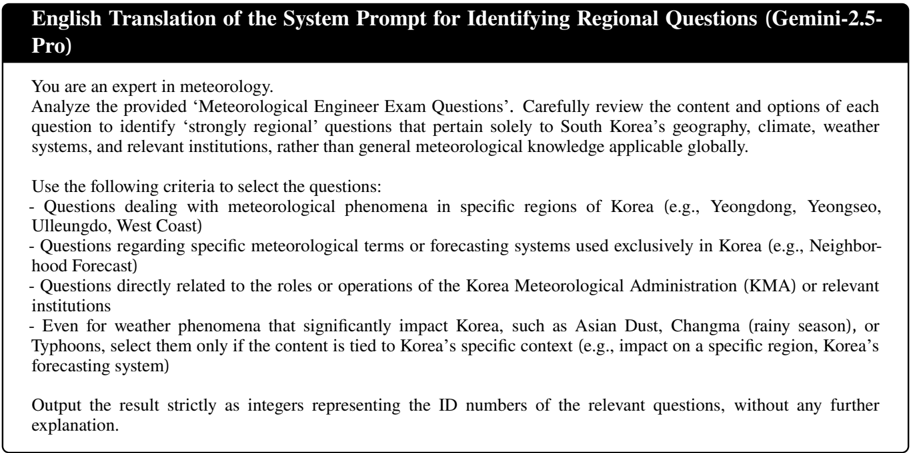
The image displays a technical system prompt for Gemini-2.5-Pro, instructing the model to act as a meteorology expert and identify "strongly regional" questions specific to South Korea's geography, climate, and institutions. The prompt emphasizes filtering out globally applicable meteorological knowledge in favor of context tied to Korea.
---
### Components/Axes
- **Title**: "English Translation of the System Prompt for Identifying Regional Questions (Gemini-2.5-Pro)"
- **Main Sections**:
1. **Role Assignment**: "You are an expert in meteorology."
2. **Task**: Analyze "Meteorological Engineer Exam Questions" to identify regionally specific content.
3. **Selection Criteria**: Four bullet-pointed rules for filtering questions.
4. **Output Format**: Integers representing question IDs (no explanations).
---
### Detailed Analysis
#### Role Assignment
- Explicitly defines the model's role as a meteorology expert.
#### Task Description
- Requires analyzing exam questions to distinguish "strongly regional" content from general knowledge.
- Focus areas: South Korea’s geography, climate, weather systems, and institutions.
#### Selection Criteria
1. **Region-Specific Phenomena**:
- Examples: Yeongdong, Yeongseo, Ulleungdo, West Coast.
2. **Local Terminology/Systems**:
- Terms: Neighborhood Forecast.
3. **KMA/Korea-Specific Institutions**:
- Directly tied to the Korea Meteorological Administration (KMA) or its operations.
4. **Contextual Weather Phenomena**:
- Includes Asian Dust, Changma (rainy season), Typhoons **only if** tied to Korea’s context (e.g., regional impact, Korea’s forecasting system).
#### Output Format
- Strictly integers (question IDs) with no additional text.
---
### Key Observations
- **Regional Specificity**: The prompt prioritizes questions tied to South Korea’s unique geography (e.g., Ulleungdo) and institutions (KMA).
- **Exclusion of Global Knowledge**: General meteorological concepts (e.g., hurricanes) are excluded unless explicitly linked to Korea.
- **Examples Provided**: Concrete instances (Yeongdong, Neighborhood Forecast) clarify ambiguous criteria.
- **Output Constraints**: No explanations—only integers, suggesting automated processing or integration with a database.
---
### Interpretation
The prompt is designed to ensure responses are hyper-localized to South Korea, avoiding generic meteorological knowledge. By emphasizing regional phenomena (e.g., Changma) and institutions (KMA), it aligns with Korea’s unique climatic challenges and governance structures. The exclusion of non-contextual global phenomena (e.g., Typhoons unless tied to Korea) suggests a focus on practical, actionable insights for local stakeholders. The strict output format (integers) implies integration with a system requiring minimal human intervention, such as automated exam grading or database queries.