## Diagram: Logical Flow
### Overview
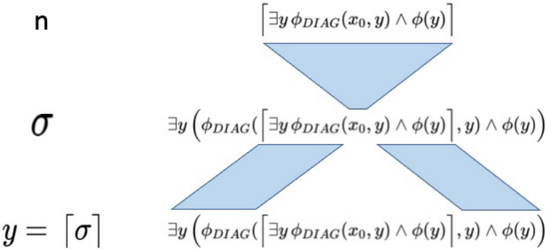
The image presents a diagram illustrating a logical flow or derivation process. It uses symbols and mathematical notation to represent steps or transformations. The diagram consists of three levels, each associated with a symbol (n, σ, y=[σ]) and connected by geometric shapes containing logical expressions.
### Components/Axes
* **Left Column:** Contains the symbols 'n', 'σ', and 'y = [σ]' arranged vertically.
* **Right Side:** Contains logical expressions enclosed within geometric shapes.
* **Geometric Shapes:** A triangle at the top, and two parallelograms at the bottom. These shapes contain logical expressions.
### Detailed Analysis or ### Content Details
* **Top Level:**
* Symbol: 'n'
* Shape: An inverted triangle.
* Expression inside the triangle: "∃y φ<sub>DIAG</sub>(x<sub>0</sub>, y) ∧ φ(y)"
* **Middle Level:**
* Symbol: 'σ'
* Shape: The triangle from the top level splits into two parallelograms.
* Expression inside the parallelograms: "∃y (φ<sub>DIAG</sub>([∃y φ<sub>DIAG</sub>(x<sub>0</sub>, y) ∧ φ(y)], y) ∧ φ(y))"
* **Bottom Level:**
* Symbol: 'y = [σ]'
* Shape: The two parallelograms from the middle level continue.
* Expression inside the parallelograms: "∃y (φ<sub>DIAG</sub>([∃y φ<sub>DIAG</sub>(x<sub>0</sub>, y) ∧ φ(y)], y) ∧ φ(y))"
### Key Observations
* The diagram appears to represent a derivation or transformation process, where 'n' is transformed into 'σ', and then 'σ' is transformed into 'y = [σ]'.
* The logical expressions become more complex as the process progresses from top to bottom.
* The triangle splits into two parallelograms, suggesting a branching or parallel processing of the logical expression.
* The expressions in the two parallelograms at the bottom level are identical.
### Interpretation
The diagram likely illustrates a logical derivation or transformation process. The initial state 'n' is transformed into 'σ' through a logical operation represented by the expression in the triangle. This operation then branches into two parallel paths, both applying the same logical operation to arrive at the final state 'y = [σ]'. The use of existential quantifiers (∃y) and the function φ<sub>DIAG</sub> suggests that the process involves finding a 'y' that satisfies certain conditions related to 'x<sub>0</sub>' and the function φ. The branching could represent different possible derivations or scenarios leading to the same final state. The diagram is abstract and requires further context to fully understand the specific meaning of the symbols and functions involved.