## Complex Diagram: AI Ethics Synthesis
### Overview
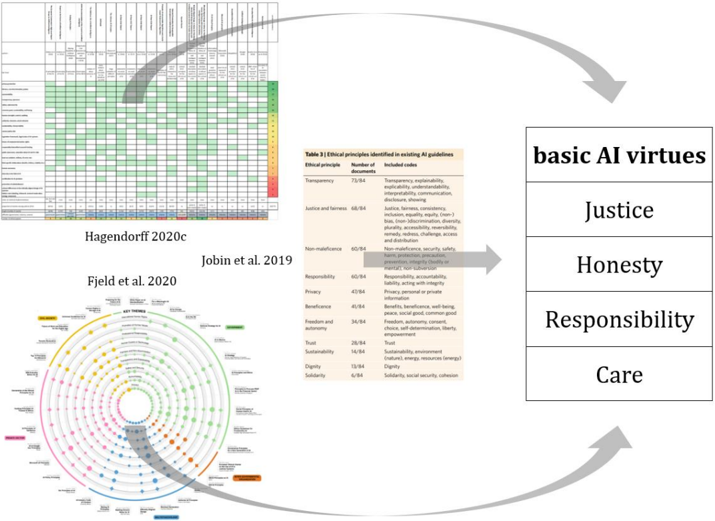
The image presents a synthesis of AI ethics principles from multiple sources, visualized through a combination of a heatmap, a circular plot, a table, and a list of basic AI virtues. The diagram illustrates how different ethical principles are identified and emphasized across various studies and guidelines. Arrows indicate a flow of information and synthesis between the different visual elements.
### Components/Axes
1. **Heatmap (Hagendorff 2020c):** Located in the top-left corner. It appears to represent a matrix of ethical considerations, with cells colored based on some metric (likely frequency or importance). The rows represent different ethical principles, and the columns likely represent different AI applications or contexts. The color gradient ranges from green (high) to red (low).
2. **Table (Jobin et al. 2019):** Positioned in the upper-right quadrant. It's titled "Table 3 | Ethical principles identified in existing AI guidelines." The table lists ethical principles, the number of documents in which they appear, and included codes.
* **Columns:** Ethical principle, Number of documents, Included codes.
* **Ethical Principles (with Number of Documents):**
* Transparency (75/84)
* Justice and fairness (66/84)
* Non-maleficence (60/84)
* Responsibility (60/84)
* Privacy (43/84)
* Beneficence (41/84)
* Freedom and autonomy (34/84)
* Trust (26/84)
* Sustainability (14/84)
* Dignity (13/84)
* Solidarity (4/84)
3. **Circular Plot (Fjeld et al. 2020):** Situated in the bottom-left corner. It's a radial visualization of AI themes, with concentric circles representing different categories or levels of analysis. The size and color of the data points likely indicate the frequency or importance of each theme.
4. **Basic AI Virtues List:** Located on the right side of the image. It lists four core AI virtues:
* Justice
* Honesty
* Responsibility
* Care
5. **Arrows:** Two curved arrows connect the elements. One arrow originates from the heatmap and table, pointing towards the "basic AI virtues" list. The other arrow originates from the circular plot and points towards the "basic AI virtues" list.
### Detailed Analysis or Content Details
#### Heatmap (Hagendorff 2020c)
The heatmap shows a grid of ethical considerations. Without a clear legend, it's difficult to determine the exact meaning of each cell. However, the color gradient suggests that green cells represent a high level of adherence or importance, while red cells indicate a low level. The rows likely represent different ethical principles, and the columns may represent different AI applications or contexts.
#### Table (Jobin et al. 2019)
The table provides a quantitative overview of ethical principles identified in existing AI guidelines.
* **Transparency (75/84):** Transparency, explainability, understandability, interpretability, communication, disclosure, showing.
* **Justice and fairness (66/84):** Justice, fairness, consistency, inclusion, equality, equity, (non-) bias, (non-)discrimination, diversity, plurality, accessibility, reversibility, remedy, redress, challenge, access and distribution.
* **Non-maleficence (60/84):** Non-maleficence, security, safety, harm, protection, precaution, prevention, integrity (entity or mental), 'non-subversion'.
* **Responsibility (60/84):** Responsibility, accountability, liability, acting with integrity.
* **Privacy (43/84):** Privacy, personal or private information.
* **Beneficence (41/84):** Benefits, beneficence, well-being, peace, social good, common good.
* **Freedom and autonomy (34/84):** Freedom, autonomy, consent, choice, self-determination, liberty, empowerment.
* **Trust (26/84):** Trust.
* **Sustainability (14/84):** Sustainability, environment (nature), energy, resources (energy).
* **Dignity (13/84):** Dignity.
* **Solidarity (4/84):** Solidarity, social security, cohesion.
#### Circular Plot (Fjeld et al. 2020)
The circular plot visualizes AI themes in a radial format. The plot contains multiple concentric circles, each representing a different level or category of themes. The size and color of the data points likely indicate the frequency or importance of each theme. Without a legend, it's difficult to determine the exact meaning of each color and size.
#### Basic AI Virtues List
The list presents four fundamental AI virtues: Justice, Honesty, Responsibility, and Care. These virtues are likely derived from the ethical principles identified in the heatmap, table, and circular plot.
### Key Observations
* The heatmap provides a high-level overview of ethical considerations in AI.
* The table quantifies the frequency of different ethical principles in existing AI guidelines.
* The circular plot visualizes AI themes in a radial format.
* The basic AI virtues list summarizes the core ethical principles for AI.
* The arrows suggest a synthesis of information from the heatmap, table, and circular plot into the basic AI virtues list.
### Interpretation
The image illustrates a process of synthesizing ethical principles for AI from multiple sources. The heatmap, table, and circular plot represent different perspectives on AI ethics, while the basic AI virtues list provides a concise summary of the core principles. The arrows indicate that the basic AI virtues are derived from the ethical considerations identified in the heatmap, table, and circular plot. This suggests a comprehensive approach to AI ethics, integrating insights from various studies and guidelines to define fundamental virtues for AI development and deployment. The diagram highlights the importance of considering a wide range of ethical principles when designing and implementing AI systems.