## Heatmap & Diagram: Ethical Principles in AI Guidelines
### Overview
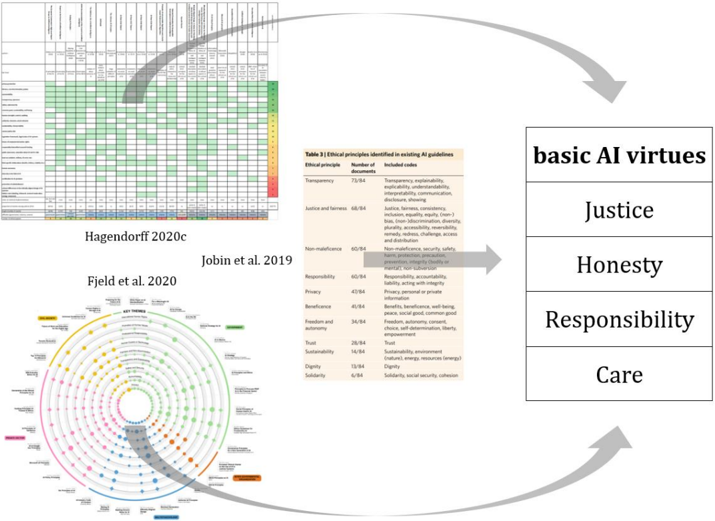
The image presents a combination of a heatmap visualizing the prevalence of ethical principles across different AI guidelines, a circular diagram representing the distribution of principles in specific research papers, and a block listing basic AI virtues. The heatmap is the dominant visual element, with the circular diagram positioned to the bottom-left and the virtues listed on the right. A table accompanies the heatmap, providing numerical data.
### Components/Axes
* **Heatmap:** Rows represent ethical principles (Transparency, Justice and fairness, Non-maleficence, etc.). Columns represent different AI guidelines (Hagendorff 2020c, Jobin et al. 2019, Fjeld et al. 2020, etc.). The color intensity indicates the frequency with which a principle is included in a guideline.
* **Table:** "Table 3.1 Ethical principles identified in existing AI guidelines". Columns: "Ethical principle", "Number of included codes".
* **Circular Diagram:** Concentric circles with points representing principles. Color-coding indicates the source research paper (Fjeld et al. 2020, Jobin et al. 2019, Hagendorff 2020c).
* **Virtue Block:** A rectangular block listing "basic AI virtues": Justice, Honesty, Responsibility, Care.
* **Arrows:** Curved arrows connect the heatmap, circular diagram, and virtue block, suggesting a relationship between them.
### Detailed Analysis or Content Details
**Heatmap Data (Approximate, based on color intensity):**
The heatmap shows the presence/absence of ethical principles in various AI guidelines. The color scale appears to be: Green (High), Yellow (Medium), Red (Low/Absent).
* **Transparency:** Appears in approximately 73/84 guidelines (Dark Green).
* **Justice and fairness:** Appears in approximately 66/84 guidelines (Dark Green).
* **Non-maleficence:** Appears in approximately 60/84 guidelines (Green).
* **Responsibility:** Appears in approximately 60/84 guidelines (Green).
* **Privacy:** Appears in approximately 43/84 guidelines (Yellow-Green).
* **Beneficence:** Appears in approximately 41/84 guidelines (Yellow-Green).
* **Freedom and autonomy:** Appears in approximately 34/84 guidelines (Yellow).
* **Trust:** Appears in approximately 26/84 guidelines (Yellow).
* **Sustainability:** Appears in approximately 14/84 guidelines (Red-Yellow).
* **Dignity:** Appears in approximately 13/84 guidelines (Red).
* **Solidarity:** Appears in approximately 12/84 guidelines (Red).
**Circular Diagram:**
The diagram shows the distribution of ethical principles across three research papers. The diagram is complex, but the following can be observed:
* **Fjeld et al. 2020 (Orange):** Principles are distributed across all circles, with a concentration in the inner circles.
* **Jobin et al. 2019 (Blue):** Principles are concentrated in the middle circles.
* **Hagendorff 2020c (Green):** Principles are distributed across all circles, with a concentration in the outer circles.
**Virtue Block:**
The block simply lists the four basic AI virtues: Justice, Honesty, Responsibility, and Care.
### Key Observations
* Transparency, Justice and fairness, and Non-maleficence are the most frequently included ethical principles in the analyzed AI guidelines.
* Sustainability, Dignity, and Solidarity are the least frequently included principles.
* The circular diagram suggests that different research papers emphasize different sets of ethical principles.
* The arrows suggest a connection between the specific ethical principles identified in guidelines (heatmap), their distribution in research (circular diagram), and the overarching AI virtues (virtue block).
### Interpretation
The image demonstrates a mapping between concrete ethical principles identified in AI guidelines, their representation in academic research, and fundamental AI virtues. The heatmap highlights the relative importance of different ethical considerations in current AI governance frameworks. The prominence of principles like Transparency and Justice suggests a focus on accountability and fairness in AI development. The lower prevalence of principles like Sustainability and Dignity might indicate a need for greater attention to these aspects.
The circular diagram provides a nuanced view, showing how different research perspectives prioritize different ethical concerns. The connection to the "basic AI virtues" suggests that these virtues serve as foundational values underpinning the more specific ethical principles. The arrows imply a hierarchical relationship: guidelines operationalize virtues through principles, and research investigates the application of these principles.
The data suggests a growing awareness of ethical considerations in AI, but also highlights potential gaps and areas for improvement. The varying emphasis across research papers indicates a lack of consensus on the relative importance of different ethical principles. This could be due to differing philosophical perspectives, methodological approaches, or contextual factors. The image serves as a valuable tool for understanding the complex landscape of AI ethics and identifying areas for further research and policy development.