TECHNICAL ASSET FINGERPRINT
a1beacab4c32a5678b13fc63
Click to view fullscreen
Press ESC or click to close
FOUND IN PAPERS
EXPERT: healer-alpha-free VERSION 1
RUNTIME: free/openrouter/healer-alpha
INTEL_VERIFIED
## Diagram: Synthesis of AI Ethics Principles into Core Virtues
### Overview
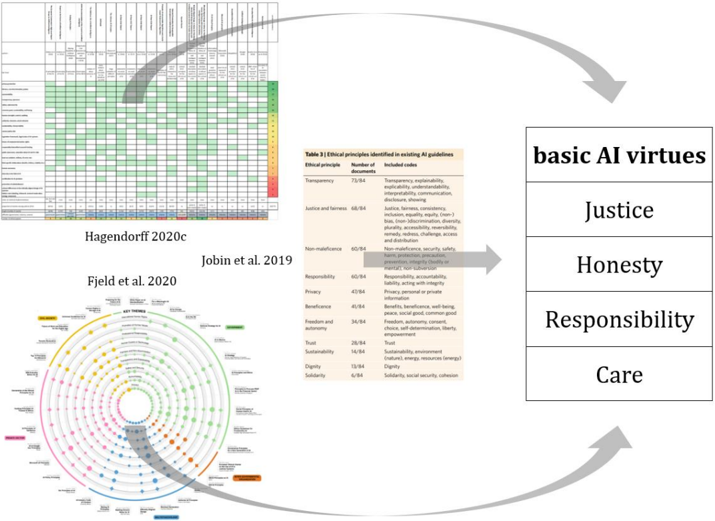
This image is a composite diagram illustrating the synthesis of research findings from multiple academic sources into a distilled set of "basic AI virtues." It visually maps how broad surveys and analyses of AI ethics guidelines (represented by a large table, a circular chart, and a summary table) converge to identify a core set of ethical principles. The flow is indicated by large, gray, curved arrows connecting the source materials to the final list.
### Components & Spatial Layout
The diagram is organized into four main regions:
1. **Top-Left (Source 1):** A large, dense table/matrix labeled **"Hagendorff 2020c"**. It appears to be a heatmap or frequency chart with rows representing ethical concepts and columns representing sources or studies. Cells are color-coded on a green-to-red scale (green likely indicating high frequency/agreement, red low). A vertical color legend bar is on its right edge.
2. **Bottom-Left (Source 2):** A circular, radial chart labeled **"Fjeld et al. 2020"**. It consists of concentric rings and colored segments radiating from the center. Each segment contains text labels (difficult to read at this resolution) representing ethical principles or categories. The colors likely correspond to different thematic groups.
3. **Center (Synthesis Table):** A clearly formatted table titled **"Table 3 | Ethical principles identified in existing AI guidelines"**. This is the most legible component and acts as the central analytical piece.
4. **Right (Output):** A simple, vertically stacked list titled **"basic AI virtues"** containing four items: **Justice, Honesty, Responsibility, Care**.
**Flow & Relationships:** Two large, gray, curved arrows create a visual narrative:
* One arrow originates from the **Hagendorff 2020c** table and points to the **basic AI virtues** list.
* Another arrow originates from the **Fjeld et al. 2020** chart and points to the **basic AI virtues** list.
* A third, more prominent arrow originates from the central **Table 3** and points directly to the **basic AI virtues** list, suggesting this table is the primary synthesis leading to the final virtues.
### Detailed Analysis: Central Table (Table 3)
This table systematically lists ethical principles, the number of sources (out of 84 analyzed) that mention them, and the specific "codes" or related terms included under each principle.
| Ethical principle | Number of sources | Included codes (transcribed directly) |
| :--- | :--- | :--- |
| **Transparency** | 71/84 | Transparency, explainability, interpretability, openness, communication, disclosure, sharing |
| **Justice and fairness** | 68/84 | Justice, fairness, equality, equity, rights, non-discrimination, fairness, bias, discrimination, access, diversity, inclusion, social justice, challenges, access, fairness |
| **Non-maleficence** | 60/84 | Non-maleficence, security, safety, privacy, safety, harm, risk, risk management, harm reduction |
| **Responsibility** | 40/84 | Responsibility, accountability, liability, acting with integrity |
| **Privacy** | 42/84 | Privacy |
| **Beneficence** | 41/84 | Beneficence, well-being, social good, common good, human-centered values, humanity |
| **Freedom and autonomy** | 34/84 | Freedom, autonomy, choice, self-determination, liberty |
| **Trust** | 26/84 | Trust |
| **Sustainability** | 16/84 | Sustainability, environment |
| **Dignity** | 15/84 | Dignity |
| **Solidarity** | 6/84 | Solidarity, social cohesion |
**Note on Language:** The table is in English. The "Included codes" column contains English terms, some of which are repeated (e.g., "fairness," "access," "safety" appear multiple times within their respective rows), likely reflecting the aggregation of synonyms from different source guidelines.
### Key Observations
1. **Dominant Principles:** **Transparency** (71/84 sources) and **Justice and fairness** (68/84) are the most frequently identified principles in the surveyed AI guidelines, forming a clear top tier.
2. **Secondary Tier:** **Non-maleficence** (60/84) is also highly prevalent. **Privacy** (42/84), **Beneficence** (41/84), and **Responsibility** (40/84) form a middle cluster.
3. **Long Tail:** Principles like **Trust, Sustainability, Dignity,** and **Solidarity** are mentioned in a significantly smaller subset of guidelines (26 down to 6 sources).
4. **Synthesis to Virtues:** The final list of "basic AI virtues" (**Justice, Honesty, Responsibility, Care**) does not directly mirror the top-ranked principles from Table 3. "Honesty" and "Care" are not explicit row titles in the table, suggesting they are higher-order abstractions or interpretations derived from the codes. For example:
* **Justice** maps directly to "Justice and fairness."
* **Honesty** likely synthesizes "Transparency" and aspects of "Responsibility" (integrity).
* **Responsibility** maps directly.
* **Care** may be an interpretation of "Non-maleficence," "Beneficence," and "Well-being."
5. **Visual Synthesis:** The diagram argues that while the academic literature (Hagendorff, Fjeld et al.) identifies a wide array of principles with varying frequencies (shown in the complex table and radial chart), a focused synthesis (Table 3) can distill these into a shortlist of core, actionable virtues for AI.
### Interpretation
This diagram presents a **Peircean investigative process** of moving from a broad, complex set of observations (the multitude of ethical codes in existing guidelines) to a simplified, interpretable conclusion (the basic virtues).
* **What it demonstrates:** It shows the methodological journey from **data collection** (surveys by Hagendorff and Fjeld et al.) to **data analysis** (the frequency-based synthesis in Table 3) to **conceptual distillation** (the final virtues). The arrows are not just connectors but represent an act of **abductive reasoning**—inferring the most essential, overarching virtues from the available evidence.
* **Relationships:** The central table is the critical pivot. It transforms the raw, visual complexity of the heatmap and radial chart into a ranked, quantifiable list. The final virtues list then performs a second-order synthesis, grouping the ranked principles into broader, more philosophically grounded categories. The disconnect between the top-ranked principle ("Transparency") and the final virtues (where it's subsumed under "Honesty") is particularly notable, suggesting the authors prioritize **moral character** (virtues) over **functional requirements** (transparency as a mechanism).
* **Notable Anomaly:** The principle of **"Privacy"** is highly ranked (5th) in Table 3 but does not appear as a standalone virtue. This implies that in this framework, privacy is considered a component of a larger virtue like "Care" or "Non-maleficence," rather than a foundational end in itself. This is a significant interpretive choice that shapes the final ethical framework for AI being proposed.
DECODING INTELLIGENCE...