## Heatmap and Table: Ethical Principles in AI Guidelines
### Overview
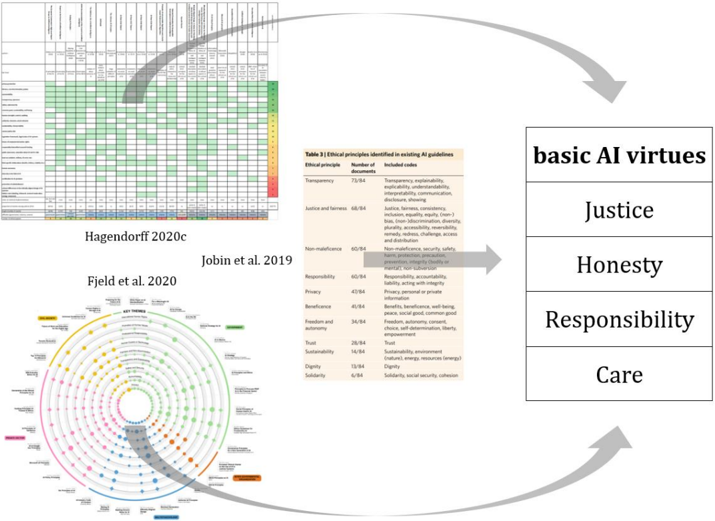
The image presents a comparative analysis of ethical principles in AI guidelines across multiple studies (Hagendorff 2020c, Jobin et al. 2019, Fjeld et al. 2020). It combines a heatmap, a data table, and a conceptual diagram to illustrate the frequency and categorization of ethical principles in existing AI frameworks.
---
### Components/Axes
#### Heatmap (Left Section)
- **Rows**: Ethical principles (e.g., Transparency, Justice, Non-maleficence, Responsibility, Privacy, Beneficence, Freedom and autonomy, Trust, Sustainability, Dignity, Solidarity).
- **Columns**: Documents (studies or guidelines analyzed).
- **Color Legend**:
- Green: High frequency (70-80% of documents).
- Yellow: Moderate frequency (40-60%).
- Red: Low frequency (<40%).
- **Key Observations**:
- Transparency (73/84 documents) and Justice (68/84) dominate.
- Solidarity (6/84) and Dignity (15/84) are least represented.
- Green/Yellow shading indicates strong consensus on core principles like Transparency and Justice.
#### Table (Center Section)
- **Title**: "Table 3 | Ethical principles identified in existing AI guidelines."
- **Columns**:
1. **Ethical Principle**: Listed principles (e.g., Transparency, Justice).
2. **Number of Documents**: Frequency of inclusion (e.g., 73/84 for Transparency).
3. **Included Codes**: Descriptions of how principles are operationalized (e.g., "Transparency: explainability, interpretability, disclosure").
- **Notable Entries**:
- **Transparency**: 73/84 documents emphasize explainability, interpretability, and disclosure.
- **Justice**: 68/84 documents address fairness, equity, and non-discrimination.
- **Solidarity**: 6/84 documents focus on social security and cohesion.
#### Circular Diagram (Bottom Left)
- **Structure**: Concentric circles with colored dots (yellow, green, blue, red) radiating from a central axis.
- **Labels**: Unreadable due to image resolution, but likely represent subcategories or themes (e.g., technical, social, ethical).
- **Color Coding**:
- Yellow: Core principles (e.g., Transparency).
- Green: Intermediate principles (e.g., Justice).
- Blue/Red: Peripheral or emerging themes (e.g., Sustainability, Dignity).
#### Right Section: Basic AI Virtues
- **List**:
1. Justice
2. Honesty
3. Responsibility
4. Care
- **Arrows**: Connect the table and circular diagram to the virtues, suggesting a hierarchical or integrative relationship.
---
### Detailed Analysis
#### Heatmap Trends
- **Dominant Principles**:
- Transparency (73/84) and Justice (68/84) are nearly universal.
- Non-maleficence (60/84) and Responsibility (60/84) are moderately represented.
- **Emerging Themes**:
- Sustainability (14/84) and Dignity (15/84) appear in fewer documents.
- Solidarity (6/84) is the least addressed principle.
#### Table Insights
- **Operationalization**:
- **Transparency**: Focus on technical aspects (explainability, interpretability).
- **Justice**: Emphasis on fairness, equity, and anti-discrimination.
- **Solidarity**: Limited to social security and cohesion.
- **Gaps**:
- Few guidelines address systemic issues like environmental sustainability or cultural dignity.
#### Circular Diagram
- **Structure**:
- Central axis likely represents foundational AI ethics.
- Outer rings may categorize principles by domain (e.g., technical, societal).
- **Color Significance**:
- Yellow/green dots (core principles) are clustered near the center.
- Blue/red dots (emerging themes) are peripheral, indicating lower prioritization.
---
### Key Observations
1. **Consensus on Core Principles**: Transparency and Justice are consistently prioritized across studies.
2. **Neglected Areas**: Solidarity and Dignity receive minimal attention, suggesting gaps in addressing social and cultural dimensions.
3. **Operational Focus**: Most guidelines emphasize technical implementations (e.g., explainability) over broader ethical frameworks (e.g., care, solidarity).
---
### Interpretation
The data reveals a **hierarchical prioritization** of AI ethics, with technical and legal principles (Transparency, Justice) dominating over societal and care-oriented values (Solidarity, Care). The heatmap and table highlight a **systemic bias** toward quantifiable metrics (e.g., fairness, privacy) at the expense of holistic, human-centric values. The circular diagram’s color coding reinforces this hierarchy, positioning emerging themes like Sustainability and Dignity as secondary concerns. This suggests a need for interdisciplinary frameworks that integrate technical rigor with ethical pluralism to address AI’s societal impacts comprehensively.