## Diagram: Trustworthy AI Components
### Overview
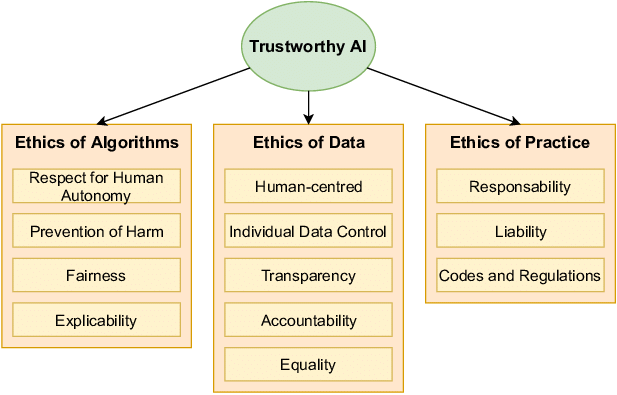
The image is a diagram illustrating the components of Trustworthy AI. It presents three main categories: Ethics of Algorithms, Ethics of Data, and Ethics of Practice, each with sub-categories listed below them. The diagram uses a top-down approach, starting with "Trustworthy AI" at the top and branching out to the three ethical categories.
### Components/Axes
* **Main Node:** "Trustworthy AI" (located at the top-center, in a green circle)
* **Category 1:** "Ethics of Algorithms" (located on the left)
* Sub-category 1: "Respect for Human Autonomy"
* Sub-category 2: "Prevention of Harm"
* Sub-category 3: "Fairness"
* Sub-category 4: "Explicability"
* **Category 2:** "Ethics of Data" (located in the center)
* Sub-category 1: "Human-centred"
* Sub-category 2: "Individual Data Control"
* Sub-category 3: "Transparency"
* Sub-category 4: "Accountability"
* Sub-category 5: "Equality"
* **Category 3:** "Ethics of Practice" (located on the right)
* Sub-category 1: "Responsibility"
* Sub-category 2: "Liability"
* Sub-category 3: "Codes and Regulations"
All categories and sub-categories are contained within rectangular boxes with rounded corners, filled with a light yellow color.
### Detailed Analysis or ### Content Details
The diagram visually represents a hierarchical structure. "Trustworthy AI" is the overarching concept, which is then broken down into three key ethical areas. Each ethical area is further detailed with specific principles or considerations.
* **Ethics of Algorithms:** Focuses on ensuring algorithms are respectful, safe, fair, and understandable.
* **Ethics of Data:** Emphasizes the importance of human-centered data practices, individual control over data, transparency, accountability, and equality.
* **Ethics of Practice:** Highlights the need for responsibility, liability, and adherence to codes and regulations in the practice of AI.
### Key Observations
* The diagram provides a structured overview of the ethical considerations for AI.
* The sub-categories under each ethical area offer specific guidance for developing and deploying AI systems responsibly.
* The diagram suggests that Trustworthy AI is a multi-faceted concept, encompassing algorithms, data, and practical implementation.
### Interpretation
The diagram illustrates a framework for achieving Trustworthy AI by addressing ethical concerns related to algorithms, data handling, and practical application. It emphasizes the importance of human-centered design, fairness, transparency, and accountability in AI development and deployment. The diagram serves as a visual aid for understanding the key components of ethical AI and can be used as a guide for developing and implementing AI systems responsibly.