## Flowchart: Trustworthy AI Framework
### Overview
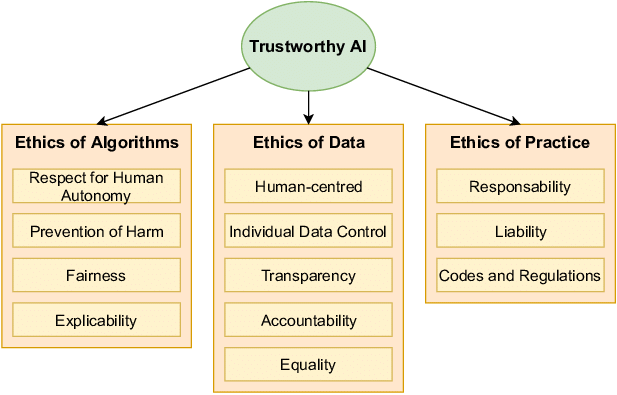
The image depicts a hierarchical flowchart centered on "Trustworthy AI" as the core concept. Three primary branches radiate from the central node, each representing a distinct ethical dimension: **Ethics of Algorithms**, **Ethics of Data**, and **Ethics of Practice**. Each branch contains subpoints detailing specific ethical principles.
### Components/Axes
- **Central Node**: "Trustworthy AI" (green oval, top-center).
- **Branches**:
1. **Ethics of Algorithms** (left rectangle, peach-colored).
- Subpoints:
- Respect for Human Autonomy
- Prevention of Harm
- Fairness
- Explicability
2. **Ethics of Data** (center rectangle, peach-colored).
- Subpoints:
- Human-centred
- Individual Data Control
- Transparency
- Accountability
- Equality
3. **Ethics of Practice** (right rectangle, peach-colored).
- Subpoints:
- Responsibility
- Liability
- Codes and Regulations
### Detailed Analysis
- **Ethics of Algorithms**: Focuses on algorithmic behavior, emphasizing human-centric design (autonomy, harm prevention, fairness, and transparency in decision-making).
- **Ethics of Data**: Addresses data governance, prioritizing individual rights (control, transparency, accountability) and societal equity (equality).
- **Ethics of Practice**: Highlights operational accountability (responsibility, liability) and adherence to regulatory frameworks (codes and regulations).
### Key Observations
- The flowchart uses a **top-down structure**, with the central concept ("Trustworthy AI") as the root node.
- **Ethics of Data** has the most subpoints (5), suggesting greater complexity or emphasis on data-related principles.
- **Ethics of Practice** has the fewest subpoints (3), potentially indicating a narrower scope compared to the other branches.
- All subpoints are listed in **vertical alignment** under their respective branch titles, with no numerical or quantitative data present.
### Interpretation
This flowchart outlines a **comprehensive ethical framework** for AI systems, structured around three pillars:
1. **Algorithmic Integrity**: Ensuring AI systems respect human values (autonomy, fairness) and avoid harm.
2. **Data Ethics**: Prioritizing individual rights and societal equity in data handling.
3. **Practical Accountability**: Enforcing responsibility and compliance with regulations.
The absence of numerical data or visual trends suggests the diagram is **conceptual**, designed to guide policy or design rather than measure outcomes. The hierarchical layout implies that "Trustworthy AI" is achieved through the integration of these three ethical dimensions, with no single branch being subordinate to another. The emphasis on "Human-centred" and "Equality" in the data ethics branch highlights a societal focus, while "Codes and Regulations" in practice underscores legal compliance as a foundational requirement.