## Diagram: Chain-of-Thought Reconstruction
### Overview
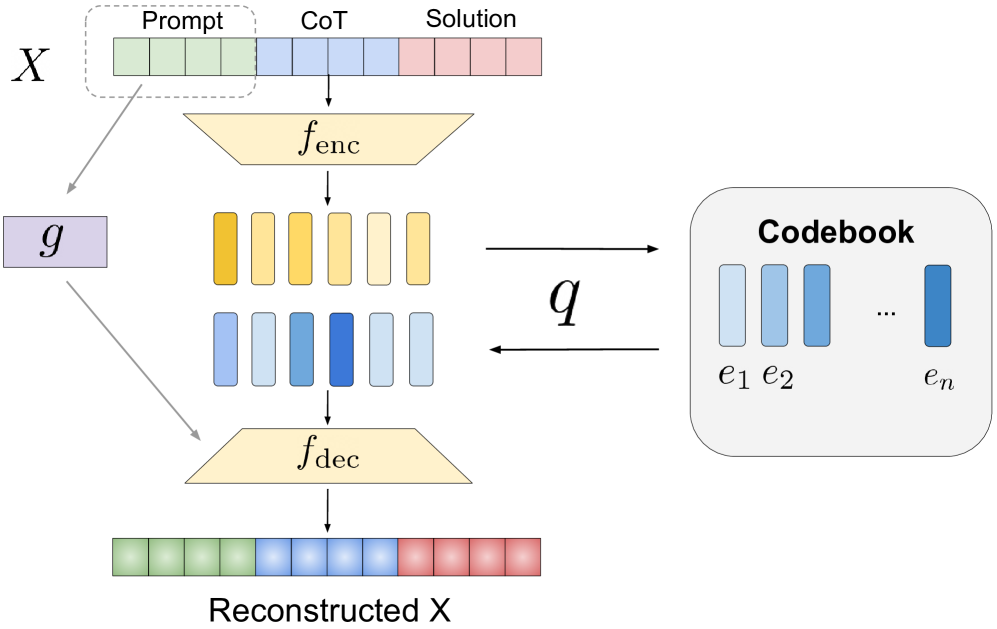
The image is a diagram illustrating a process for reconstructing data, likely related to chain-of-thought reasoning. It involves encoding an input, interacting with a codebook, and then decoding to reconstruct the original input.
### Components/Axes
* **X**: Represents the input data, segmented into "Prompt" (green), "CoT" (Chain of Thought, blue), and "Solution" (red) sections.
* **f_enc**: Represents an encoding function, depicted as a yellow trapezoid.
* **f_dec**: Represents a decoding function, depicted as a yellow trapezoid.
* **g**: Represents an external input or condition, depicted as a purple rectangle.
* **Codebook**: A collection of encoded representations, labeled as e1, e2, ..., en. The codebook entries are varying shades of blue.
* **q**: Represents the query or selection process from the codebook.
* **Reconstructed X**: The output of the process, aiming to replicate the original input X. It is segmented into green, blue, and red sections, corresponding to the "Prompt", "CoT", and "Solution" respectively.
### Detailed Analysis
1. **Input X**: The input X is a sequence divided into three parts:
* "Prompt": Represented by 4 green blocks.
* "CoT": Represented by 4 blue blocks.
* "Solution": Represented by 3 red blocks.
2. **Encoding (f_enc)**: The input X is passed through the encoding function f_enc, which transforms it into a different representation. The output of f_enc is a sequence of 7 yellow blocks.
3. **External Input (g)**: An external input 'g' (purple) is introduced.
4. **Codebook Interaction (q)**: The encoded representation interacts with a "Codebook" via a query process 'q'. The codebook contains 'n' entries (e1, e2, ..., en), each represented by a blue block of varying shades.
5. **Decoding (f_dec)**: The output from the codebook interaction, represented by 7 blue blocks of varying shades, is passed through the decoding function f_dec.
6. **Reconstructed X**: The output of the decoding function is the "Reconstructed X", which aims to replicate the original input X. It consists of:
* 4 green blocks (corresponding to the "Prompt").
* 4 blue blocks (corresponding to the "CoT").
* 3 red blocks (corresponding to the "Solution").
### Key Observations
* The diagram illustrates a process where an input X is encoded, interacts with a codebook, and then decoded to produce a reconstructed version of X.
* The "Prompt", "CoT", and "Solution" segments are maintained throughout the process, suggesting that the reconstruction aims to preserve these components.
* The external input 'g' influences the process, likely affecting the codebook interaction and the final reconstructed output.
### Interpretation
The diagram represents a system for reconstructing chain-of-thought reasoning. The input X, which includes a prompt, the chain of thought, and the solution, is encoded. The encoded representation is then used to query a codebook, potentially retrieving relevant information or patterns. The decoding function then reconstructs the original input, potentially improving or refining the chain of thought and solution based on the codebook interaction and external input 'g'. This suggests a mechanism for learning and improving reasoning processes by leveraging a codebook of pre-existing knowledge or patterns. The system could be used to enhance the quality of generated solutions or to correct errors in the chain of thought.