\n
## Bar Chart: MUSHA for the TUT Mono To Binaural Dataset
### Overview
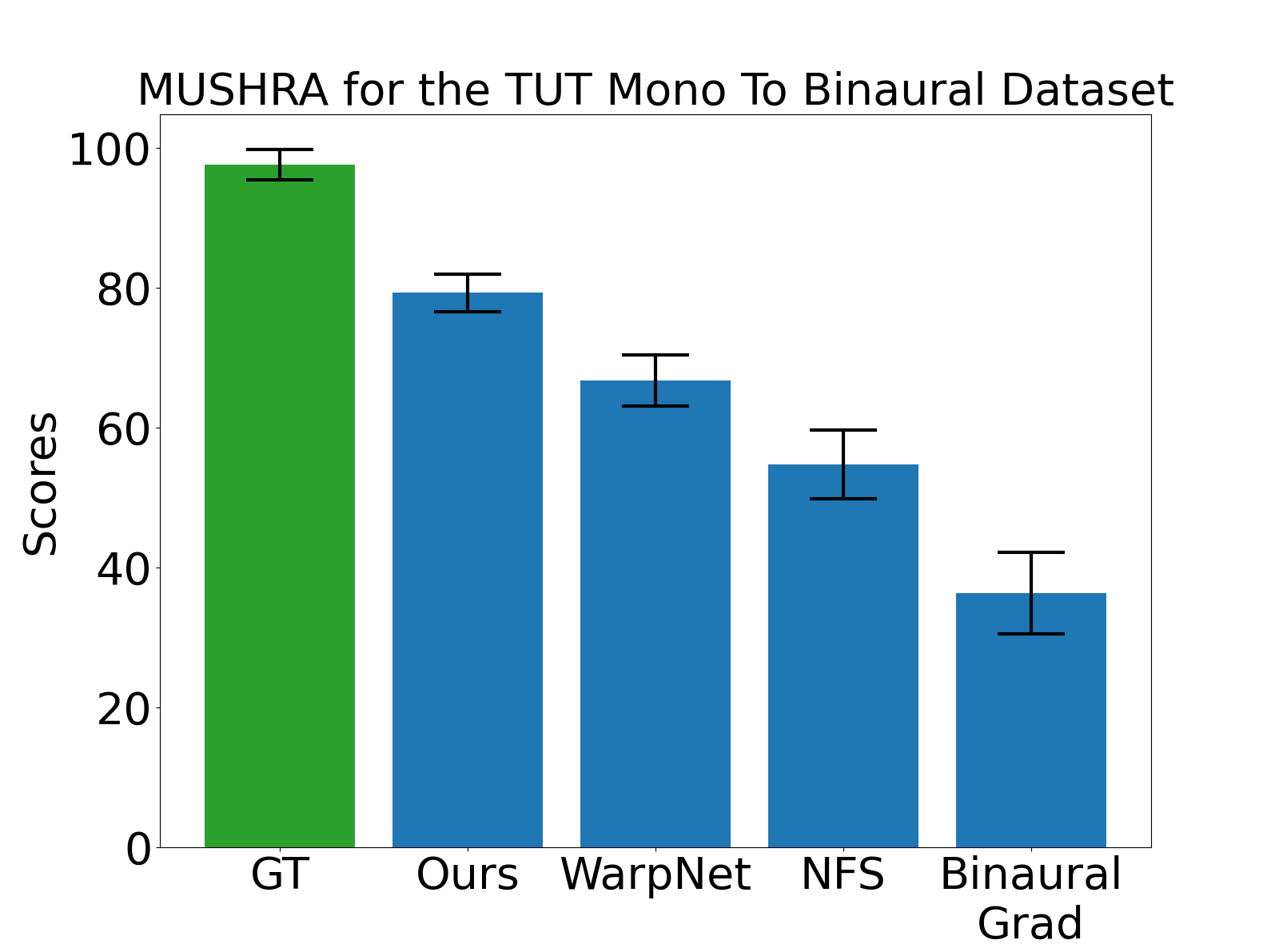
This bar chart presents the results of a MUSHA (Multi-channel Unified Subjective Hearing Assessment) evaluation for different methods applied to the TUT Mono To Binaural Dataset. The chart compares the scores achieved by "GT" (Ground Truth), "Ours" (the proposed method), "WarpNet", "NFS", and "Binaural Grad". Each bar represents the average score, with error bars indicating the variability or confidence interval around that average.
### Components/Axes
* **Title:** "MUSHA for the TUT Mono To Binaural Dataset" - positioned at the top-center.
* **X-axis:** Represents the different methods being evaluated: "GT", "Ours", "WarpNet", "NFS", "Binaural Grad".
* **Y-axis:** Represents the "Scores" obtained from the MUSHA evaluation, ranging from 0 to 100.
* **Bars:** Each bar corresponds to a method, with its height indicating the average score.
* **Error Bars:** Black lines extending above and below each bar, representing the standard error or confidence interval.
### Detailed Analysis
The chart displays five bars, each representing a different method. The bars are colored as follows:
* **GT (Ground Truth):** Green, with a score of approximately 98 ± 2. The bar is the tallest, indicating the highest average score.
* **Ours:** Blue, with a score of approximately 82 ± 3.
* **WarpNet:** Blue, with a score of approximately 69 ± 3.
* **NFS:** Blue, with a score of approximately 60 ± 3.
* **Binaural Grad:** Blue, with a score of approximately 35 ± 3.
The trend is a clear decline in scores from "GT" to "Binaural Grad". The error bars suggest that the differences between "GT" and "Ours", "WarpNet", "NFS", and "Binaural Grad" are statistically significant.
### Key Observations
* "GT" achieves the highest scores, as expected, serving as the baseline for comparison.
* The proposed method ("Ours") performs significantly better than "WarpNet", "NFS", and "Binaural Grad", but is still considerably lower than "GT".
* "Binaural Grad" has the lowest score, indicating the poorest performance among the evaluated methods.
* The error bars are relatively consistent across all methods, suggesting similar levels of variability in the results.
### Interpretation
The data suggests that the proposed method ("Ours") is a promising approach for mono-to-binaural conversion, but still falls short of achieving the quality of the ground truth. The significant difference between "GT" and all other methods highlights the challenges involved in accurately recreating binaural audio from mono sources. The consistent decline in scores from "GT" to "Binaural Grad" indicates a clear ranking of the methods' performance. The error bars provide a measure of confidence in these rankings, suggesting that the observed differences are not simply due to random chance. The chart demonstrates the effectiveness of different methods in converting mono audio to binaural audio, as evaluated by human listeners using the MUSHA metric. The results can be used to guide further research and development in this area, with the goal of closing the gap between the performance of the proposed methods and the ground truth.