## Program Analysis Diagram
### Overview
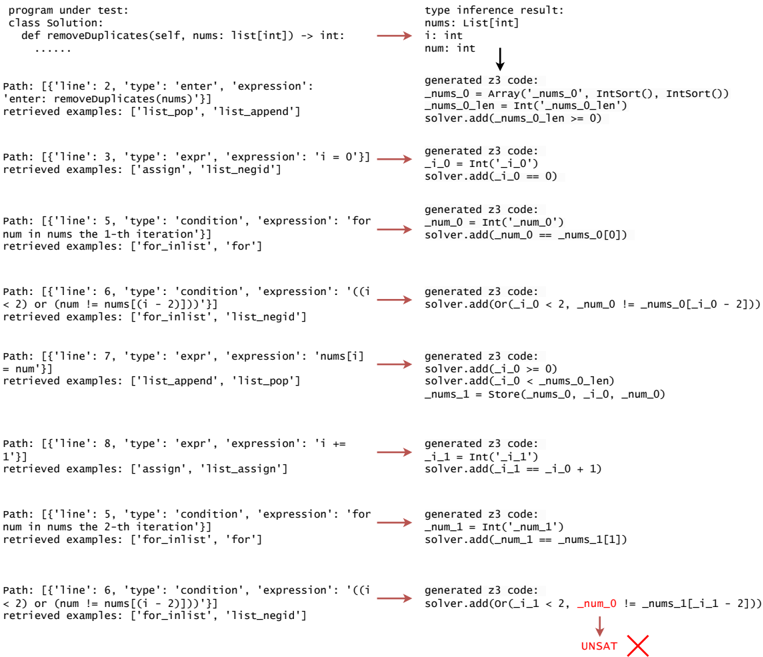
The image presents a program analysis diagram. It shows the execution path of a Python function `removeDuplicates` along with type inference results and generated z3 code for each path. The diagram highlights the program's logic and how it's translated into constraints for a solver. The final path leads to an "UNSAT" result, indicating a potential issue or inconsistency in the program's logic.
### Components/Axes
* **Program Under Test:**
* `class Solution:`
* `def removeDuplicates(self, nums: list[int]) -> int:`
* **Type Inference Result:**
* `nums: List[int]`
* `i: int`
* `num: int`
* **Paths:** Each path is represented as a dictionary containing:
* `line`: The line number in the original code.
* `type`: The type of statement (e.g., 'enter', 'expr', 'condition').
* `expression`: The expression being evaluated.
* `retrieved examples`: Examples related to the path.
* **Generated z3 code:** The corresponding z3 code generated for each path.
* **UNSAT:** Indicates that the constraints generated for a particular path are unsatisfiable.
### Detailed Analysis
The diagram traces the execution of the `removeDuplicates` function. Each path shows the line number, type of statement, expression, and corresponding z3 code.
* **Path 1 (Line 2):**
* Type: 'enter'
* Expression: 'enter: removeDuplicates(nums)'
* Retrieved examples: `['list_pop', 'list_append']`
* Generated z3 code:
* `_nums_0 = Array('_nums_0', IntSort(), IntSort())`
* `_nums_0_len = Int('_nums_0_len')`
* `solver.add(_nums_0_len >= 0)`
* **Path 2 (Line 3):**
* Type: 'expr'
* Expression: 'i = 0'
* Retrieved examples: `['assign', 'list_negid']`
* Generated z3 code:
* `_i_0 = Int('_i_0')`
* `solver.add(_i_0 == 0)`
* **Path 3 (Line 5):**
* Type: 'condition'
* Expression: 'for num in nums the 1-th iteration'
* Retrieved examples: `['for_inlist', 'for']`
* Generated z3 code:
* `_num_0 = Int('_num_0')`
* `solver.add(_num_0 == _nums_0[0])`
* **Path 4 (Line 6):**
* Type: 'condition'
* Expression: '((i < 2) or (num != nums[(i - 2)]))'
* Retrieved examples: `['for_inlist', 'list_negid']`
* Generated z3 code:
* `solver.add(or(_i_0 < 2, _num_0 != _nums_0[_i_0 - 2]))`
* **Path 5 (Line 7):**
* Type: 'expr'
* Expression: 'nums[i] = num'
* Retrieved examples: `['list_append', 'list_pop']`
* Generated z3 code:
* `solver.add(_i_0 >= 0)`
* `solver.add(_i_0 < _nums_0_len)`
* `_nums_1 = Store(_nums_0, _i_0, _num_0)`
* **Path 6 (Line 8):**
* Type: 'expr'
* Expression: 'i += 1'
* Retrieved examples: `['assign', 'list_assign']`
* Generated z3 code:
* `_i_1 = Int('_i_1')`
* `solver.add(_i_1 == _i_0 + 1)`
* **Path 7 (Line 5):**
* Type: 'condition'
* Expression: 'for num in nums the 2-th iteration'
* Retrieved examples: `['for_inlist', 'for']`
* Generated z3 code:
* `_num_1 = Int('_num_1')`
* `solver.add(_num_1 == _nums_1[1])`
* **Path 8 (Line 6):**
* Type: 'condition'
* Expression: '((i < 2) or (num != nums[(i - 2)]))'
* Retrieved examples: `['for_inlist', 'list_negid']`
* Generated z3 code:
* `solver.add(or(_i_1 < 2, _num_0 != _nums_1[_i_1 - 2]))`
* **Final Result:** The last path leads to "UNSAT", indicating that the constraints generated for this path are unsatisfiable.
### Key Observations
* The diagram shows the step-by-step translation of the Python code into z3 constraints.
* The "UNSAT" result suggests a potential issue in the program's logic or in the way the constraints are being generated.
### Interpretation
The diagram provides a detailed view of how the `removeDuplicates` function is analyzed and translated into z3 constraints. The "UNSAT" result indicates that the solver could not find a solution that satisfies all the constraints generated for the program. This could be due to a bug in the program's logic, an incorrect translation of the code into z3 constraints, or limitations in the solver's ability to handle the constraints. Further investigation is needed to identify the root cause of the "UNSAT" result and fix the underlying issue.