\n
## Diagram: Program Under Test & Type Inference Result
### Overview
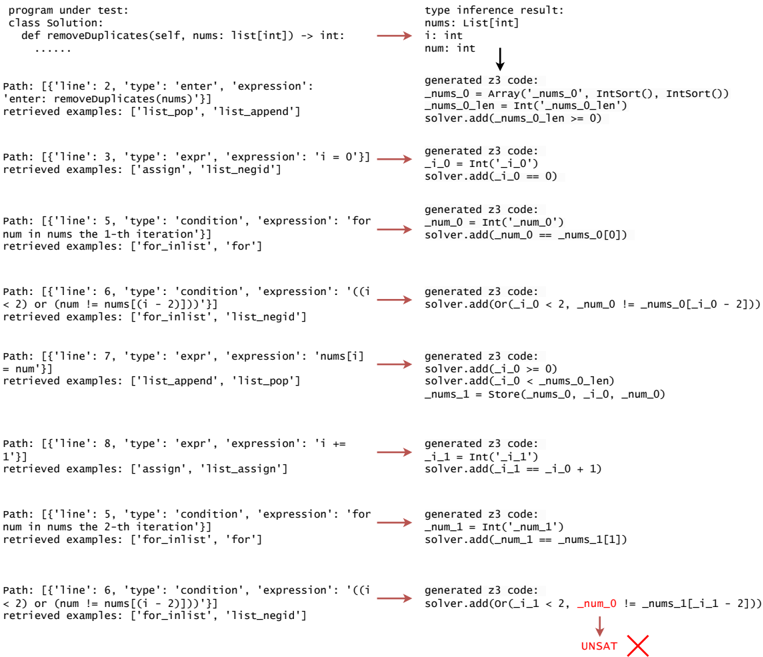
The image presents a diagram illustrating the process of type inference for a Python function `removeDuplicates`. It shows the program under test (PUT), the type inference result, and the generated Z3 code for each path within the function. The diagram uses arrows to indicate the flow from the PUT to the type inference and then to the generated Z3 code. Each path is labeled with a line number and details about the type, expression, and retrieved examples.
### Components/Axes
The diagram is structured into three main columns:
1. **Program Under Test (PUT):** Describes the function `removeDuplicates` and the execution paths within it. Includes line numbers, type of operation, expression, and retrieved examples.
2. **Type Inference Result:** Shows the inferred types for variables used in the PUT.
3. **Generated Z3 Code:** Displays the Z3 code generated based on the type inference for each path.
The diagram also includes a small copyright notice at the bottom right: "© 2020 Microsoft".
### Detailed Analysis or Content Details
Here's a breakdown of each path, extracted from the diagram:
* **Path: ['line: 2', 'type': 'enter', 'expression': 'enter: removeDuplicates(nums)']**
* Retrieved examples: `['list_pop', 'list_append']`
* Type inference result: `nums: list[int]`, `i: int`, `num: int`
* Generated Z3 code: `_nums_0 = Array('_nums_0', IntSort(), IntSort())`, `_nums_0.len = Int('nums_0_len >= 0')`, `solver.add(_nums_0.len >= 0)`
* **Path: ['line: 3', 'type': 'expr', 'expression': 'i = 0']**
* Retrieved examples: `['assign', 'list_negid']`
* Generated Z3 code: `_i_0 = Int('_i_0')`, `solver.add(_i_0 == 0)`
* **Path: ['line: 5', 'type': 'condition', 'expression': 'for num in nums the 1-th iteration']**
* Retrieved examples: `['for_inlist', 'for']`
* Generated Z3 code: `_num_0 = Int('_num_0')`, `solver.add(_num_0 == _nums_0[0])`
* **Path: ['line: 6', 'type': 'condition', 'expression': '((i < 2) or (num != nums[(i - 2)]))']**
* Retrieved examples: `['for_inlist', 'list_negid']`
* Generated Z3 code: `solver.add(Or(_i_0 < 2, _num_0 != _nums_0[(_i_0 - 2)]))`
* **Path: ['line: 7', 'type': 'expr', 'expression': 'nums[i] = num']**
* Retrieved examples: `['list_append', 'list_pop']`
* Generated Z3 code: `solver.add(_i_0 >= 0)`, `solver.add(_i_0 < _nums_0.len)`, `_nums_1 = Store(_nums_0, _i_0, _num_0)`
* **Path: ['line: 8', 'type': 'expr', 'expression': 'i += 1']**
* Retrieved examples: `['assign', 'list_assign']`
* Generated Z3 code: `_i_1 = Int('_i_1')`, `solver.add(_i_1 == (_i_0 + 1))`
* **Path: ['line: 5', 'type': 'condition', 'expression': 'for num in nums the 2-th iteration']**
* Retrieved examples: `['for_inlist', 'for']`
* Generated Z3 code: `_num_1 = Int('_num_1')`, `solver.add(_num_1 == _nums_0[1])`
* **Path: ['line: 6', 'type': 'condition', 'expression': '((i < 2) or (num != nums[(i - 2)]))']**
* Retrieved examples: `['for_inlist', 'list_negid']`
* Generated Z3 code: `solver.add(Or(_i_0 < 2, _num_1 != _nums_0[(_i_0 - 2)]))`
* **Path: ['line: 11', 'type': 'return', 'expression': 'return nums']**
* Retrieved examples: `['list_assign', 'list_negid']`
* Generated Z3 code: `solver.add(_nums_1 == _nums_0)`, `_return_0 = _nums_1`
### Key Observations
The diagram demonstrates how a simple Python function is analyzed and translated into Z3 code for formal verification. Each path through the function generates corresponding Z3 constraints. The type inference step is crucial, as it determines the types of variables used in the Z3 code. The copyright notice suggests this is related to research or a tool developed by Microsoft.
### Interpretation
This diagram illustrates a technique for program verification using formal methods. The process involves:
1. **Execution Path Analysis:** Identifying different execution paths through the code.
2. **Type Inference:** Determining the data types of variables.
3. **Z3 Code Generation:** Translating the program logic and type information into constraints that can be solved by a Satisfiability Modulo Theories (SMT) solver (Z3).
The Z3 code represents a logical formula that must hold true for the program to be correct. By solving this formula, one can verify whether the program satisfies certain properties or identify potential bugs. The diagram highlights the connection between high-level code and formal verification techniques. The retrieval examples suggest a system that learns from previous executions to improve the type inference and Z3 code generation process. The diagram is a visual representation of a complex process, aiming to make it more understandable.