TECHNICAL ASSET FINGERPRINT
a21372cc50b1ea61ea427752
Click to view fullscreen
Press ESC or click to close
FOUND IN PAPERS
EXPERT: healer-alpha-free VERSION 1
RUNTIME: free/openrouter/healer-alpha
INTEL_VERIFIED
## Technical Diagram: Program Analysis and Z3 Code Generation Flow
### Overview
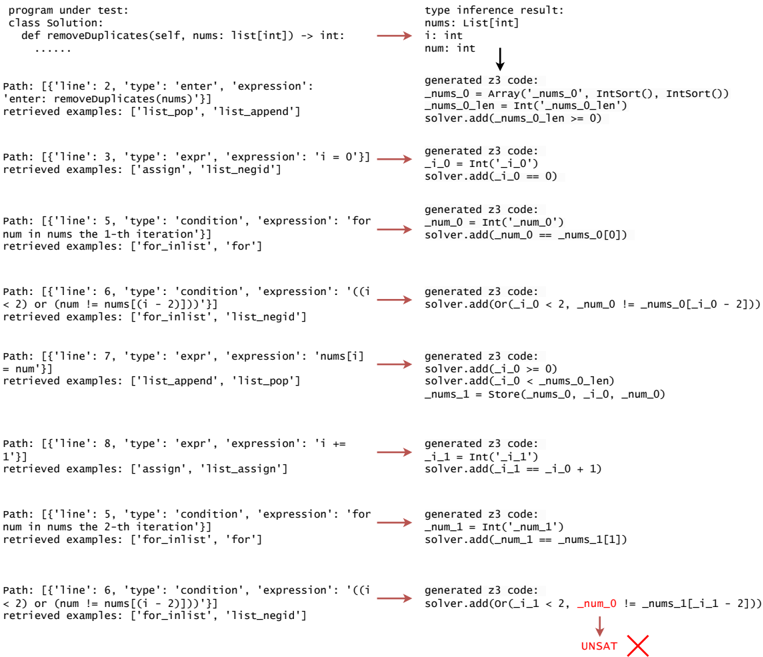
This image is a technical diagram illustrating the step-by-step process of analyzing a Python program method (`removeDuplicates`) and translating its execution paths into Z3 (a theorem prover) constraints. The diagram is structured in two parallel columns: the left column details the program analysis steps (paths, expressions, and retrieved examples), while the right column shows the corresponding type inference results and generated Z3 code. The process culminates in a final "UNSAT" (unsatisfiable) result, indicated by a red "X".
### Components/Axes
The diagram is organized into two primary vertical sections connected by red arrows, indicating a flow from analysis to code generation.
| Left Column (Program Analysis) | Right Column (Type Inference & Z3 Code Generation) |
| :--- | :--- |
| **Header/Initial Setup:** "program under test:" followed by a Python class and method definition. | **Type Inference Result:** A block showing inferred types for variables (`nums`, `i`, `num`). |
| **Path Steps:** A series of "Path:" entries, each containing: <br> - `line`: The line number in the source code. <br> - `type`: The type of code element (e.g., 'enter', 'expr', 'condition'). <br> - `expression`: The specific code expression being analyzed. <br> - `retrieved examples`: A list of related code patterns or examples (e.g., `['list_pop', 'list_append']`). | **Generated Z3 Code:** A series of "generated z3 code:" blocks, each containing Z3 Python API calls (e.g., `Array`, `Int`, `solver.add`). |
| | **Final Result:** The text "UNSAT" with a red "X" symbol at the bottom right. |
**Spatial Layout:**
- The left column occupies approximately the left 50% of the image.
- The right column occupies the right 50%.
- Red arrows point from each "Path" entry on the left to its corresponding "generated z3 code" block on the right.
- The "UNSAT" result is positioned at the bottom of the right column, below the final Z3 code block.
### Detailed Analysis
The diagram traces the analysis of a Python method `removeDuplicates(self, nums: list[int]) -> int`. Below is a precise transcription of the textual content, following the flow from top to bottom.
**1. Initial Setup (Top Left):**
```text
program under test:
class Solution:
def removeDuplicates(self, nums: list[int]) -> int:
......
```
**2. Type Inference Result (Top Right):**
```text
type inference result:
nums: List[int]
i: int
num: int
```
**3. Path 1 (Line 2 - Method Entry):**
- **Left (Analysis):**
`Path: [{'line': 2, 'type': 'enter', 'expression': 'enter: removeDuplicates(nums)'}]`
`retrieved examples: ['list_pop', 'list_append']`
- **Right (Z3 Code):**
`generated z3 code:`
`_nums_0 = Array('_nums_0', IntSort(), IntSort())`
`_nums_0_len = Int('_nums_0_len')`
`solver.add(_nums_0_len >= 0)`
**4. Path 2 (Line 3 - Initialization):**
- **Left:**
`Path: [{'line': 3, 'type': 'expr', 'expression': 'i = 0'}]`
`retrieved examples: ['assign', 'list_negid']`
- **Right:**
`generated z3 code:`
`_i_0 = Int('_i_0')`
`solver.add(_i_0 == 0)`
**5. Path 3 (Line 5 - First Loop Iteration Start):**
- **Left:**
`Path: [{'line': 5, 'type': 'condition', 'expression': 'for num in nums the 1-th iteration'}]`
`retrieved examples: ['for_inlist', 'for']`
- **Right:**
`generated z3 code:`
`_num_0 = Int('_num_0')`
`solver.add(_num_0 == _nums_0[0])`
**6. Path 4 (Line 6 - First Loop Condition):**
- **Left:**
`Path: [{'line': 6, 'type': 'condition', 'expression': '((i < 2) or (num != nums[(i - 2)]))'}]`
`retrieved examples: ['for_inlist', 'list_negid']`
- **Right:**
`generated z3 code:`
`solver.add(Or(_i_0 < 2, _num_0 != _nums_0[_i_0 - 2]))`
**7. Path 5 (Line 7 - Assignment in Loop):**
- **Left:**
`Path: [{'line': 7, 'type': 'expr', 'expression': 'nums[i] = num'}]`
`retrieved examples: ['list_append', 'list_pop']`
- **Right:**
`generated z3 code:`
`solver.add(_i_0 >= 0)`
`solver.add(_i_0 < _nums_0_len)`
`_nums_1 = Store(_nums_0, _i_0, _num_0)`
**8. Path 6 (Line 8 - Increment):**
- **Left:**
`Path: [{'line': 8, 'type': 'expr', 'expression': 'i += 1'}]`
`retrieved examples: ['assign', 'list_assign']`
- **Right:**
`generated z3 code:`
`_i_1 = Int('_i_1')`
`solver.add(_i_1 == _i_0 + 1)`
**9. Path 7 (Line 5 - Second Loop Iteration Start):**
- **Left:**
`Path: [{'line': 5, 'type': 'condition', 'expression': 'for num in nums the 2-th iteration'}]`
`retrieved examples: ['for_inlist', 'for']`
- **Right:**
`generated z3 code:`
`_num_1 = Int('_num_1')`
`solver.add(_num_1 == _nums_1[1])`
**10. Path 8 (Line 6 - Second Loop Condition):**
- **Left:**
`Path: [{'line': 6, 'type': 'condition', 'expression': '((i < 2) or (num != nums[(i - 2)]))'}]`
`retrieved examples: ['for_inlist', 'list_negid']`
- **Right:**
`generated z3 code:`
`solver.add(Or(_i_1 < 2, _num_0 != _nums_0[_i_1 - 2]))`
*(Note: There appears to be a potential inconsistency here; the Z3 code references `_num_0` and `_nums_0`, while the context suggests it might relate to `_num_1` and `_nums_1`. This is transcribed as shown.)*
**11. Final Result (Bottom Right):**
```text
UNSAT ❌
```
(The "X" is a red cross symbol).
### Key Observations
1. **Process Flow:** The diagram clearly maps each step of the program's abstract execution (paths) to formal logical constraints in Z3.
2. **Variable Versioning:** The Z3 code uses versioned variable names (e.g., `_i_0`, `_i_1`, `_nums_0`, `_nums_1`) to track state changes across iterations, which is a common technique in symbolic execution.
3. **Constraint Evolution:** The constraints build upon each other. For example, the array `_nums_1` is defined as a `Store` operation on `_nums_0`, modeling the assignment `nums[i] = num`.
4. **Final Outcome:** The process concludes with "UNSAT", meaning the set of generated Z3 constraints is unsatisfiable. This is the key result of the analysis.
5. **Potential Anomaly:** In the final Z3 code block (Path 8), the constraint uses `_num_0` and `_nums_0` where the context of the "2-th iteration" might suggest `_num_1` and `_nums_1`. This could be a transcription error in the original diagram or a point of interest in the analysis.
### Interpretation
This diagram demonstrates a **symbolic execution** or **formal verification** pipeline for a Python function. The goal is to automatically reason about the program's behavior by translating its code paths into mathematical constraints solvable by an SMT solver like Z3.
- **What it suggests:** The analysis is checking a property related to the `removeDuplicates` method. The specific property isn't stated, but the final "UNSAT" result indicates that the property **cannot hold** under the explored execution paths. In verification terms, this often means a bug or a specification violation has been found.
- **How elements relate:** The left column represents the *concrete* program world (source code, execution steps). The right column represents the *abstract* logical world (types, constraints). The red arrows show the translation process. The "retrieved examples" suggest a machine-learning or pattern-based component that helps guide the translation by recalling similar code constructs.
- **Why it matters:** This process automates the discovery of program errors. An "UNSAT" result is a definitive, mathematical proof that a certain condition is impossible given the code and the explored paths. It moves debugging from a manual, intuition-based activity to an automated, rigorous one. The diagram serves as a trace of this automated reasoning, showing exactly how each line of code contributed to the final, conclusive result.
DECODING INTELLIGENCE...