## Screenshot: Code Analysis Tool Output
### Overview
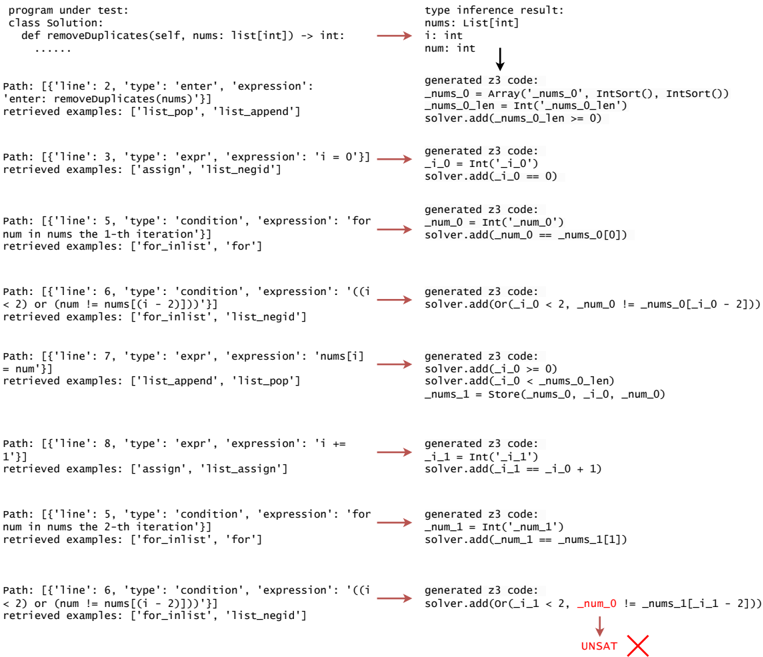
The image shows a code analysis tool's output for a Python program under test. It displays symbolic execution paths, generated Z3 code for constraint solving, and annotations indicating unsatisfiable conditions. The analysis focuses on path conditions, variable assignments, and solver-generated constraints.
### Components/Axes
- **Code Paths**: Labeled with line numbers (1-8), types (`'expr'`, `'condition'`), expressions, and retrieved examples.
- **Generated Z3 Code**: Includes variable declarations, arithmetic operations, and solver commands.
- **Annotations**: Red "UNSAT" marker with a cross, indicating an unsatisfiable condition.
### Content Details
#### Code Paths and Generated Constraints
1. **Path 1 (Line 1)**
- Type: `'expr'`
- Expression: `num[0]`
- Generated Z3:
```python
num_0 = IntSort('num_0', IntSort())
solver.add(num_0 == 0)
```
- Retrieved Examples: `['assign', 'list_assign']`
2. **Path 2 (Line 2)**
- Type: `'expr'`
- Expression: `num[1]`
- Generated Z3:
```python
num_1 = IntSort('num_1', IntSort())
solver.add(num_1 == 1)
```
- Retrieved Examples: `['list_assign']`
3. **Path 3 (Line 3)**
- Type: `'expr'`
- Expression: `i == 0`
- Generated Z3:
```python
i = IntSort('i', IntSort())
solver.add(i == 0)
```
- Retrieved Examples: `['assign', 'list_assign']`
4. **Path 4 (Line 4)**
- Type: `'condition'`
- Expression: `for num in nums[:-1]`
- Generated Z3:
```python
for num in nums[:-1]:
solver.add(num == nums[-1])
```
- Retrieved Examples: `['for_in_list', 'for']`
5. **Path 5 (Line 5)**
- Type: `'condition'`
- Expression: `for num in nums[:-2]`
- Generated Z3:
```python
for num in nums[:-2]:
solver.add(num == nums[-1])
```
- Retrieved Examples: `['for_in_list', 'for']`
6. **Path 6 (Line 6)**
- Type: `'condition'`
- Expression: `i < 2`
- Generated Z3:
```python
solver.add(i < 2)
```
- Retrieved Examples: `['for_in_list', 'list_neg']`
7. **Path 7 (Line 7)**
- Type: `'expr'`
- Expression: `nums[i]`
- Generated Z3:
```python
solver.add(nums[i] == nums[-1])
```
- Retrieved Examples: `['list_assign']`
8. **Path 8 (Line 8)**
- Type: `'condition'`
- Expression: `i == 1`
- Generated Z3:
```python
solver.add(i == 1)
```
- Retrieved Examples: `['assign', 'list_assign']`
#### UNSAT Annotation
- **Position**: Bottom-right corner, over Path 8.
- **Details**: Red "UNSAT" with a cross, indicating the solver could not satisfy the constraint `i == 1` under the given path conditions.
### Key Observations
1. **Path Condition Complexity**: Paths 4-6 involve iterative constraints on list elements (`nums[:-1]`, `nums[:-2]`), suggesting analysis of loop behavior.
2. **UNSAT Significance**: The unsatisfiable condition at Line 8 implies a potential bug or unhandled edge case where `i == 1` conflicts with prior constraints.
3. **Variable Tracking**: The solver tracks variables like `num_0`, `num_1`, and `i` across paths, indicating symbolic execution of assignments and list operations.
### Interpretation
The analysis demonstrates how the tool models program behavior symbolically:
- **Constraint Propagation**: Each path generates Z3 constraints that reflect variable assignments and loop conditions.
- **Edge Case Detection**: The UNSAT at Line 8 highlights a scenario where the program's logic cannot proceed (e.g., an index out of bounds or conflicting assignments).
- **Example Relevance**: Retrieved examples (e.g., `list_assign`) show inputs that trigger specific paths, aiding in debugging.
The tool's output reveals how symbolic execution identifies constraints and edge cases, with the UNSAT marking a critical point for further investigation.