## Diagram: State Transition System with Unfolding Mechanism
### Overview
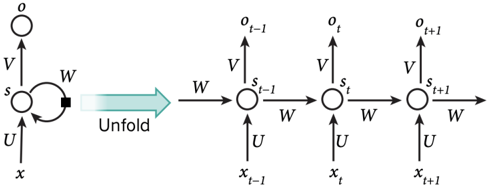
The diagram illustrates a dynamic system with sequential state transitions over time. It features a central "Unfold" mechanism that propagates information across three time steps: *t-1*, *t*, and *t+1*. The system includes feedback loops (W), input/output channels (U, V), and state variables (S, O, X).
### Components/Axes
1. **Left Block (Initial State)**:
- A circle labeled **s** (state) with:
- **U** (upward arrow): Input signal **x** (bottom).
- **V** (downward arrow): Output signal **o** (top).
- **W** (rightward arrow): Feedback loop to itself.
- **Unfold** arrow (light blue) points rightward to the time-expanded blocks.
2. **Time-Expanded Blocks (Right Side)**:
- Three identical blocks for *t-1*, *t*, and *t+1*, each containing:
- **s_{t-1}/s_t/s_{t+1}**: State variables at respective time steps.
- **o_{t-1}/o_t/o_{t+1}**: Output signals (connected via **V** arrows).
- **x_{t-1}/x_t/x_{t+1}**: Input signals (connected via **U** arrows).
- **W** arrows link adjacent blocks horizontally (e.g., *s_t* → *s_{t+1}*).
3. **Arrows and Connections**:
- **U**: Input propagation (bottom → state).
- **V**: Output propagation (state → top).
- **W**: Feedback/forwarding between states.
### Detailed Analysis
- **Initial State (Left Block)**:
The system starts with a static state **s**, receiving input **x** (U) and producing output **o** (V). The **W** loop suggests self-reinforcement or memory retention.
- **Unfold Mechanism**:
The "Unfold" arrow indicates a temporal expansion, replicating the initial state across three time steps. This implies the system evolves dynamically, with states and signals propagating forward.
- **Time-Expanded Blocks**:
Each block mirrors the initial structure but operates at discrete time steps. Horizontal **W** connections enforce temporal coherence (e.g., *s_t* influences *s_{t+1}*). Vertical **U**/**V** arrows maintain input-output consistency across time.
### Key Observations
1. **Sequential Dependency**: States and signals at *t* depend on prior states (*t-1*) and influence future states (*t+1*).
2. **Feedback Loops**: **W** arrows create cyclical dependencies, enabling memory or error correction.
3. **Temporal Symmetry**: The system treats past, present, and future states uniformly, suggesting a Markovian or autoregressive process.
### Interpretation
This diagram likely represents a **state-space model** or **recurrent system** (e.g., in control theory, signal processing, or machine learning). The "Unfold" mechanism mirrors techniques like **unfolding recurrent networks** (e.g., in reservoir computing) or **dynamic time-warping**.
- **Purpose**: The system processes inputs (**x**) over time, generates outputs (**o**), and maintains state (**s**) with feedback.
- **Notable Features**:
- The absence of explicit time derivatives suggests discrete-time modeling.
- Uniform **W** connections imply equal weighting of temporal dependencies.
- The "Unfold" label hints at a method to unroll recursive operations for analysis or computation.
- **Underlying Assumptions**:
- Linearity: No nonlinear operators (e.g., activation functions) are shown.
- Determinism: No stochastic elements (e.g., noise terms) are depicted.
- Discrete Time: Continuous-time models would require differential equations.
This structure is foundational for algorithms requiring temporal memory, such as **LSTMs** (Long Short-Term Memory networks) or **dynamic systems** in robotics. The "Unfold" step is critical for simulating or optimizing long-term behavior.