## Screenshot: Text Message Conversation with Code Overlay
### Overview
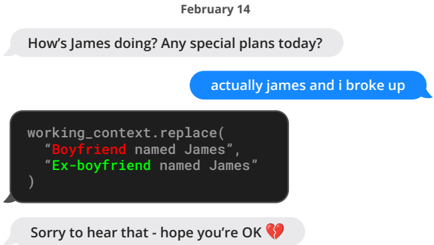
The image is a screenshot of a text message conversation on a mobile device, dated February 14. A code snippet is superimposed over the middle of the conversation, illustrating a programmatic "find and replace" operation as a metaphor for updating a relationship status.
### Components/Axes
The image is composed of three primary regions:
1. **Header**: Contains the date "February 14".
2. **Main Chat Area**: Displays a sequence of text message bubbles.
3. **Overlay**: A dark-themed code block positioned centrally over the chat.
**Text Message Bubbles:**
* **Received Message (Left-aligned, grey bubble):** "How's James doing? Any special plans today?"
* **Sent Message (Right-aligned, blue bubble):** "actually james and i broke up"
* **Received Message (Left-aligned, grey bubble, partially obscured):** "Sorry to hear that - hope you're OK 💔"
**Code Block Overlay:**
* **Background:** Dark grey/black.
* **Text:** Monospaced font with syntax highlighting.
* **Content:**
```python
working_context.replace(
"Boyfriend named James",
"Ex-boyfriend named James"
)
```
* **Syntax Highlighting:**
* `working_context.replace(` is in white/light grey.
* The first string argument `"Boyfriend named James"` is highlighted in **red**.
* The second string argument `"Ex-boyfriend named James"` is highlighted in **green**.
* The closing parenthesis `)` is in white/light grey.
### Detailed Analysis
The conversation flow is chronological from top to bottom.
1. **Top (Feb 14):** An inquiry about "James" and plans, implying a romantic context.
2. **Middle (Response):** The revelation of a breakup.
3. **Overlay (Code):** This is the central, explanatory element. It uses a common programming method (`.replace()`) to visually demonstrate the mental or contextual update required: changing the label from "Boyfriend" to "Ex-boyfriend" within the "working_context" of the speaker's life.
4. **Bottom (Response):** A sympathetic reply with a broken heart emoji (`💔`).
### Key Observations
* **Temporal Context:** The date "February 14" (Valentine's Day) is prominently displayed, adding significant emotional weight to the conversation about a breakup.
* **Visual Metaphor:** The code block is not part of the actual chat interface but is an added graphic. It serves as a literal, technical representation of an emotional update.
* **Color Symbolism in Code:** The use of **red** for the old status ("Boyfriend") and **green** for the new status ("Ex-boyfriend") mirrors common UI patterns where red signifies deletion/error/stop and green signifies addition/success/go.
* **Spatial Grounding:** The code block is centered, deliberately obscuring part of the conversation to draw focus to its message. The sympathetic reply is partially visible beneath it.
### Interpretation
This image is a meme or a humorous technical illustration. It uses the precise, logical syntax of programming to depict the often messy and emotional process of updating one's personal life circumstances after a breakup.
* **What it suggests:** The creator is likely framing a personal emotional event through a technical, problem-solving lens. The "working_context" is a metaphor for one's current understanding of their life and relationships. The `.replace()` operation is the conscious act of revising that understanding.
* **How elements relate:** The text messages provide the real-world emotional trigger (the breakup). The code block provides the analytical, almost clinical, response to that trigger. The final sympathetic message grounds the technical metaphor back in human emotion.
* **Notable Anomaly:** The primary "data" here is not numerical but linguistic and symbolic. The key insight is the juxtaposition of cold, logical code with warm, human communication, highlighting a specific (and likely relatable) way of processing events. The Valentine's Day date is a critical piece of context that amplifies the irony and emotional impact of the situation described.