## Screenshot: Messaging App Conversation with Code Snippet
### Overview
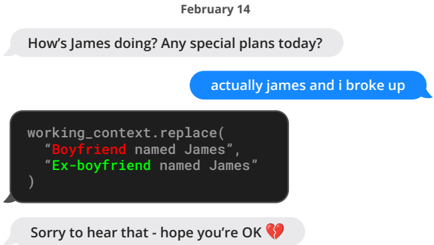
The image depicts a messaging app interface showing a conversation between two users. The exchange includes a personal update about a breakup, a code snippet demonstrating text replacement logic, and an empathetic response. The conversation occurs on February 14.
### Components/Axes
- **Chat Interface Elements**:
- Gray speech bubbles (sender 1)
- Blue speech bubbles (sender 2)
- Black code snippet bubble
- **Text Content**:
- Date stamp: "February 14"
- Emojis: ❤️ (broken heart)
- **Code Snippet**:
- Function: `working_context.replace()`
- Placeholders: `"Boyfriend named James"` (red), `"Ex-boyfriend named James"` (green)
### Detailed Analysis
1. **Conversation Flow**:
- Sender 1 inquires about James' well-being and plans.
- Sender 2 reveals a breakup involving someone named James.
- Sender 1 responds with sympathy and a broken heart emoji.
2. **Code Snippet**:
- Demonstrates dynamic text replacement logic.
- Replaces "Boyfriend" with "Ex-boyfriend" in a message template.
- Maintains the name "James" across both placeholders.
### Key Observations
- The breakup announcement uses the name "James" ambiguously, requiring contextual disambiguation.
- The code snippet suggests a system for personalizing messages based on relationship status.
- The broken heart emoji visually reinforces the emotional tone of the conversation.
### Interpretation
The conversation reveals a personal relationship update that necessitates technical handling of name ambiguity. The code snippet implies an automated system designed to:
1. Preserve proper nouns (James) while modifying relationship descriptors
2. Maintain contextual consistency in message templates
3. Adapt communication based on changing relationship statuses
The use of color-coded placeholders (red/green) in the code may indicate priority levels or categorization in the replacement logic. The broken heart emoji serves as a non-verbal cue to emphasize emotional gravity, suggesting the system might integrate emotional context markers alongside textual data.