## Astronomical Diagram: Zodiac Constellations and Earth's Orbit
### Overview
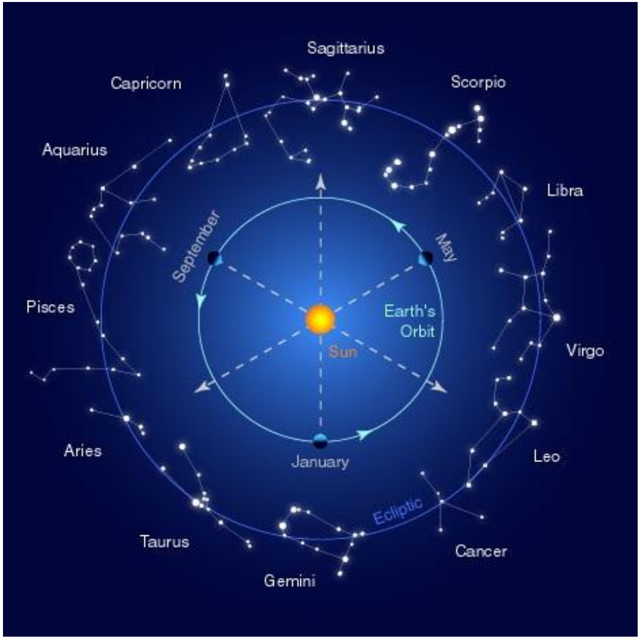
This is an educational astronomical diagram illustrating the relationship between Earth's orbit around the Sun and the apparent positions of the twelve zodiac constellations along the ecliptic plane. The diagram uses a top-down, schematic view with the Sun at the center.
### Components/Axes
**Central Object:**
* **Sun:** A yellow/orange circle at the geometric center of the diagram.
**Orbital Path:**
* **Earth's Orbit:** A light blue, circular path surrounding the Sun. It is labeled "Earth's Orbit" in the right-center region.
* **Directional Arrows:** Small, light blue arrows on the orbital path indicate a counter-clockwise direction of motion.
* **Earth Positions:** Three blue spheres represent Earth at different points in its orbit, labeled with months:
* **January:** Positioned at the bottom (6 o'clock position).
* **May:** Positioned at the upper-right (approximately 2 o'clock position).
* **September:** Positioned at the upper-left (approximately 10 o'clock position).
* **Ecliptic:** A dashed white line forms a larger circle concentric with Earth's orbit. It is labeled "Ecliptic" in the lower-right quadrant.
**Zodiac Constellations:**
Twelve constellations are depicted as connected white dots (stars) and lines, arranged in a ring outside the ecliptic. Each is labeled with its name. Listed clockwise from the top:
1. **Sagittarius** (Top center)
2. **Scorpio** (Top-right)
3. **Libra** (Right, upper)
4. **Virgo** (Right, lower)
5. **Leo** (Bottom-right)
6. **Cancer** (Bottom, right of center)
7. **Gemini** (Bottom center)
8. **Taurus** (Bottom, left of center)
9. **Aries** (Bottom-left)
10. **Pisces** (Left, lower)
11. **Aquarius** (Left, upper)
12. **Capricorn** (Top-left)
**Other Labels:**
* **"September", "May", "January":** Month labels adjacent to the corresponding Earth positions on its orbit.
* **Dashed Lines:** White dashed lines radiate from the Sun, passing through each of the three Earth positions and extending outward toward the zodiac ring, indicating the line of sight from Earth through the Sun to the background constellations.
### Detailed Analysis
The diagram is a static representation, not a data chart with variable values. Its primary function is to show spatial relationships.
* **Spatial Layout:** The Sun is the central anchor. Earth's orbit is an inner circle. The ecliptic and the ring of zodiac constellations form an outer circle. The three marked Earth positions (Jan, May, Sep) are spaced roughly 120 degrees apart along the orbit.
* **Constellation Depictions:** Each zodiac constellation is shown in a simplified, iconic form. For example:
* **Leo** shows a sickle-shaped head and a triangular body.
* **Scorpio** has a distinct curved tail.
* **Gemini** is represented by two parallel stick figures.
* **Line of Sight:** The dashed lines are critical. They demonstrate that when Earth is at the "January" position, the Sun appears in the direction of the constellations between Capricorn and Sagittarius. When Earth is at "May," the Sun appears in the direction of Taurus and Gemini. When Earth is at "September," the Sun appears in the direction of Virgo and Libra.
### Key Observations
1. **Ecliptic Alignment:** All twelve zodiac constellations are positioned along the single, dashed ecliptic line, accurately representing the plane of Earth's orbit.
2. **Asymmetrical Spacing:** The constellations are not spaced at perfect 30-degree intervals around the circle. Their sizes and the gaps between them vary, reflecting their actual approximate angular sizes in the sky (e.g., Virgo is large, Cancer is small).
3. **Orbital Direction:** The arrows on Earth's orbit clearly indicate a counter-clockwise revolution when viewed from this north ecliptic pole perspective.
4. **Seasonal Marker:** The three Earth positions correspond roughly to the start of seasons in the Northern Hemisphere: January (winter), May (late spring), and September (autumn).
### Interpretation
This diagram is a pedagogical tool designed to explain the **zodiac**. It visually answers the question: "Why do the zodiac signs correspond to certain times of the year?"
The core concept demonstrated is **apparent motion**. As Earth orbits the Sun, our line of sight to the Sun changes against the distant backdrop of stars. The constellation that lies directly behind the Sun (along the ecliptic) as seen from Earth is the "sign" the Sun is "in" for that period. The diagram makes this abstract concept concrete by freezing Earth at three points and drawing the sightlines.
**Notable Implications:**
* The diagram shows the **astronomical basis** for astrology, while also highlighting its static, schematic nature. It does not account for the precession of the equinoxes, which has shifted the alignment between the calendar dates and the actual constellations over the last two millennia.
* The choice of January, May, and September as reference points is likely for visual clarity and to represent different quadrants of the orbit, rather than marking precise astronomical events like solstices and equinoxes.
* The viewer is placed in a "God's-eye" view from above the solar system, a perspective impossible to achieve physically but essential for understanding orbital mechanics.
In essence, the image translates the temporal experience of the year (changing seasons and "birth signs") into a spatial map of Earth's journey around the Sun.