## Diagram: Earth's Orbit and Zodiac Constellations
### Overview
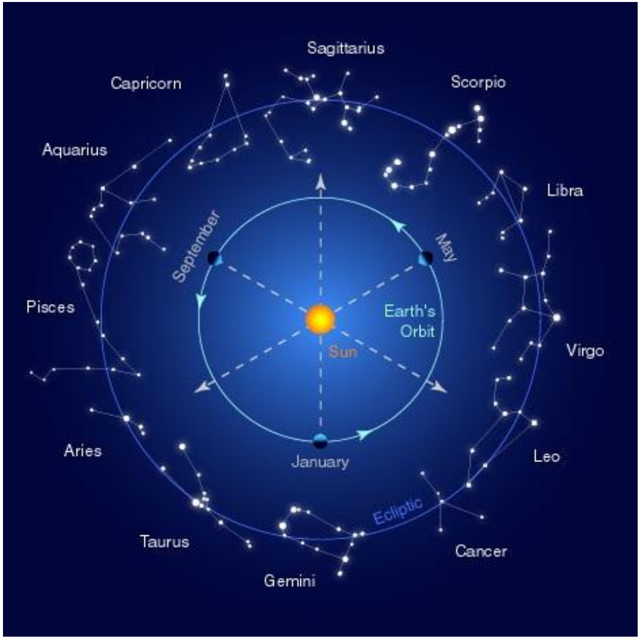
The diagram illustrates the Earth's orbit around the Sun, overlaid with the positions of 12 zodiac constellations. The Earth's orbit is depicted as a circular path with directional arrows indicating seasonal transitions (September, January, May, July). The Sun is centrally located, and constellations are arranged along the orbital path, with their names labeled.
### Components/Axes
- **Central Elements**:
- **Sun**: Labeled "Sun" in yellow, positioned at the center.
- **Earth's Orbit**: A blue circular path labeled "Earth's Orbit," with four blue arrows pointing to seasonal markers (September, January, May, July).
- **Zodiac Constellations**:
- 12 constellations (e.g., Sagittarius, Capricorn, Aquarius, Pisces, Aries, Taurus, Gemini, Cancer, Leo, Virgo, Libra, Scorpio) are labeled in white text along the orbital path.
- Constellation patterns are represented by white dots connected by lines.
- **Seasonal Markers**:
- Arrows point to four positions on the orbit:
- **September** (top-left),
- **January** (bottom),
- **May** (top-right),
- **July** (bottom-right).
- **Legend**:
- Blue: Earth's orbit and directional arrows.
- White: Zodiac constellation labels and patterns.
- Yellow: Sun.
### Detailed Analysis
- **Zodiac Constellation Placement**:
- Starting from the top (September):
1. **Sagittarius** (topmost),
2. **Capricorn** (left of Sagittarius),
3. **Aquarius** (below Capricorn),
4. **Pisces** (left of Aquarius),
5. **Aries** (below Pisces),
6. **Taurus** (below Aries),
7. **Gemini** (below Taurus),
8. **Cancer** (below Gemini),
9. **Leo** (right of Cancer),
10. **Virgo** (below Leo),
11. **Libra** (right of Virgo),
12. **Scorpio** (below Libra),
13. **Sagittarius** (closing the loop).
- **Seasonal Arrows**:
- Arrows are evenly spaced along the orbit, pointing to the four cardinal months.
- The orbit is divided into 12 equal segments, aligning with the zodiac constellations.
### Key Observations
- The diagram emphasizes the cyclical relationship between Earth's orbit and the zodiac constellations, with each constellation occupying a 30° segment of the orbit.
- The Sun is centrally positioned, reinforcing its role as the focal point of the solar system.
- The seasonal markers (September, January, May, July) are placed at 90° intervals, corresponding to the Earth's axial tilt and orbital position.
### Interpretation
This diagram demonstrates how the Earth's orbit and axial tilt influence the visibility of zodiac constellations throughout the year. The placement of constellations along the orbital path suggests their apparent movement across the sky as Earth revolves around the Sun. The seasonal markers highlight key points in the orbital cycle, likely correlating with solstices and equinoxes. The use of color (blue for orbit, white for constellations) aids in distinguishing dynamic elements (orbit) from static celestial patterns (constellations). The diagram serves as an educational tool to visualize the connection between astronomy and seasonal cycles.