## Diagram: Memory Architecture Comparison
### Overview
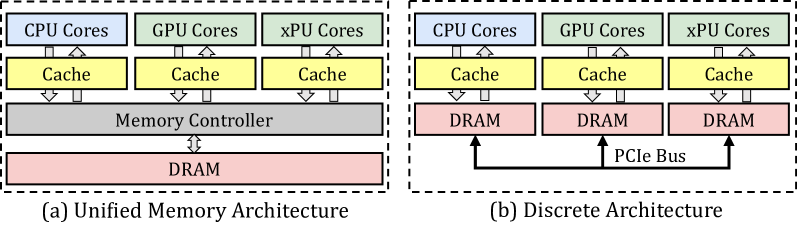
The image compares two memory architectures: **(a) Unified Memory Architecture** and **(b) Discrete Architecture**. Both diagrams illustrate hierarchical relationships between processing units (CPU, GPU, xPU cores), memory hierarchies (cache, DRAM), and interconnects.
### Components/Axes
- **Labels**:
- **Processing Units**: CPU Cores (blue), GPU Cores (green), xPU Cores (yellow).
- **Memory Hierarchy**: Cache (yellow), Memory Controller (gray), DRAM (pink).
- **Interconnect**: PCIe Bus (black).
- **Spatial Grounding**:
- **Unified Architecture (a)**:
- CPU/GPU/xPU cores at the top, connected to shared caches.
- Caches feed into a single Memory Controller.
- Memory Controller connects to a shared DRAM.
- **Discrete Architecture (b)**:
- CPU/GPU/xPU cores at the top, each with dedicated caches.
- Caches connect directly to individual DRAM modules.
- DRAM modules linked via a PCIe Bus.
### Detailed Analysis
- **Unified Architecture (a)**:
- Shared resources: All cores share a single Memory Controller and DRAM.
- Hierarchical flow: Data moves from cores → caches → Memory Controller → DRAM.
- **Discrete Architecture (b)**:
- Dedicated resources: Each core type has its own DRAM.
- Interconnect: PCIe Bus enables communication between DRAM modules.
- Hierarchical flow: Data moves from cores → caches → DRAM → PCIe Bus (for cross-core communication).
### Key Observations
1. **Unified Architecture**:
- Simplified memory hierarchy with centralized control.
- Potential bottleneck at the Memory Controller and shared DRAM.
2. **Discrete Architecture**:
- Decentralized memory access reduces contention.
- PCIe Bus introduces latency for inter-DRAM communication.
### Interpretation
- **Unified Architecture** prioritizes resource sharing, which may improve efficiency for workloads with uniform memory access patterns but risks contention during high concurrency.
- **Discrete Architecture** isolates memory resources per core type, enhancing scalability and reducing contention but at the cost of increased complexity and latency due to the PCIe Bus.
- The diagrams emphasize trade-offs between centralized vs. decentralized memory management, critical for optimizing performance in heterogeneous computing systems.
*Note: No numerical data or trends are present; the focus is on structural and hierarchical relationships.*