## Diagram: Tripartite Systemic Relationships
### Overview
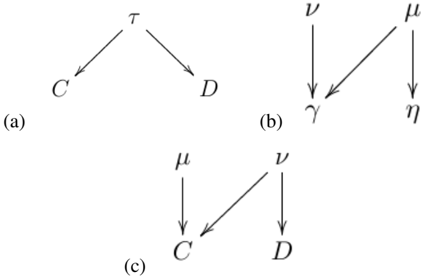
The image presents three distinct diagrams (a, b, c) illustrating abstract systemic relationships between labeled components (C, D, γ, μ, ν, τ, η). Arrows indicate directional flows or dependencies, with Greek letters representing transformation or interaction mechanisms.
### Components/Axes
**Diagram (a):**
- **Labels:** C (source), D (target), τ (transformation mechanism)
- **Flow:** Bidirectional arrows between C and D, mediated by τ
- **Spatial Positioning:** τ centered above C-D axis
**Diagram (b):**
- **Labels:** γ (source), μ (intermediate), ν (feedback), D (target), η (transformation)
- **Flow:**
- γ → μ → D (primary pathway)
- ν → γ (feedback loop)
- μ → ν (cross-path interaction)
- **Spatial Positioning:** γ at top-left, D at bottom-right, η centered
**Diagram (c):**
- **Labels:** C (source), D (target), μ (pathway), ν (pathway)
- **Flow:**
- μ: C → D (direct)
- ν: C → D (parallel)
- **Spatial Positioning:** μ and ν arrows diverge from C, converge at D
### Detailed Analysis
1. **Diagram (a):** Represents a symmetric bidirectional relationship between C and D, with τ acting as a mutual transformation catalyst. The equal arrow thickness suggests balanced interaction strength.
2. **Diagram (b):** Depicts a hierarchical system with γ initiating processes through μ to reach D, while ν creates a feedback loop to γ. The η label implies a secondary transformation mechanism between μ and ν.
3. **Diagram (c):** Shows parallel pathways (μ and ν) from C to D, suggesting redundancy or alternative routes for C→D conversion.
### Key Observations
- τ in (a) vs. μ/ν in (c) both mediate C→D relationships but with different structural implications (bidirectional vs. parallel)
- Diagram (b) introduces feedback (ν→γ) absent in other diagrams
- All diagrams use Greek letters for transformation mechanisms, suggesting standardized notation
### Interpretation
These diagrams likely represent:
1. **System Dynamics:** τ in (a) could model equilibrium states, while (b) shows non-equilibrium processes with feedback
2. **Pathway Redundancy:** (c) suggests biological/technical systems with multiple conversion routes
3. **Feedback Importance:** (b) emphasizes regulatory mechanisms through its γ→μ→D→ν→γ loop
4. **Component Roles:** C consistently acts as source, D as target, while Greek letters represent process-specific mediators
The absence of quantitative data prevents statistical analysis, but the structural patterns suggest these diagrams model either:
- Biological pathways (e.g., metabolic processes)
- Technical systems (e.g., data flow architectures)
- Socio-technical interactions (e.g., organizational communication flows)