## Hierarchical Diagram: Climatology Topics and Subtopics
### Overview
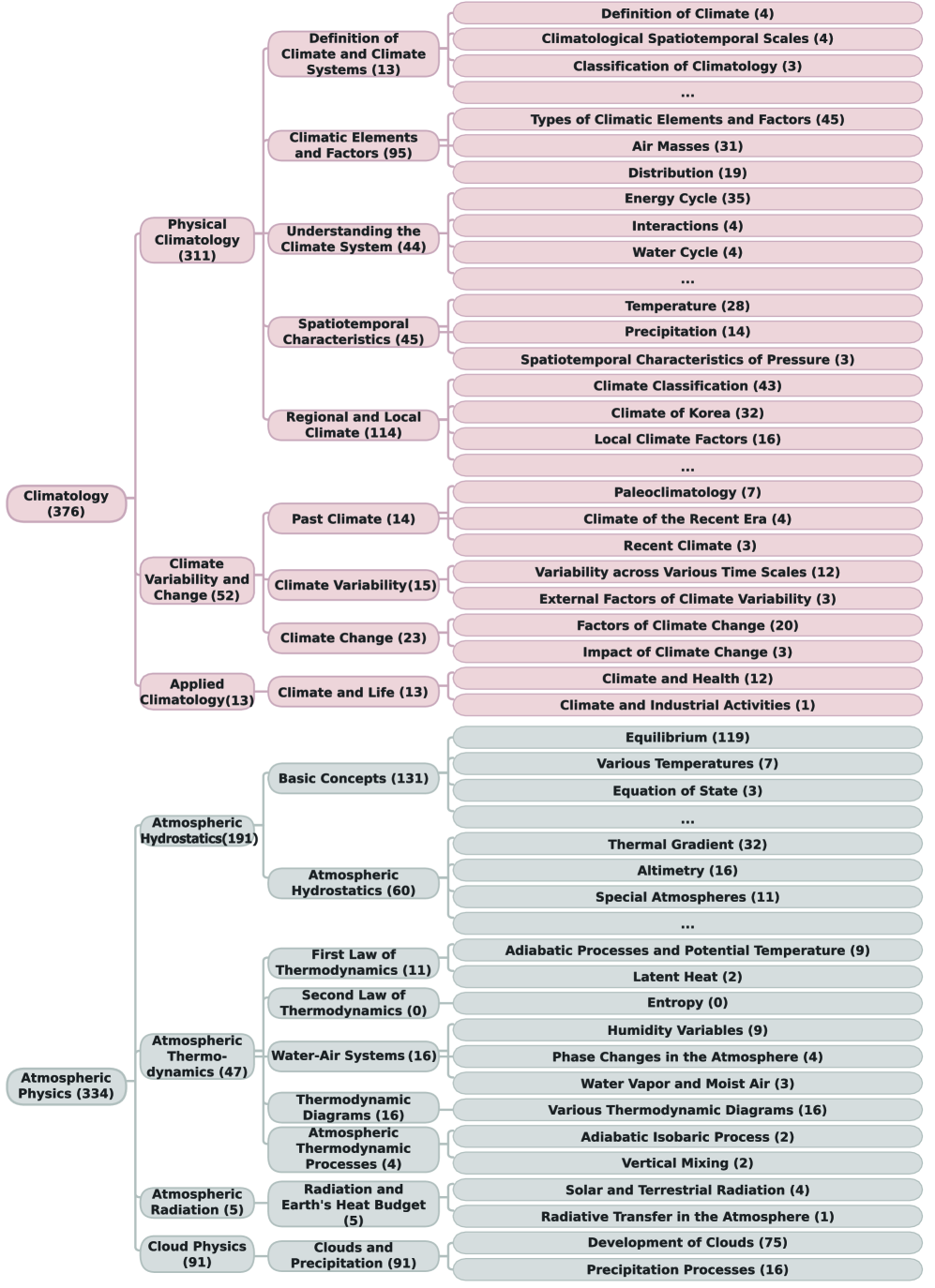
The image is a hierarchical diagram organizing climatology into main categories and subcategories, each annotated with numerical values in parentheses. The structure reflects a tree-like taxonomy, with indentation indicating subtopic relationships. The numbers likely represent metrics such as page counts, section identifiers, or topic weights within a curriculum or textbook.
### Components/Axes
- **Main Categories** (bolded, top-level labels):
- Climatology (376)
- Physical Climatology (311)
- Climate Variability and Change (52)
- Applied Climatology (13)
- Atmospheric Physics (334)
- Atmospheric Hydrostatics (191)
- Atmospheric Thermodynamics (47)
- **Subcategories** (indented under main categories):
- **Climatology (376)**:
- Definition of Climate and Climate Systems (13)
- Climatic Elements and Factors (95)
- Understanding the Climate System (44)
- Spatiotemporal Characteristics (45)
- Regional and Local Climate (114)
- Past Climate (14)
- Climate Variability (15)
- Climate Change (23)
- Climate and Life (13)
- Climate and Industrial Activities (1)
- **Physical Climatology (311)**:
- Spatiotemporal Scales (4)
- Classification of Climatology (3)
- **Climate Variability and Change (52)**:
- Variability across Time Scales (12)
- External Factors of Variability (3)
- Factors of Climate Change (20)
- Impact of Climate Change (3)
- **Applied Climatology (13)**:
- Climate and Health (12)
- **Atmospheric Physics (334)**:
- Basic Concepts (131)
- Atmospheric Hydrostatics (60)
- First Law of Thermodynamics (11)
- Second Law of Thermodynamics (0)
- Water-Air Systems (16)
- Thermodynamic Diagrams (16)
- Atmospheric Thermodynamic Processes (4)
- Radiation and Earth's Heat Budget (5)
- Clouds and Precipitation (91)
- **Atmospheric Hydrostatics (191)**:
- Equilibrium (119)
- Thermal Gradient (32)
- Altimetry (16)
- Special Atmospheres (11)
- **Atmospheric Thermodynamics (47)**:
- Adiabatic Processes and Potential Temperature (9)
- Humidity Variables (9)
- Phase Changes in the Atmosphere (4)
- Water Vapor and Moist Air (3)
- Adiabatic Isobaric Process (2)
- Vertical Mixing (2)
- Solar and Terrestrial Radiation (4)
- Radiative Transfer in the Atmosphere (1)
- Development of Clouds (75)
- Precipitation Processes (16)
### Detailed Analysis
- **Hierarchical Structure**: The diagram uses indentation to denote subtopic relationships. For example, "Climate and Life (13)" is a subtopic of "Climate Variability and Change (52)," which itself is a subtopic of "Climatology (376)."
- **Numerical Values**: Numbers in parentheses likely quantify the scope or emphasis of each topic. For instance, "Climatology (376)" is the broadest category, while "Climate and Industrial Activities (1)" is the most narrowly focused.
- **Key Subtopics**:
- **Climatology**: Focuses on foundational concepts (e.g., "Definition of Climate (4)") and regional/local applications ("Climate of Korea (32)").
- **Physical Climatology**: Emphasizes system dynamics ("Understanding the Climate System (44)") and spatial-temporal analysis.
- **Atmospheric Physics**: Dominated by thermodynamics and radiation, with "Clouds and Precipitation (91)" as the largest subtopic.
- **Applied Climatology**: Highlights practical applications like "Climate and Health (12)" and industrial impacts.
### Key Observations
- **Dominant Themes**: Atmospheric Physics (334) and Climatology (376) are the largest categories, suggesting their centrality in climatology education or research.
- **Low-Weight Subtopics**: "Second Law of Thermodynamics (0)" and "Climate and Industrial Activities (1)" have the smallest values, possibly indicating minimal coverage or niche relevance.
- **Interdisciplinary Links**: Topics like "Climate and Life (13)" and "Climate and Health (12)" bridge climatology with biology and public health.
### Interpretation
The diagram illustrates the interdisciplinary and hierarchical nature of climatology, with core physical principles (e.g., thermodynamics, radiation) underpinning broader climate systems and applications. The numerical values may reflect curriculum design, textbook organization, or research priorities, with larger numbers indicating foundational or high-priority topics. The inclusion of applied subtopics (e.g., health, industrial impacts) underscores the field's relevance to real-world challenges. The absence of values for some subtopics (e.g., "Second Law of Thermodynamics (0)") could signal gaps in coverage or areas requiring further development.