\n
## Code Snippets: LLM vs. LLM + APOLLO
### Overview
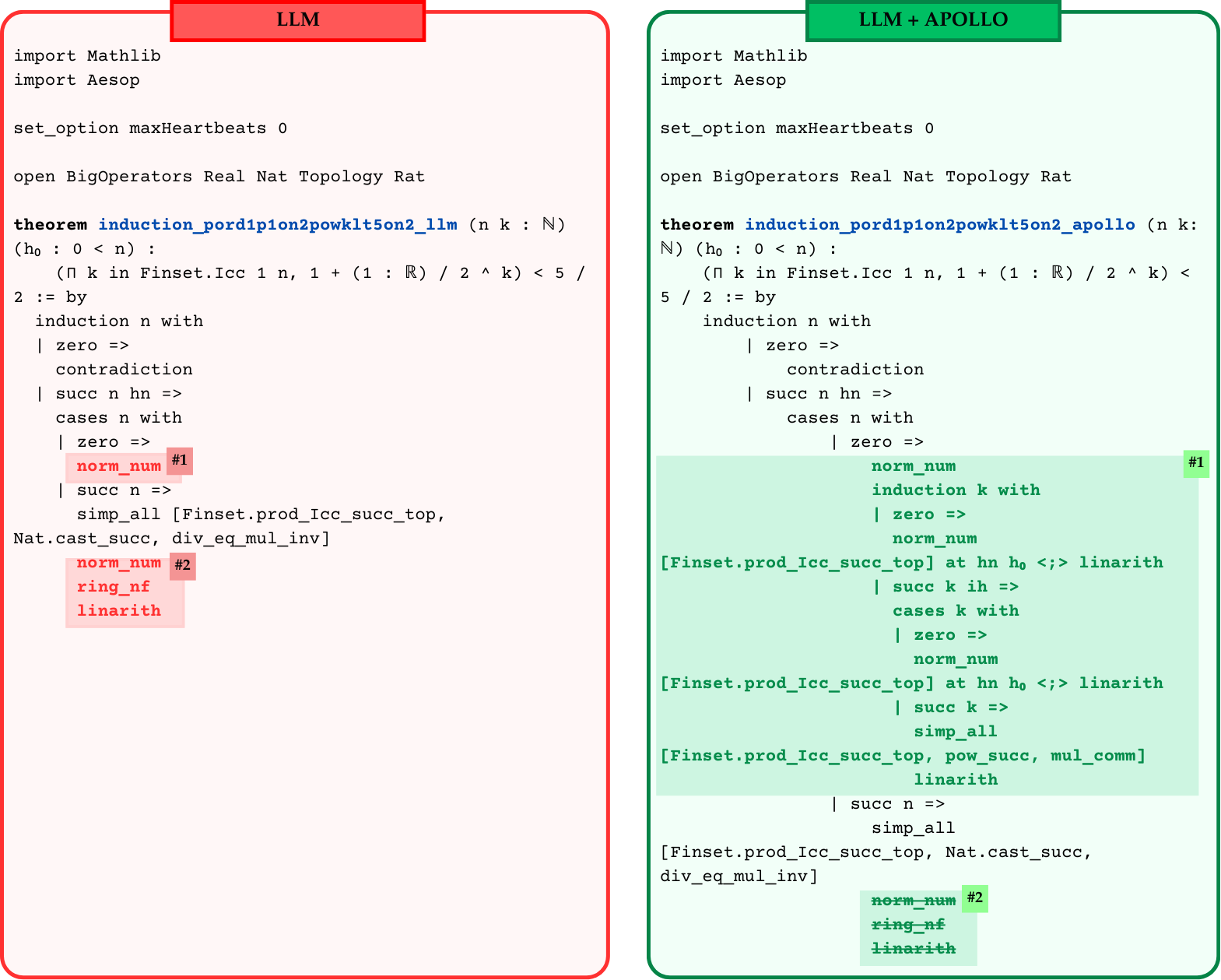
The image presents two code snippets, likely from a formal verification or theorem proving environment (Lean 4). The snippets appear to define a theorem named `induction_pordipion2powklt5on2_llm` and `induction_pordipion2powklt5on2_apollo` respectively. The code uses mathematical notation and logical operators. The snippets are visually similar, but the right-hand side (labeled "LLM + APOLLO") contains additional lines of code compared to the left-hand side ("LLM").
### Components/Axes
There are no axes or traditional chart components. The image consists of two blocks of text representing code. Each block has a header indicating "LLM" or "LLM + APOLLO". The code is structured with indentation to represent the logical hierarchy.
### Detailed Analysis or Content Details
**Left Snippet (LLM):**
```
import Mathlib
import Aesop
set_option maxHeartbeats 0
open BigOperators Real Nat Topology Rat
theorem induction_pordipion2powklt5on2_llm (n : N)
(h₀ : 0 < n) :
(∀ k in Finset.Icc 1, n + (1 : ℛ) ^ 2 ^ k) < 5 /
2 := by
induction n with
| zero =>
contradiction
| succ n hh =>
cases n with
| zero =>
norm_num #1
| succ n =>
simp all [Finset.prod_Icc succ top, Nat.cast_succ, div_eq_mul_inv]
norm_num #2
ring_nf
linarith
```
* **Imports:** `Mathlib`, `Aesop`
* **Option:** `set_option maxHeartbeats 0`
* **Open Namespace:** `BigOperators Real Nat Topology Rat`
* **Theorem Name:** `induction_pordipion2powklt5on2_llm`
* **Input:** `n : N` (n is a natural number), `h₀ : 0 < n` (n is greater than 0)
* **Statement:** `(∀ k in Finset.Icc 1, n + (1 : ℛ) ^ 2 ^ k) < 5 / 2` (For all k in the closed interval from 1 to n, n plus 1 raised to the power of 2 to the power of k is less than 5/2)
* **Proof:** `by induction n with ...` (Proof by induction on n)
* **Base Case:** `zero => contradiction` (If n is zero, a contradiction arises)
* **Inductive Step:** `succ n hh => cases n with ...` (If n is a successor, consider two cases)
* **Case 1:** `zero => norm_num #1` (If n is zero, apply `norm_num #1`)
* **Case 2:** `succ n => simp all [Finset.prod_Icc succ top, Nat.cast_succ, div_eq_mul_inv] norm_num #2 ring_nf linarith` (If n is a successor, apply simplification rules, `norm_num #2`, ring normalization, and linear arithmetic)
**Right Snippet (LLM + APOLLO):**
```
import Mathlib
import Aesop
set_option maxHeartbeats 0
open BigOperators Real Nat Topology Rat
theorem induction_pordipion2powklt5on2_apollo (n : N)
(h₀ : 0 < n) :
(∀ k in Finset.Icc 1, n + (1 : ℛ) ^ 2 ^ k) < 5 /
2 := by
induction n with
| zero =>
contradiction
| succ n hh =>
cases n with
| zero =>
norm_num #1
| succ n =>
induction k with
| zero =>
norm_num
| succ k ih =>
[Finset.prod_Icc succ top] at hn h₀ => linarith
| succ k =>
simp_all
[Finset.prod_Icc succ top, pow_succ, mul_comm]
linarith
| succ n =>
simp_all
[Finset.prod_Icc succ top, Nat.cast_succ, div_eq_mul_inv]
norm_num #2
ring_nf
linarith
```
* The initial lines are identical to the left snippet.
* The key difference is within the `succ n hh` case. Instead of directly applying simplification rules, it introduces an inner `induction k with ...`
* **Inner Base Case:** `zero => norm_num`
* **Inner Inductive Step:** `succ k ih => [Finset.prod_Icc succ top] at hn h₀ => linarith` and `succ k => simp_all [Finset.prod_Icc succ top, pow_succ, mul_comm] linarith`
* The original simplification steps from the left snippet are also present, but nested within the inner inductive step.
### Key Observations
* The "LLM + APOLLO" snippet appears to be a more refined or expanded version of the "LLM" snippet.
* The addition of the inner `induction k with` suggests that APOLLO introduces an additional level of inductive reasoning within the proof.
* The use of `at hn h₀` indicates that the `Finset.prod_Icc succ top` lemma is being applied to hypotheses `hn` and `h₀`.
* The `#1` and `#2` annotations next to `norm_num` likely refer to specific normalization tactics or lemmas.
### Interpretation
The image demonstrates a potential workflow in automated theorem proving. The "LLM" snippet represents an initial attempt at proving the theorem, while "LLM + APOLLO" shows a refined proof strategy. APOLLO seems to enhance the proof by introducing an inner inductive step, potentially breaking down the problem into smaller, more manageable subproblems. This suggests that APOLLO acts as a proof search engine or tactic selector, guiding the LLM towards a more complete and efficient proof. The difference in code length and complexity highlights the added reasoning capability provided by APOLLO. The annotations (`#1`, `#2`) suggest that the system is utilizing specific normalization procedures during the proof process. The overall data suggests a system where an LLM generates a proof, and APOLLO refines it through additional reasoning steps.