## Code Comparison: LLM vs LLM + APOLLO
### Overview
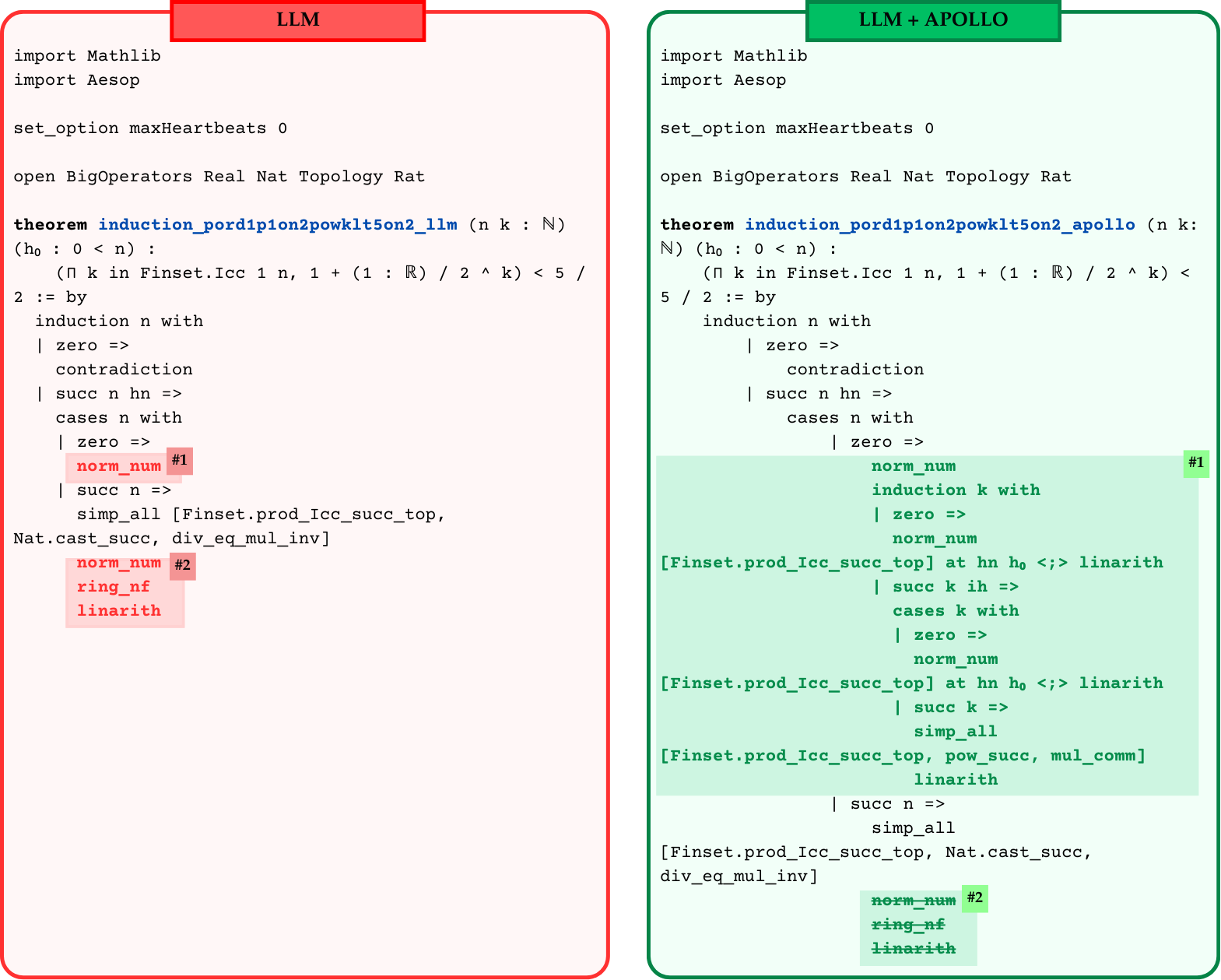
The image shows two side-by-side code snippets implementing a mathematical theorem proof using Lean 4 syntax. The left snippet is labeled "LLM" (red header), and the right is labeled "LLM + APOLLO" (green header). Both implement the same theorem (`induction_pord1p1on2powklt5on2_...`) but differ in proof structure and auxiliary lemmas.
### Components/Axes
- **Headers**:
- Red header: "LLM"
- Green header: "LLM + APOLLO"
- **Imports**:
- Both import `Mathlib` and `Aesop`.
- **Options**:
- `set_option maxHeartbeats 0` (disables interactive mode).
- **Open Statements**:
- `open BigOperators Real Nat Topology Rat` (exposes mathematical libraries).
- **Theorem Declaration**:
- Theorem name: `induction_pord1p1on2powklt5on2_...`
- Parameters: `(n k : ℕ)` (natural numbers `n` and `k`).
- Hypothesis: `(h₀ : 0 < n)` (natural number `n` is positive).
- **Proof Structure**:
- Both use induction on `n` with contradiction.
- Case analysis on `n` (zero vs successor).
- Differences in auxiliary lemmas and proof tactics.
### Detailed Analysis
#### LLM (Left Snippet)
- **Proof Steps**:
1. **Base Case**: `n = 0` → `contradiction` (no explicit handling).
2. **Successor Case**: `n = succ n` →
- Applies `simp_all` with `[Finset.prod_Icc_succ_top, Nat.cast_succ, div_eq_mul_inv]`.
- Uses `norm_num` (automated normalization) and `ring_nf` (ring normalization).
- Final step: `linarith` (linear arithmetic).
- **Key Lemmas**:
- `Finset.prod_Icc_succ_top` (product over intervals).
- `Nat.cast_succ` (natural number successor casting).
- `div_eq_mul_inv` (division equivalence).
#### LLM + APOLLO (Right Snippet)
- **Proof Steps**:
1. **Base Case**: `n = 0` → `contradiction`.
2. **Successor Case**: `n = succ n` →
- Applies `simp_all` with `[Finset.prod_Icc_succ_top, pow_succ, mul_comm]`.
- Uses `norm_num` and `ring_nf`.
- Final step: `linarith`.
- **Additional Tactics**:
- Explicit induction on `k` with `induction k with | zero => norm_num`.
- Uses `Finset.prod_Icc_succ_top` at `hn h₀` (hypothesis context).
- Applies `mul_comm` (commutativity of multiplication).
### Key Observations
1. **Theorem Parameters**:
- Both use `(n k : ℕ)`, but the Apollo version adds a closing parenthesis (`n k: ℕ)`).
2. **Proof Differences**:
- Apollo version introduces induction on `k` and uses `pow_succ`/`mul_comm` instead of `Nat.cast_succ`/`div_eq_mul_inv`.
- Apollo proof includes explicit handling of `k` in the successor case.
3. **Lemma Usage**:
- LLM relies on `div_eq_mul_inv`; Apollo uses `mul_comm`.
- Apollo adds `ring_nf` in both snippets but with different contexts.
### Interpretation
The APOLLO extension appears to optimize the proof by:
1. **Modularizing Induction**: Inducting on both `n` and `k` (vs. only `n` in LLM).
2. **Simplifying Arithmetic**: Using `pow_succ` (power successor) and `mul_comm` to reduce case complexity.
3. **Contextual Simplification**: Applying lemmas like `Finset.prod_Icc_succ_top` at specific hypothesis contexts (`hn h₀`).
The APOLLO version likely improves proof efficiency by breaking down the problem into smaller, reusable components (e.g., induction on `k`), whereas the LLM version handles everything in a single inductive step. The use of `ring_nf` and `linarith` in both suggests reliance on Lean’s automated ring and linear arithmetic solvers.
**Note**: The code uses Lean 4’s type theory syntax (e.g., `ℕ` for natural numbers, `succ` for successor). No non-English text is present.