## Chart/Diagram Type: Spatial Reasoning Problems
### Overview
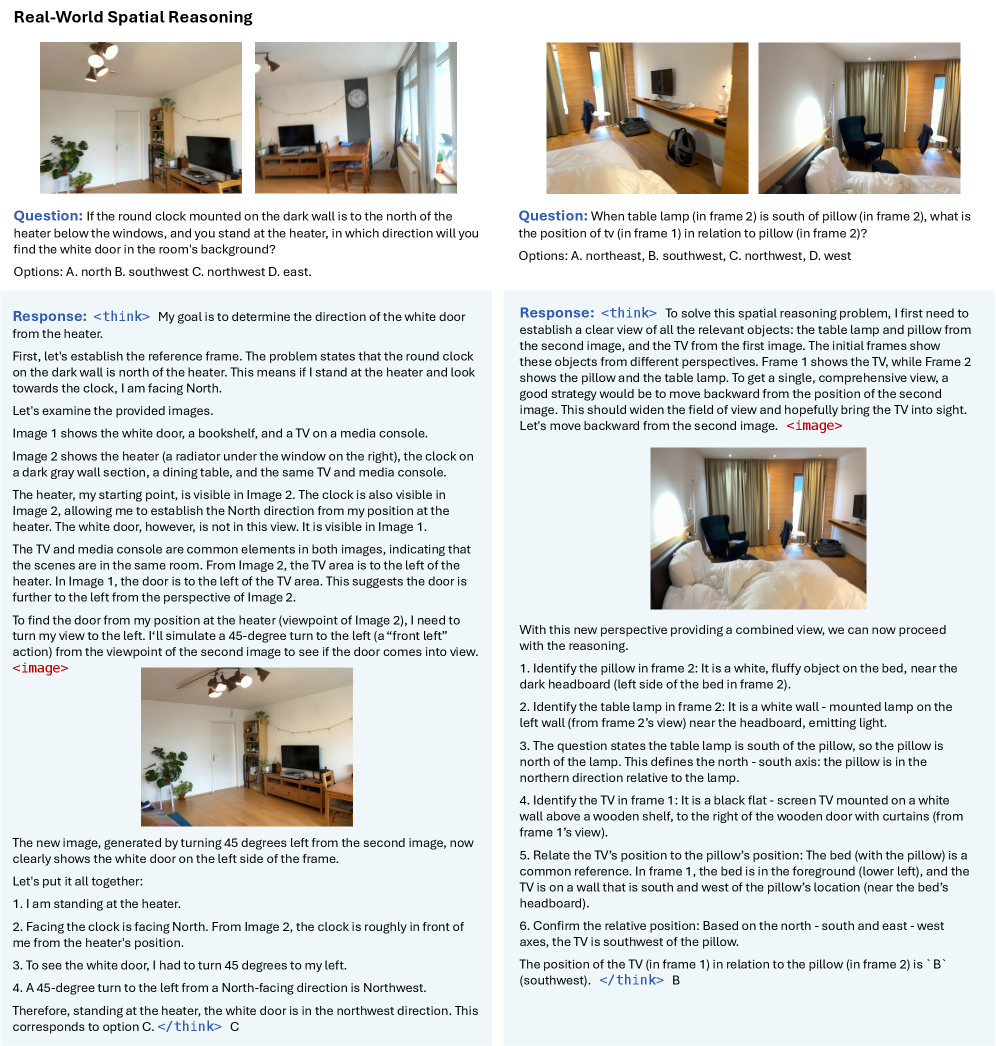
The image presents two spatial reasoning problems, each with a question, multiple-choice options, and a detailed response explaining the solution. Each problem involves visualizing objects in a room from different perspectives and determining their relative positions. The image includes textual descriptions and reasoning, along with references to "Image 1" and "Image 2" which are photographs depicting the room from different angles.
### Components/Axes
**Problem 1 (Left Side):**
* **Question:** If the round clock mounted on the dark wall is to the north of the heater below the windows, and you stand at the heater, in which direction will you find the white door in the room's background?
* **Options:** A. north B. southwest C. northwest D. east.
* **Response:** A detailed explanation of the reasoning process, including establishing a reference frame, examining provided images, simulating a 45-degree turn, and concluding that the white door is in the northwest direction.
* **Answer:** C (northwest)
**Problem 2 (Right Side):**
* **Question:** When table lamp (in frame 2) is south of pillow (in frame 2), what is the position of tv (in frame 1) in relation to pillow (in frame 2)?
* **Options:** A. northeast, B. southwest, C. northwest, D. west
* **Response:** A detailed explanation of the reasoning process, including establishing a clear view of relevant objects, relating the TV's position to the pillow's position, and confirming the relative position based on north-south and east-west axes.
* **Answer:** B (southwest)
### Detailed Analysis or Content Details
**Problem 1 Analysis:**
1. **Reference Frame:** The clock is north of the heater.
2. **Image 1:** Shows the white door, a bookshelf, and a TV on a media console.
3. **Image 2:** Shows the heater, the clock, and the same TV and media console.
4. **Spatial Reasoning:** The solver simulates a 45-degree turn to the left from the heater's position to locate the white door.
5. **Conclusion:** The white door is in the northwest direction.
**Problem 2 Analysis:**
1. **Object Identification:** Pillow and table lamp in Frame 2, TV in Frame 1.
2. **Spatial Relationship:** The table lamp is south of the pillow.
3. **TV Position:** The TV is on a wall that is south and west of the pillow's location.
4. **Conclusion:** The TV is southwest of the pillow.
### Key Observations
* Both problems involve spatial reasoning and require the solver to visualize objects from different perspectives.
* The responses provide step-by-step explanations of the reasoning process.
* The problems rely on the relative positions of objects within a room.
### Interpretation
The image demonstrates how spatial reasoning can be used to solve problems involving the relative positions of objects. The problems highlight the importance of establishing a reference frame, visualizing objects from different perspectives, and using logical deduction to arrive at a solution. The detailed explanations provided in the responses offer insights into the cognitive processes involved in spatial reasoning. The use of images (though not directly present in the provided text) is crucial for visualizing the scene and understanding the spatial relationships between the objects.