TECHNICAL ASSET FINGERPRINT
a2c895e9ddb0442b44e1caba
Click to view fullscreen
Press ESC or click to close
FOUND IN PAPERS
EXPERT: healer-alpha-free VERSION 1
RUNTIME: free/openrouter/healer-alpha
INTEL_VERIFIED
## Diagram: Real-World Spatial Reasoning Problems
### Overview
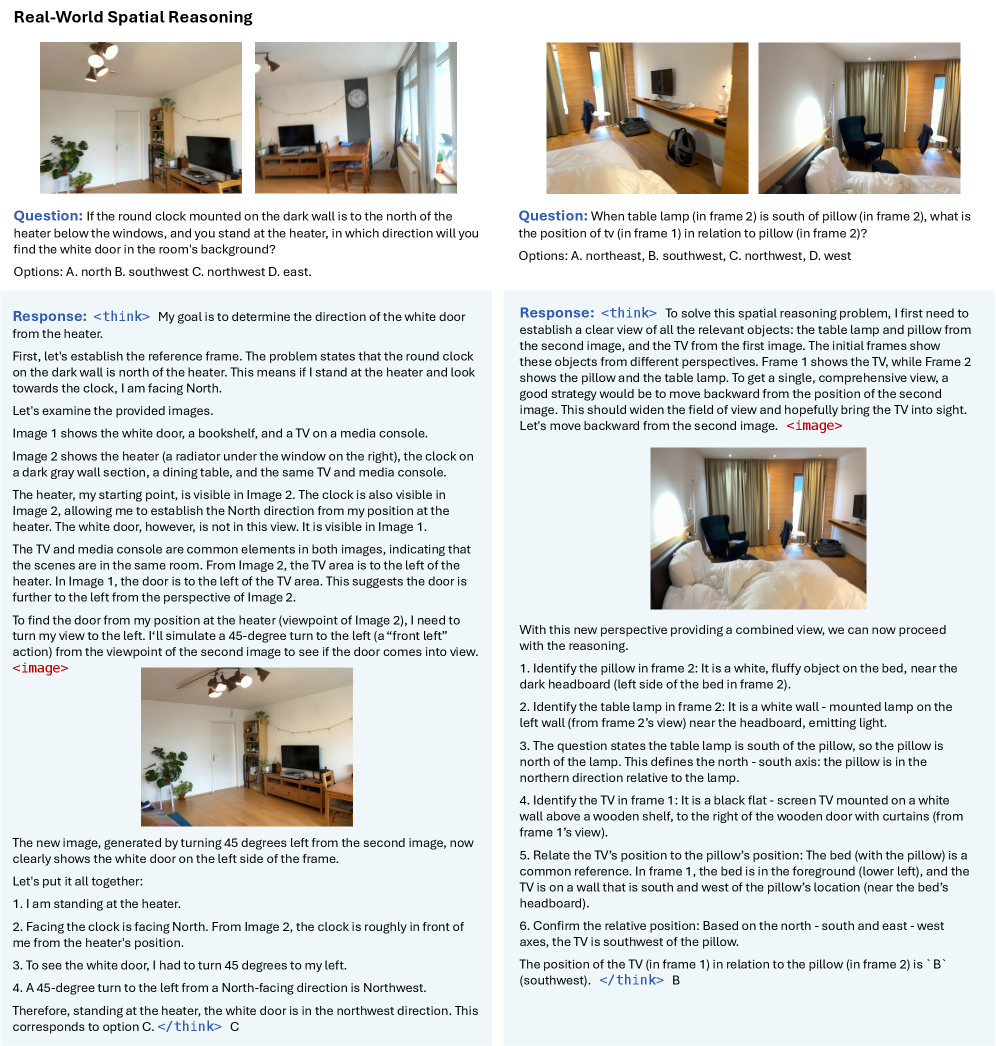
The image is a composite document presenting two distinct spatial reasoning problems. Each problem includes a question, multiple-choice options, and a detailed, step-by-step "think-aloud" response that solves the problem by analyzing provided photographs. The document is structured in two columns, with the left column dedicated to the first problem and the right column to the second.
### Components/Axes
The document is divided into two primary sections:
**Left Column (Problem 1):**
* **Title:** "Real-World Spatial Reasoning" (Top-left, main heading).
* **Images:** Two photographs are referenced.
* Image 1: Shows a white door, a bookshelf, and a TV on a media console.
* Image 2: Shows a heater (radiator under a window), a round clock on a dark gray wall, a dining table, and the same TV/media console.
* **Question Text:** "Question: If the round clock mounted on the dark wall is to the north of the heater below the windows, and you stand at the heater, in which direction will you find the white door in the room's background?"
* **Options:** "Options: A. north B. southwest C. northwest D. east."
* **Response Section:** Labeled "Response:" and contains a detailed reasoning process enclosed in `` tags. It includes an embedded image placeholder `<image>`.
**Right Column (Problem 2):**
* **Images:** Three photographs are referenced.
* Frame 1: Shows a TV mounted on a white wall above a wooden shelf, to the right of a wooden door with curtains.
* Frame 2: Shows a bed with a white, fluffy pillow on the left side near a dark headboard, and a white wall-mounted lamp on the left wall near the headboard.
* Combined View Image: A third, wider-angle photograph generated to show both the bed/pillow area and the TV wall in a single perspective.
* **Question Text:** "Question: When table lamp (in frame 2) is south of pillow (in frame 2), what is the position of tv (in frame 1) in relation to pillow (in frame 2)?"
* **Options:** "Options: A. northeast, B. southwest, C. northwest, D. west"
* **Response Section:** Labeled "Response:" and contains a detailed reasoning process enclosed in `` tags. It includes an embedded image placeholder `<image>`.
### Detailed Analysis
**Problem 1 (Left Column) - Reasoning Transcript:**
The response establishes a reference frame: the clock is north of the heater. Standing at the heater and facing the clock means facing North.
* **Image Analysis:** Image 2 shows the heater and clock, establishing the North direction. The TV is to the left of the heater in this view. Image 1 shows the white door is to the left of the TV area.
* **Spatial Deduction:** From the heater's perspective (Image 2), the door is further left than the TV. To see the door, a 45-degree left turn from the North-facing position is simulated.
* **Conclusion:** A 45-degree left turn from North is Northwest. Therefore, the white door is in the northwest direction.
* **Final Answer:** "This corresponds to option C."
**Problem 2 (Right Column) - Reasoning Transcript:**
The response aims to create a unified spatial model from two different camera perspectives.
* **Object Identification:**
1. Pillow (Frame 2): White, fluffy object on the bed near the dark headboard (left side of bed in frame 2's view).
2. Table Lamp (Frame 2): White wall-mounted lamp on the left wall near the headboard.
3. TV (Frame 1): Black flat-screen TV on a white wall above a wooden shelf, to the right of a wooden door with curtains.
* **Establishing Axes:** The problem states the lamp is south of the pillow. This defines a north-south axis: the pillow is north relative to the lamp.
* **Spatial Integration:** A combined view image is generated to see both objects. In this new perspective, the bed (with pillow) is in the foreground (lower left), and the TV is on a wall that is south and west of the pillow's location.
* **Conclusion:** Based on the established north-south and east-west axes, the TV is southwest of the pillow.
* **Final Answer:** "The position of the tv (in frame 1) in relation to the pillow (in frame 2) is `B` (southwest)."
### Key Observations
1. **Methodology:** Both problems employ a consistent, analytical methodology: establish a reference frame/direction from given information, identify common landmarks across images, mentally simulate movement or perspective shifts, and deduce relative positions.
2. **Visual Aids:** The solutions rely heavily on visual cross-referencing between photographs. The second problem explicitly generates a new, synthesized image to resolve the spatial ambiguity between two separate frames.
3. **Language:** The entire document is in English. The reasoning is technical and procedural, using precise spatial language (north, south, left, turn 45 degrees).
4. **Structure:** The layout is clean and pedagogical, presenting the problem, the tools (images), and a model solution that exposes the cognitive process.
### Interpretation
This document serves as an educational or demonstrative piece on solving complex spatial reasoning tasks using real-world visual data. It doesn't present empirical data or trends but rather illustrates a **problem-solving algorithm**.
* **What it Demonstrates:** The core principle is that spatial relationships can be deduced by constructing a mental or descriptive 3D model from multiple 2D viewpoints. Key steps include: 1) Anchoring to a given directional fact (e.g., "clock is north of heater," "lamp is south of pillow"), 2) Identifying shared reference objects between views (the TV in Problem 1, the bed/pillow in Problem 2), and 3) Performing mental transformations (rotation, perspective shift) to integrate the information.
* **Underlying Logic:** The solutions highlight the importance of **frame of reference**. All directions are relative to a chosen point and orientation. The problems test the ability to maintain and manipulate this frame during perspective changes.
* **Notable Technique:** The use of a generated "combined view" image in Problem 2 is a significant strategy. It shows that when direct visual correlation is difficult, creating an intermediate, integrated representation can simplify the reasoning process. This mimics a cognitive strategy of "zooming out" or finding a vantage point that reveals all relevant relationships at once.
* **Purpose:** The document likely aims to teach or benchmark AI systems (or humans) on embodied spatial reasoning—the ability to understand and navigate environments based on visual and descriptive cues, a fundamental aspect of intelligence for navigation and interaction.
DECODING INTELLIGENCE...