## Photograph: Educational Play Setup
### Overview
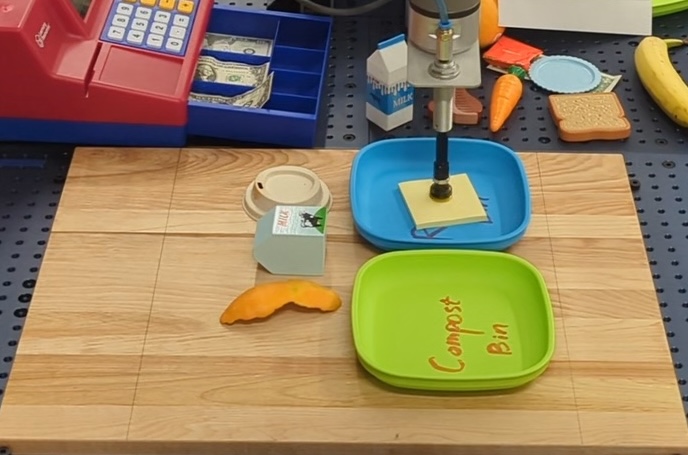
The image displays a tabletop arrangement of various toy and household objects, likely set up for a child's educational play scenario or a demonstration. The scene is captured from a slightly elevated, angled perspective looking down onto a light-colored wooden surface placed on a dark, perforated workbench or table.
### Components & Spatial Layout
The scene can be segmented into distinct regions:
**1. Background/Perimeter (Top & Sides):**
* **Top-Left:** A red and blue toy cash register. It features a numeric keypad with white buttons, a small display screen, and a blue drawer containing several folded pieces of play money (green, resembling dollar bills).
* **Top-Center:** A small, white cardboard carton labeled "MILK" in blue text, with a blue cow illustration. Next to it is a small, brown, rectangular object (possibly a toy brick or block).
* **Top-Right:** A collection of play food items on the dark surface: an orange carrot with a green top, a slice of brown bread, a yellow banana, and a light blue plate. A red rectangular object (possibly a toy wallet or case) is also present.
* **Top-Center (Elevated):** A metallic stand or tool (possibly a small drill press or clamp) is positioned above the main wooden board, holding a yellow sticky note pad in a blue tray.
**2. Main Wooden Board (Center & Foreground):**
* **Center-Right:** A shallow, square, blue plastic tray. Inside it rests a pad of yellow sticky notes and a black pen or stylus held by the metallic stand above.
* **Bottom-Right:** A bright green, square plastic container with rounded corners. The words **"Compost Bin"** are written on its side in a casual, orange, handwritten-style font.
* **Center-Left:** A gray, rectangular object with a small, circular, beige component on top (resembling a toy coffee grinder or a small appliance). It has a green and white label, but the text is not fully legible.
* **Bottom-Left:** An orange, crescent-shaped object, likely a toy slice of cheese or a similar play food item.
**3. Surface:**
* The primary surface is a light wood-grain board, possibly a cutting board or a section of a table.
* This board sits on a dark gray or black workbench surface with a grid of small, regular holes.
### Detailed Analysis
* **Text Extraction:**
* **"Compost Bin"**: Clearly visible on the side of the green container in the foreground.
* **"MILK"**: Printed on the white carton in the background.
* **Cash Register Buttons**: The keypad shows numbers and symbols, but specific values are indistinct due to resolution and angle.
* **Gray Object Label**: Contains a green graphic and text, but the words cannot be transcribed with certainty.
* **Object Identification:** The items are predominantly toys or props: play food (carrot, bread, banana, cheese), a toy cash register with play money, a toy appliance, and labeled containers ("MILK", "Compost Bin").
* **Spatial Relationships:** The setup suggests a flow or process. The cash register and money imply a "store" or "market." The "MILK" carton and play food are "products." The "Compost Bin" is positioned as a receptacle, possibly for waste from the food items. The blue tray with notepad and pen could represent a station for lists or notes.
### Key Observations
1. **Thematic Grouping:** Objects are loosely grouped by function: financial (cash register, money), consumables (milk, food), and waste management (compost bin).
2. **Color Coding:** Containers are color-coded: blue for the note-taking tray, green for the compost bin, red for the cash register.
3. **Staged Arrangement:** The items are neatly placed, not randomly scattered, indicating intentional setup for a specific purpose, such as a learning activity.
4. **Mixed Realism:** The setup combines realistic elements (the wooden board, the metallic stand) with clearly toy-like objects (the plastic food, the bright cash register).
### Interpretation
This image depicts a **pretend play or educational model** designed to teach concepts related to a **market, grocery store, or food cycle**. The presence of a "Compost Bin" alongside food items and a cash register suggests a lesson that integrates **commerce with environmental awareness**, possibly illustrating where food waste goes after a purchase or meal.
The setup is **investigative in a Peircean sense**:
* **Iconic:** The toys directly represent their real-world counterparts (a carrot looks like a carrot).
* **Indexical:** The arrangement points to a process—food is acquired (cash register), consumed (implied), and its waste is disposed of in a specific bin (compost).
* **Symbolic:** The labeled "Compost Bin" introduces the abstract concept of organic waste recycling into the concrete play scenario.
The **notable anomaly** is the metallic stand holding the notepad, which seems more like a piece of lab or workshop equipment than a typical play item. This might indicate the setup is part of a structured experiment, observation, or a more technical educational demonstration about systems or workflows, rather than purely imaginative play. The entire scene serves as a **tangible metaphor for a sustainable food system**, simplified for understanding.