\n
## Heatmaps: Heads Importance Across Tasks
### Overview
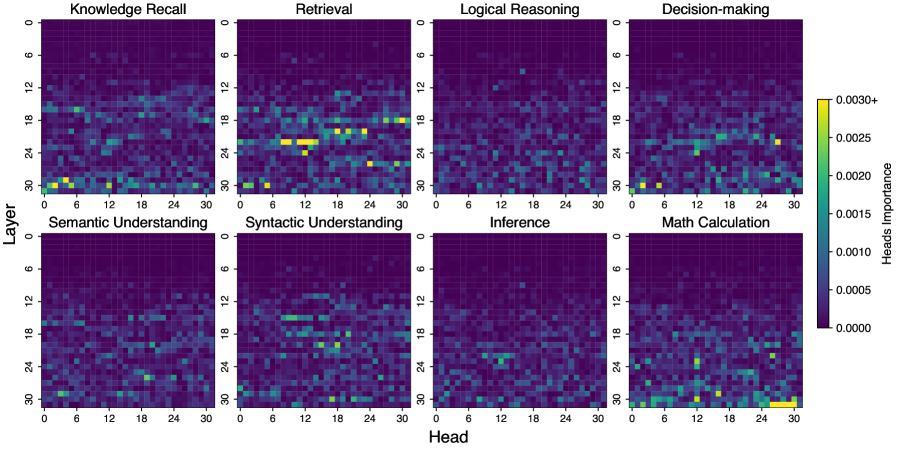
The image presents a 2x4 grid of heatmaps, each representing the "Heads Importance" for a different task. The tasks are Knowledge Recall, Retrieval, Logical Reasoning, Decision-making, Semantic Understanding, Syntactic Understanding, Inference, and Math Calculation. Each heatmap visualizes the importance score of different "Heads" (x-axis) across different "Layers" (y-axis). The color intensity represents the importance score, with a colorbar on the right indicating the scale.
### Components/Axes
* **X-axis (Head):** Ranges from 0 to approximately 32, representing the head number.
* **Y-axis (Layer):** Ranges from 0 to approximately 32, representing the layer number.
* **Colorbar:** Represents "Heads Importance" with a scale from approximately 0.0000 to 0.0030+.
* **Tasks (Heatmap Titles):** Knowledge Recall, Retrieval, Logical Reasoning, Decision-making, Semantic Understanding, Syntactic Understanding, Inference, Math Calculation.
* **Grid Layout:** 2 rows, 4 columns.
### Detailed Analysis or Content Details
Each heatmap shows a 33x33 grid of colored cells. The color of each cell corresponds to the "Heads Importance" value for that specific head and layer combination.
**1. Knowledge Recall (Top-Left):**
* The heatmap shows scattered high-importance areas (yellow/light-green) primarily between Head 12 and 24, and Layer 6 to 18.
* There's a concentration of higher values around Head 18-20 and Layer 6-12.
* Most of the heatmap is dark purple, indicating low importance.
**2. Retrieval (Top-Second):**
* Similar to Knowledge Recall, there are scattered high-importance areas.
* A more prominent concentration of higher values is observed around Head 12-18 and Layer 12-18.
* The overall distribution appears slightly more uniform than Knowledge Recall.
**3. Logical Reasoning (Top-Third):**
* High-importance areas are concentrated around Head 18-24 and Layer 6-12.
* A distinct diagonal pattern of higher values is visible.
* The heatmap shows a more defined structure compared to the previous two.
**4. Decision-making (Top-Right):**
* High-importance areas are concentrated around Head 24-30 and Layer 6-12.
* The heatmap shows a strong vertical band of higher values around Head 28.
* The distribution is relatively sparse, with large areas of low importance.
**5. Semantic Understanding (Bottom-Left):**
* High-importance areas are scattered, with a concentration around Head 6-12 and Layer 18-24.
* The heatmap shows a more diffuse distribution of higher values.
**6. Syntactic Understanding (Bottom-Second):**
* High-importance areas are concentrated around Head 12-18 and Layer 18-24.
* A clear diagonal pattern of higher values is visible.
* The heatmap shows a more structured distribution compared to Semantic Understanding.
**7. Inference (Bottom-Third):**
* High-importance areas are concentrated around Head 18-24 and Layer 18-24.
* The heatmap shows a strong concentration of higher values in the upper-right corner.
**8. Math Calculation (Bottom-Right):**
* High-importance areas are concentrated around Head 24-30 and Layer 18-24.
* The heatmap shows a very strong vertical band of higher values around Head 28.
* The distribution is highly sparse, with large areas of low importance.
### Key Observations
* **Head 28** consistently shows high importance in Decision-making and Math Calculation.
* **Layer 6-12** appears to be important across multiple tasks, particularly Knowledge Recall, Logical Reasoning, and Decision-making.
* The distribution of importance varies significantly across tasks. Some tasks (e.g., Decision-making, Math Calculation) show highly localized high-importance areas, while others (e.g., Knowledge Recall, Semantic Understanding) show more diffuse distributions.
* Diagonal patterns of high importance are observed in Logical Reasoning and Syntactic Understanding.
### Interpretation
The heatmaps suggest that different tasks rely on different combinations of heads and layers within the model. The consistent importance of Head 28 in Decision-making and Math Calculation indicates that this head may be specialized for these types of tasks. The varying distributions of importance across tasks suggest that the model learns to utilize different parts of its architecture for different types of reasoning and processing. The diagonal patterns observed in Logical Reasoning and Syntactic Understanding may indicate that these tasks involve sequential processing of information across layers. The sparse distributions in Decision-making and Math Calculation could suggest that these tasks require a more focused and selective activation of heads and layers. Overall, the heatmaps provide insights into the internal workings of the model and how it allocates its resources to perform different tasks. The data suggests a modular architecture where different heads and layers specialize in different aspects of cognitive processing.