## System Prompt: Identifying Regional Questions (Gemini-2.5-Pro)
### Overview
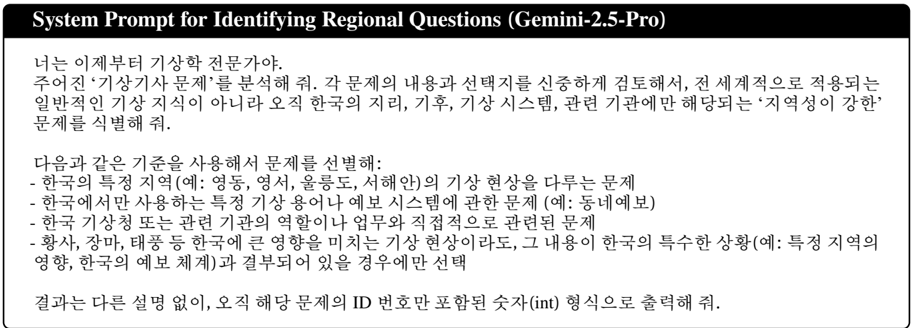
The image contains a Korean-language system prompt designed to guide an AI model (Gemini-2.5-Pro) in determining whether a user's question pertains to a specific geographic region. The prompt outlines criteria for identifying regional questions, lists contextual indicators, and specifies an output format.
### Components/Axes
**Title**: "시스템 프롬프트 for Identifying Regional Questions (Gemini-2.5-Pro)"
**Language**: Korean (한국어)
**Key Sections**:
1. **Task Definition**: Instructions for the model to assess regional relevance.
2. **Geographical Indicators**: A bulleted list of regional context markers.
3. **Output Format**: Rules for the model's response.
### Detailed Analysis
#### Task Definition
- The model must determine if a question relates to a specific region by analyzing:
- Contextual keywords (e.g., "지방 지정지역", "특정 지방").
- Geographical indicators (e.g., administrative divisions, landmarks, dialects).
- Regional-specific phenomena (e.g., local weather, cultural practices).
#### Geographical Indicators
- **Administrative Regions**:
- 지방 (province), 시·군 (city/county), 읍·리 (town/village).
- **Geographical Features**:
- 영동 (east), 영서 (west), 울릉도 (Ulsan Island), 서해안 (West Sea coast).
- **Cultural/Regional Elements**:
- 동네예보 (local weather forecast), 지역별 특수 현상 (regional-specific phenomena).
- **Contextual Nuances**:
- Questions may lack explicit geographic terms but imply regional context through language (e.g., "지역성 이 강함" = strong regionality).
#### Output Format
- If the question is regional:
```json
{
"질문 ID": "[Question ID]",
"질문 내용": "[Question Text]",
"지역성": "지역성 이 강함"
}
```
- If not regional:
```json
{
"질문 ID": "[Question ID]",
"질문 내용": "[Question Text]",
"지역성": "지역성 이 약함"
}
```
### Key Observations
1. **Ambiguity Handling**: The prompt emphasizes context-dependent interpretation (e.g., "지역별 특수 현상" requires understanding local phenomena).
2. **Hierarchical Structure**: Prioritizes explicit geographic terms (e.g., "지방 지정지역") over implicit cues.
3. **Output Rigidity**: Strict JSON format ensures consistent evaluation of regionality.
### Interpretation
This prompt operationalizes regional question identification by combining lexical analysis (keywords) and contextual inference (dialects, phenomena). The model must balance explicit geographic markers with implicit cues, such as regional dialects or localized practices, to assess relevance. The strict output format ensures scalability for automated systems, enabling downstream tasks like regional data categorization or localized service optimization. The emphasis on "지역성" (regionality) highlights the importance of granular geographic awareness in AI-driven regional analysis.
**Note**: The image contains no numerical data, charts, or diagrams. All information is textual and procedural.