## Diagram Type: Flowchart
### Overview
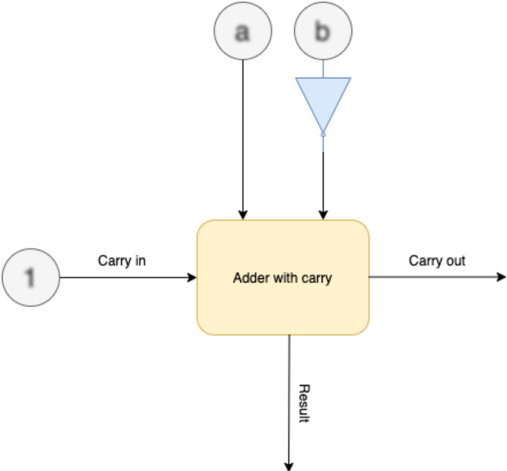
The image depicts a flowchart illustrating the process of addition with carry. It shows the input of two numbers, 'a' and 'b', which are added together by an "Adder with carry" block. The result of the addition is then carried out, and the final result is displayed.
### Components/Axes
- **Input**: Two circles labeled 'a' and 'b' represent the input numbers.
- **Adder with carry**: A rectangular block labeled "Adder with carry" performs the addition.
- **Carry in**: An arrow pointing from the input circles to the adder block indicates the input of the numbers.
- **Carry out**: An arrow pointing from the adder block to the right side of the image indicates the output of the carry.
- **Result**: An arrow pointing from the adder block to the bottom of the image indicates the final result of the addition.
### Detailed Analysis or ### Content Details
- The flowchart shows a simple addition process with carry.
- The input numbers 'a' and 'b' are added together by the "Adder with carry" block.
- The carry from the addition is then carried out, which is indicated by the arrow pointing to the right.
- The final result of the addition is displayed at the bottom of the image.
### Key Observations
- The flowchart is straightforward and easy to understand.
- It clearly shows the process of addition with carry.
- The use of arrows indicates the direction of the flow of data.
### Interpretation
The flowchart demonstrates the process of addition with carry, which is a fundamental concept in arithmetic. The addition of two numbers 'a' and 'b' is performed by the "Adder with carry" block, and the carry from the addition is then carried out. The final result of the addition is displayed at the bottom of the image. This flowchart is useful for understanding the process of addition with carry and can be used as a reference for implementing this process in programming or other applications.