\n
## Bar Chart: Overall Accuracy Comparison
### Overview
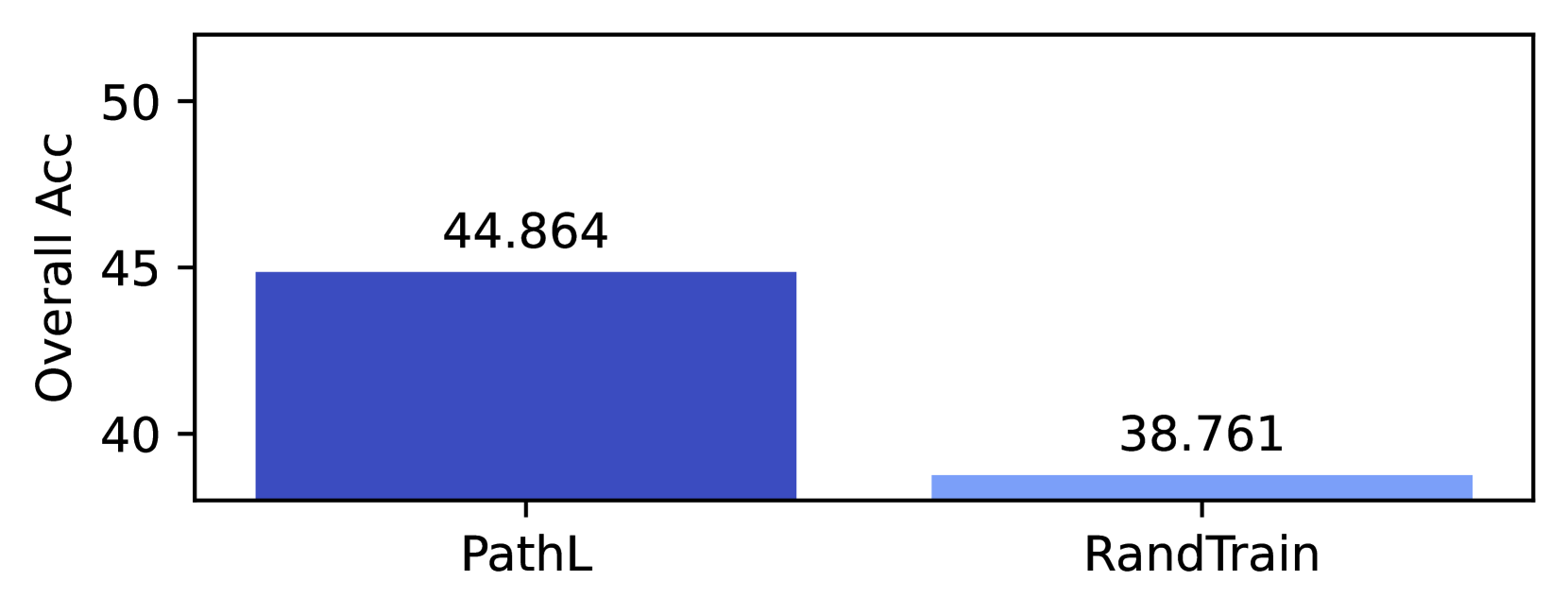
This image presents a bar chart comparing the "Overall Acc" (Overall Accuracy) between two methods: "PathL" and "RandTrain". The chart visually represents the accuracy scores for each method using bar heights.
### Components/Axes
* **X-axis:** Represents the methods being compared: "PathL" and "RandTrain".
* **Y-axis:** Labeled "Overall Acc", representing the overall accuracy score. The scale ranges from approximately 35 to 55, with markings at 40 and 50.
* **Bars:** Two bars, one for each method, indicating the accuracy score.
* "PathL" bar is filled with a dark blue color.
* "RandTrain" bar is filled with a light blue color.
* **Data Labels:** Numerical values are displayed above each bar, representing the accuracy score.
### Detailed Analysis
* **PathL:** The bar for "PathL" reaches a height corresponding to approximately 44.864 on the "Overall Acc" scale. The bar is positioned on the left side of the chart.
* **RandTrain:** The bar for "RandTrain" reaches a height corresponding to approximately 38.761 on the "Overall Acc" scale. The bar is positioned on the right side of the chart.
* **Trend:** The "PathL" bar is significantly taller than the "RandTrain" bar, indicating a higher accuracy score for "PathL".
### Key Observations
* "PathL" demonstrates a higher overall accuracy compared to "RandTrain".
* The difference in accuracy between the two methods is approximately 6.103 (44.864 - 38.761).
### Interpretation
The data suggests that the "PathL" method achieves a better overall accuracy than the "RandTrain" method. This could indicate that "PathL" is a more effective approach for the task being evaluated. The difference in accuracy is substantial enough to suggest a meaningful performance advantage for "PathL". Further investigation might be needed to understand *why* "PathL" performs better – for example, examining the specific characteristics of the data or the algorithms used in each method. The chart provides a clear, quantitative comparison of the two methods, allowing for a straightforward assessment of their relative performance.