## Diagram: Technical Architecture of a Sparse Attention Mechanism
### Overview
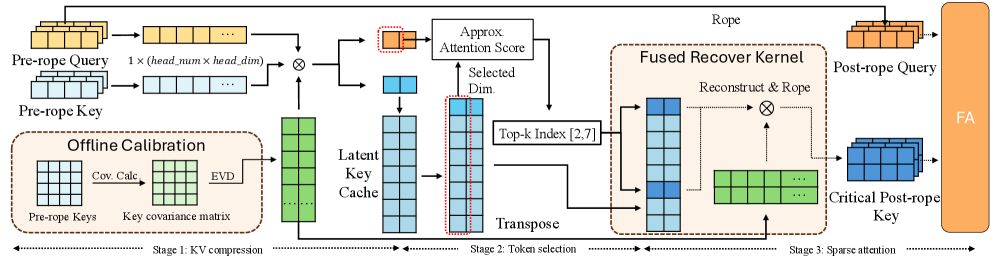
The diagram illustrates a multi-stage technical architecture for optimizing attention mechanisms, likely in a transformer-based model. It emphasizes key-value (KV) compression, token selection, and sparse attention operations. The process flows from left to right, with distinct stages and color-coded components.
### Components/Axes
- **Color Coding**:
- **Orange**: Pre-rope Query, Post-rope Query, Approx Attention Score, Fused Recover Kernel
- **Blue**: Pre-rope Key, Latent Key Cache, Critical Post-rope Key
- **Green**: Key covariance matrix, EVD, Reconstruct & Rope
- **Red**: Approx Attention Score (highlighted)
- **Key Elements**:
- **Inputs**: Pre-rope Query (1×(head_num×head_dim)), Pre-rope Key
- **Stage 1 (KV Compression)**:
- Offline Calibration (processes Pre-rope Keys into Key covariance matrix and EVD)
- Latent Key Cache (output of Offline Calibration)
- **Stage 2 (Token Selection)**:
- Approx Attention Score (computes attention scores between Query and Key)
- Top-k Index [2,7] (selects top-k indices for sparse attention)
- Transpose (reorients data for Stage 3)
- **Stage 3 (Sparse Attention)**:
- Fused Recover Kernel (combines Reconstruct & Rope operations)
- Outputs: Post-rope Query, Critical Post-rope Key
- **Final Output**: FA (likely Feature Aggregation or Final Attention)
### Detailed Analysis
1. **Stage 1: KV Compression**
- Pre-rope Keys undergo **Offline Calibration** to compute a **Key covariance matrix** and **EVD** (Eigenvalue Decomposition), stored in the **Latent Key Cache**.
- This stage reduces dimensionality or precomputes statistics for efficiency.
2. **Stage 2: Token Selection**
- The **Approx Attention Score** (orange) computes attention scores between the Query and Key.
- **Top-k Index [2,7]** selects sparse indices (e.g., 2nd and 7th tokens) for further processing.
- Data is **Transposed** to align with Stage 3 requirements.
3. **Stage 3: Sparse Attention**
- The **Fused Recover Kernel** (orange) performs **Reconstruct & Rope** operations on the selected tokens.
- Outputs include the **Post-rope Query** (orange) and **Critical Post-rope Key** (blue), which feed into the final **FA** block.
### Key Observations
- **Color Consistency**: Orange dominates Stage 1 and 3, blue tracks Key-related components, and green represents intermediate matrices.
- **Flow Direction**: Left-to-right progression mirrors typical transformer attention workflows but with added compression/optimization steps.
- **Sparse Attention**: The Top-k Index [2,7] suggests selective token retention, reducing computational load.
### Interpretation
This architecture optimizes attention mechanisms by:
1. **Precomputing Key Statistics** (Stage 1) to accelerate attention score calculations.
2. **Sparsifying Attention** (Stage 2) via Top-k selection, reducing quadratic complexity.
3. **Fusing Operations** (Stage 3) to combine reconstruction and rope operations, minimizing memory overhead.
The **Critical Post-rope Key** (blue) likely retains essential information after sparse processing, ensuring model accuracy despite compression. The **FA** block may aggregate features or finalize attention outputs. This design balances efficiency (via sparsity) and accuracy (via offline calibration), critical for large-scale models.