## Diagram: AI Agent Architecture
### Overview
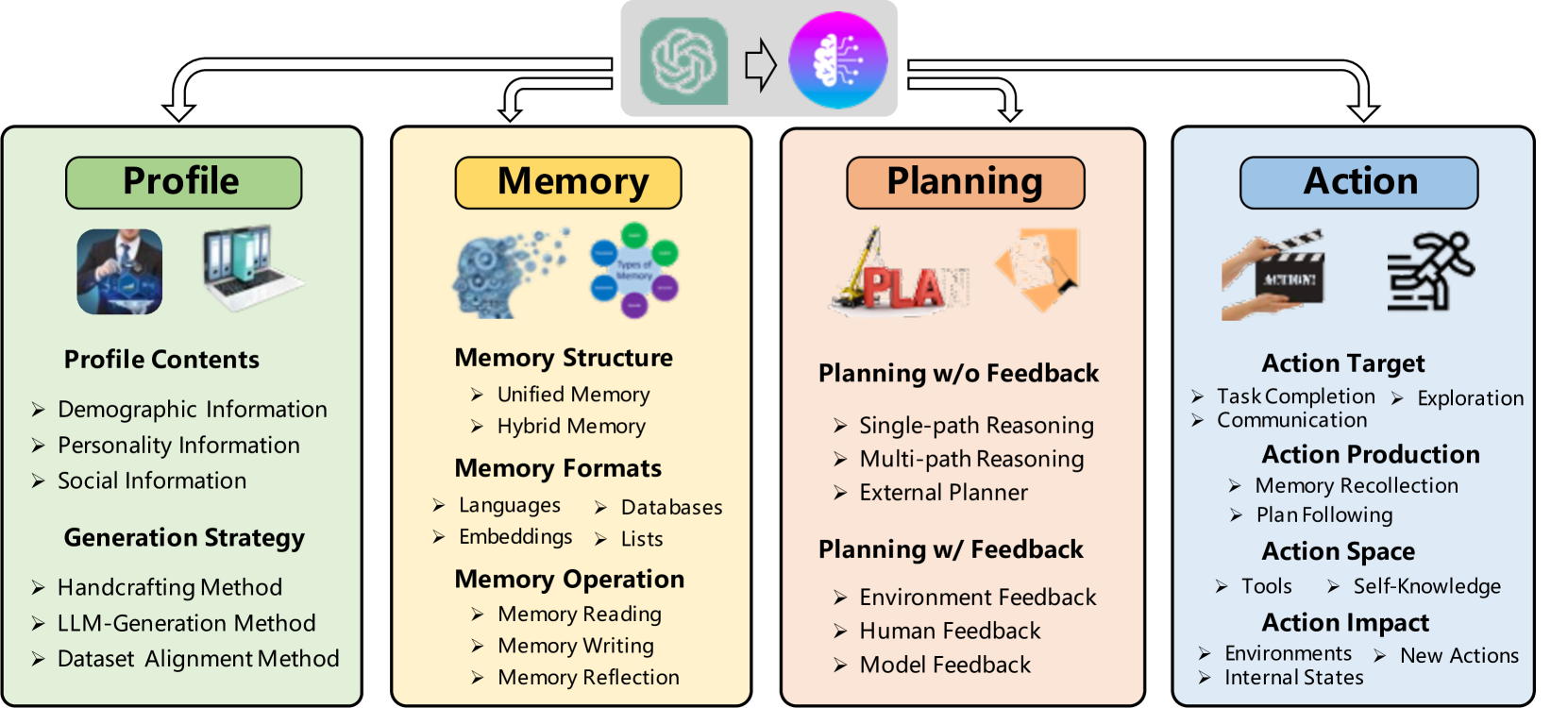
The image presents a diagram illustrating the architecture of an AI agent, breaking down its functionalities into four key components: Profile, Memory, Planning, and Action. The diagram shows the flow of information from an initial state (represented by the OpenAI logo) to a processed state (represented by an AI brain logo). Each component is detailed with sub-categories and specific functionalities.
### Components/Axes
* **Overall Flow:** The diagram shows a left-to-right flow, starting with an OpenAI logo, transitioning to an AI brain logo, and then branching into the four components.
* **Profile (Top-Left):** Green background. Focuses on the agent's identity and background.
* **Profile Contents:** Demographic Information, Personality Information, Social Information.
* **Generation Strategy:** Handcrafting Method, LLM-Generation Method, Dataset Alignment Method.
* **Memory (Top-Middle-Left):** Yellow background. Deals with the agent's storage and retrieval of information.
* **Memory Structure:** Unified Memory, Hybrid Memory.
* **Memory Formats:** Languages, Databases, Embeddings, Lists.
* **Memory Operation:** Memory Reading, Memory Writing, Memory Reflection.
* **Planning (Top-Middle-Right):** Orange background. Involves the agent's decision-making processes.
* **Planning w/o Feedback:** Single-path Reasoning, Multi-path Reasoning, External Planner.
* **Planning w/ Feedback:** Environment Feedback, Human Feedback, Model Feedback.
* **Action (Top-Right):** Blue background. Represents the agent's execution of plans.
* **Action Target:** Task Completion, Exploration, Communication.
* **Action Production:** Memory Recollection, Plan Following.
* **Action Space:** Tools, Self-Knowledge.
* **Action Impact:** Environments, New Actions, Internal States.
### Detailed Analysis
* **Profile:**
* **Profile Contents:** Includes demographic, personality, and social information.
* **Generation Strategy:** Specifies methods for creating the agent's profile, including handcrafting, LLM-generation, and dataset alignment.
* **Memory:**
* **Memory Structure:** Describes how memory is organized (Unified, Hybrid).
* **Memory Formats:** Lists the types of data stored (Languages, Databases, Embeddings, Lists).
* **Memory Operation:** Details the processes of reading, writing, and reflecting on memory.
* **Planning:**
* **Planning w/o Feedback:** Outlines reasoning strategies without external input (Single-path, Multi-path, External Planner).
* **Planning w/ Feedback:** Includes feedback mechanisms from the environment, humans, and models.
* **Action:**
* **Action Target:** Defines the goals of the agent's actions (Task Completion, Exploration, Communication).
* **Action Production:** Specifies how actions are generated (Memory Recollection, Plan Following).
* **Action Space:** Describes the resources available to the agent (Tools, Self-Knowledge).
* **Action Impact:** Details the effects of the agent's actions (Environments, New Actions, Internal States).
### Key Observations
* The diagram presents a structured view of an AI agent's architecture, emphasizing the interconnectedness of its components.
* Each component is broken down into specific functionalities, providing a detailed overview of the agent's capabilities.
* The flow from Profile to Memory to Planning to Action suggests a sequential process, where the agent's profile informs its memory, which in turn informs its planning, and finally its actions.
* The inclusion of feedback in the Planning component highlights the importance of iterative learning and adaptation.
### Interpretation
The diagram illustrates a comprehensive model for designing and understanding AI agents. It emphasizes the importance of a well-defined profile, robust memory, sophisticated planning, and effective action execution. The inclusion of feedback mechanisms in the planning stage suggests an adaptive and learning-oriented approach. The diagram serves as a blueprint for developing AI agents that can effectively interact with and learn from their environment. The progression from OpenAI to the AI brain suggests a transformation or evolution of the agent's capabilities.