## Diagram Type: Conceptual Framework for AI Agent Architecture
### Overview
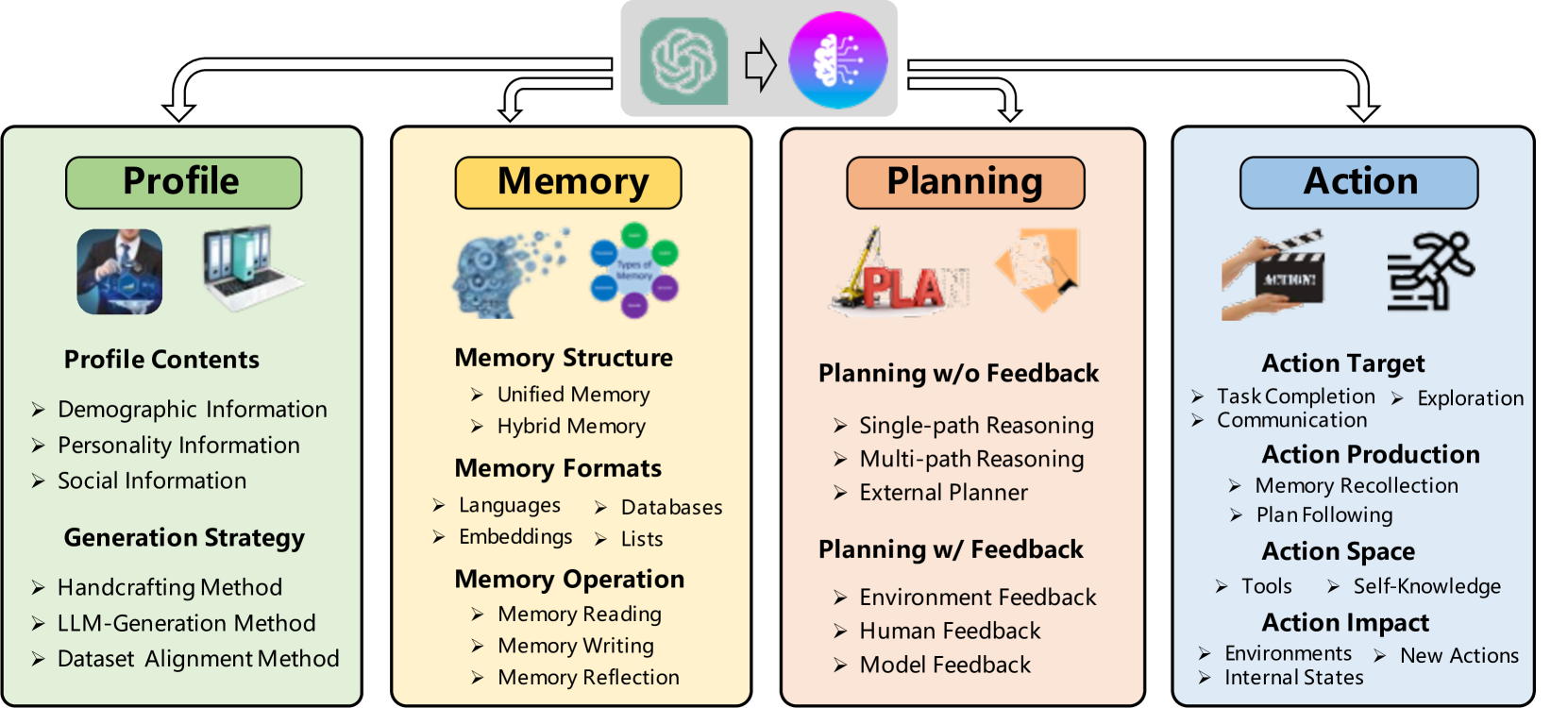
This image is a technical infographic illustrating a four-pillar conceptual framework for the architecture of an AI agent. The diagram is organized into four distinct vertical modules—**Profile**, **Memory**, **Planning**, and **Action**—each represented by a colored block. At the top center, a header section features the OpenAI logo and a stylized brain/circuitry icon, with white double-lined arrows distributing outward to each of the four modules, suggesting a centralized control or generative source.
### Components/Axes
The diagram is structured horizontally into four main columns, each with a specific color theme and internal hierarchy.
* **Header (Top-Center):** Contains two icons. On the left is the green OpenAI/ChatGPT logo. On the right is a purple and blue gradient icon of a human brain with circuit patterns. A small black arrow points from the OpenAI logo to the brain icon.
* **Flow Indicators:** Four white, double-lined arrows originate from the top-center header and point downward to the headers of the four main blocks.
* **Module 1 (Left, Light Green):** Labeled **Profile**.
* **Module 2 (Center-Left, Light Yellow):** Labeled **Memory**.
* **Module 3 (Center-Right, Light Orange):** Labeled **Planning**.
* **Module 4 (Right, Light Blue):** Labeled **Action**.
---
### Content Details
#### 1. Profile (Green Block)
* **Icons:** A professional in a suit interacting with a holographic interface; a laptop with stacked folders.
* **Profile Contents:**
* Demographic Information
* Personality Information
* Social Information
* **Generation Strategy:**
* Handcrafting Method
* LLM-Generation Method
* Dataset Alignment Method
#### 2. Memory (Yellow Block)
* **Icons:** A human profile silhouette composed of gears and digital particles; a circular "Types of Memory" diagram with eight colored nodes.
* **Memory Structure:**
* Unified Memory
* Hybrid Memory
* **Memory Formats:**
* Languages
* Databases
* Embeddings
* Lists
* **Memory Operation:**
* Memory Reading
* Memory Writing
* Memory Reflection
#### 3. Planning (Orange Block)
* **Icons:** A construction crane lifting the letter "L" in the word "PLAN"; a hand holding a document.
* **Planning w/o Feedback:**
* Single-path Reasoning
* Multi-path Reasoning
* External Planner
* **Planning w/ Feedback:**
* Environment Feedback
* Human Feedback
* Model Feedback
#### 4. Action (Blue Block)
* **Icons:** Hands holding a movie clapperboard labeled "ACTION!"; a stick figure icon representing rapid movement/running.
* **Action Target:**
* Task Completion
* Exploration
* Communication
* **Action Production:**
* Memory Recollection
* Plan Following
* **Action Space:**
* Tools
* Self-Knowledge
* **Action Impact:**
* Environments
* New Actions
* Internal States
---
### Key Observations
* **Logical Progression:** The diagram follows a logical flow from the identity of the agent (**Profile**) to its knowledge base (**Memory**), its decision-making process (**Planning**), and finally its execution and effect on the world (**Action**).
* **Feedback Loops:** The "Planning" section explicitly distinguishes between autonomous reasoning (w/o Feedback) and interactive reasoning (w/ Feedback), highlighting the importance of external inputs in complex agentic behavior.
* **Comprehensive Action Scope:** The "Action" module covers not just the execution of tasks but also the "Impact," which includes changing the agent's own "Internal States," suggesting a recursive or learning-oriented design.
---
### Interpretation
This diagram serves as a taxonomy for Large Language Model (LLM) based agents. It suggests that for an AI to function as an "agent" rather than just a chatbot, it requires:
1. **Persona (Profile):** A defined role or set of characteristics to ensure consistent behavior.
2. **Persistence (Memory):** The ability to store and retrieve information over time using various data structures (embeddings, databases).
3. **Cognition (Planning):** The ability to break down complex goals into steps, either through internal reasoning or by utilizing external tools and feedback.
4. **Agency (Action):** The capability to interact with the environment, use tools, and reflect on the outcomes of those actions to update its internal state.
The presence of the OpenAI logo at the top suggests this framework is likely derived from or applied to systems built upon GPT-style architectures, positioning the LLM as the "brain" that drives these four specialized modules.