## Diagram: Conceptual Framework for LLM-Based Agents
### Overview
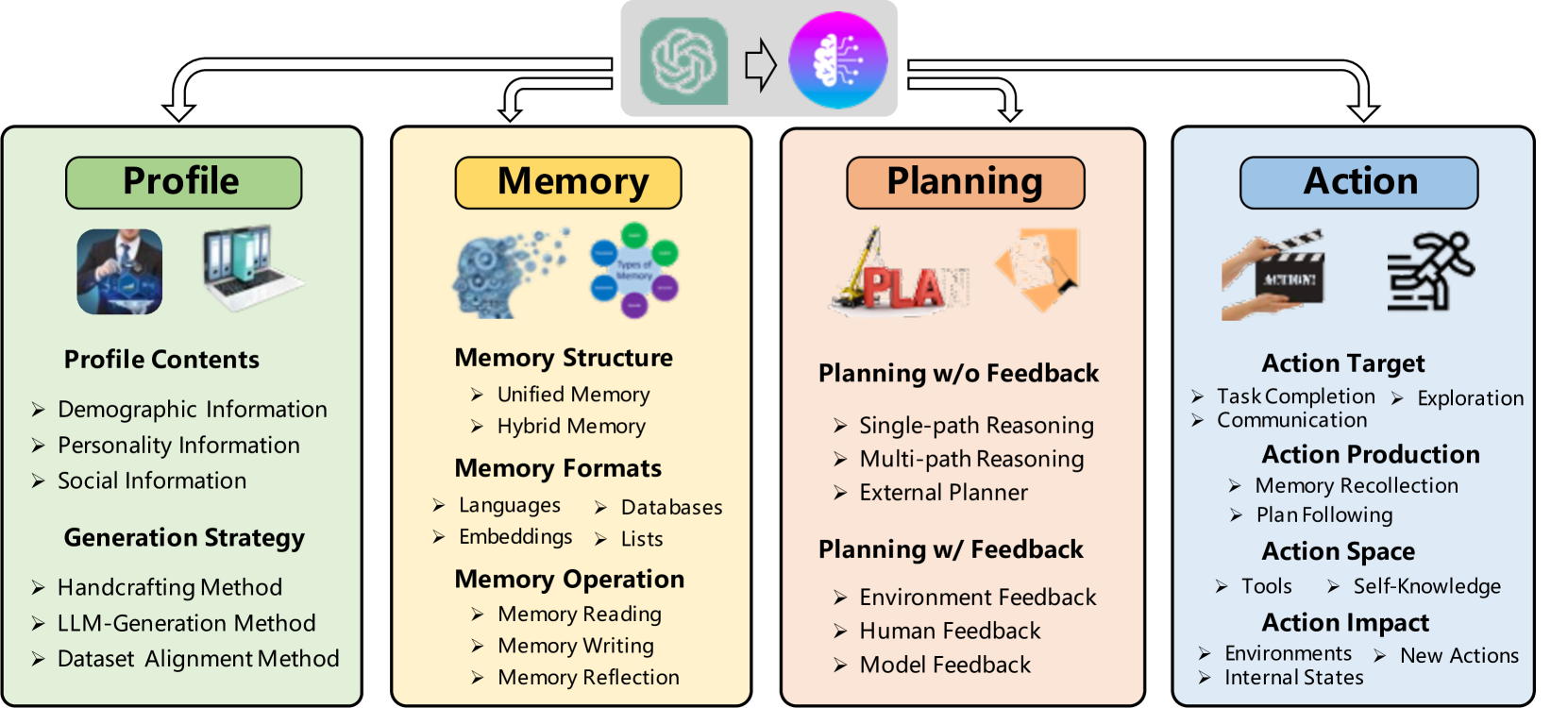
The image presents a structural diagram illustrating the core components of an LLM-based agent system. At the top center, a central hub (represented by the ChatGPT logo and an AI brain icon) acts as the core engine, with arrows branching out to four distinct pillars that define the agent's architecture: **Profile**, **Memory**, **Planning**, and **Action**. Each pillar is color-coded and contains specific sub-categories detailing the functional requirements of that component.
### Components/Axes
The diagram is organized into four vertical columns (pillars) arranged from left to right:
1. **Profile (Green Background):** Focuses on the agent's identity and creation.
2. **Memory (Yellow Background):** Focuses on storage, structure, and retrieval of information.
3. **Planning (Peach Background):** Focuses on reasoning and feedback loops.
4. **Action (Blue Background):** Focuses on execution, tools, and environmental impact.
### Detailed Analysis
#### 1. Profile (Leftmost Column)
* **Visuals:** Icons representing a business person and a laptop with file folders.
* **Profile Contents:**
* Demographic Information
* Personality Information
* Social Information
* **Generation Strategy:**
* Handcrafting Method
* LLM-Generation Method
* Dataset Alignment Method
#### 2. Memory (Second Column)
* **Visuals:** A silhouette of a human head containing a network diagram labeled "Types of Memory."
* **Memory Structure:**
* Unified Memory
* Hybrid Memory
* **Memory Formats:**
* Languages
* Databases
* Embeddings
* Lists
* **Memory Operation:**
* Memory Reading
* Memory Writing
* Memory Reflection
#### 3. Planning (Third Column)
* **Visuals:** A construction crane with the text "PLAN" on the arm, and an icon of a hand holding a document.
* **Planning w/o Feedback:**
* Single-path Reasoning
* Multi-path Reasoning
* External Planner
* **Planning w/ Feedback:**
* Environment Feedback
* Human Feedback
* Model Feedback
#### 4. Action (Rightmost Column)
* **Visuals:** A film clapperboard labeled "ACTION" and an icon depicting a figure climbing stairs.
* **Action Target:**
* Task Completion
* Exploration
* Communication
* **Action Production:**
* Memory Recollection
* Plan Following
* **Action Space:**
* Tools
* Self-Knowledge
* **Action Impact:**
* Environments
* New Actions
* Internal States
### Key Observations
* **Logical Flow:** The diagram suggests a sequential or cyclical dependency: An agent must have a **Profile** (identity) to operate, use **Memory** to store context, utilize **Planning** to determine the next step, and finally execute an **Action** to interact with the world.
* **Feedback Loops:** The "Planning" pillar explicitly distinguishes between "w/o Feedback" and "w/ Feedback," highlighting the critical role of external validation (Human, Environment, Model) in advanced agentic behavior.
* **Action-Oriented:** The "Action" pillar is the most granular, suggesting that the ultimate goal of the agent is to produce tangible outcomes (Impact) within an environment.
### Interpretation
This diagram serves as a taxonomy for "Agentic AI." It breaks down the abstract concept of an "AI Agent" into modular, engineering-focused components.
* **The "Profile"** represents the initialization phase—defining *who* the agent is.
* **The "Memory"** represents the state-management phase—defining *what* the agent knows.
* **The "Planning"** represents the cognitive phase—defining *how* the agent thinks.
* **The "Action"** represents the operational phase—defining *what* the agent does.
The inclusion of "Memory Reflection" and "Feedback" loops (Human/Model/Environment) indicates that this framework is designed for autonomous agents that are expected to improve over time or adapt to dynamic environments, rather than static chatbots. The structure implies that an effective agent is not just a model (the central hub), but a system that integrates these four pillars to bridge the gap between raw intelligence and real-world utility.