\n
## Diagram: Agent Architecture - Profile, Memory, Planning, Action
### Overview
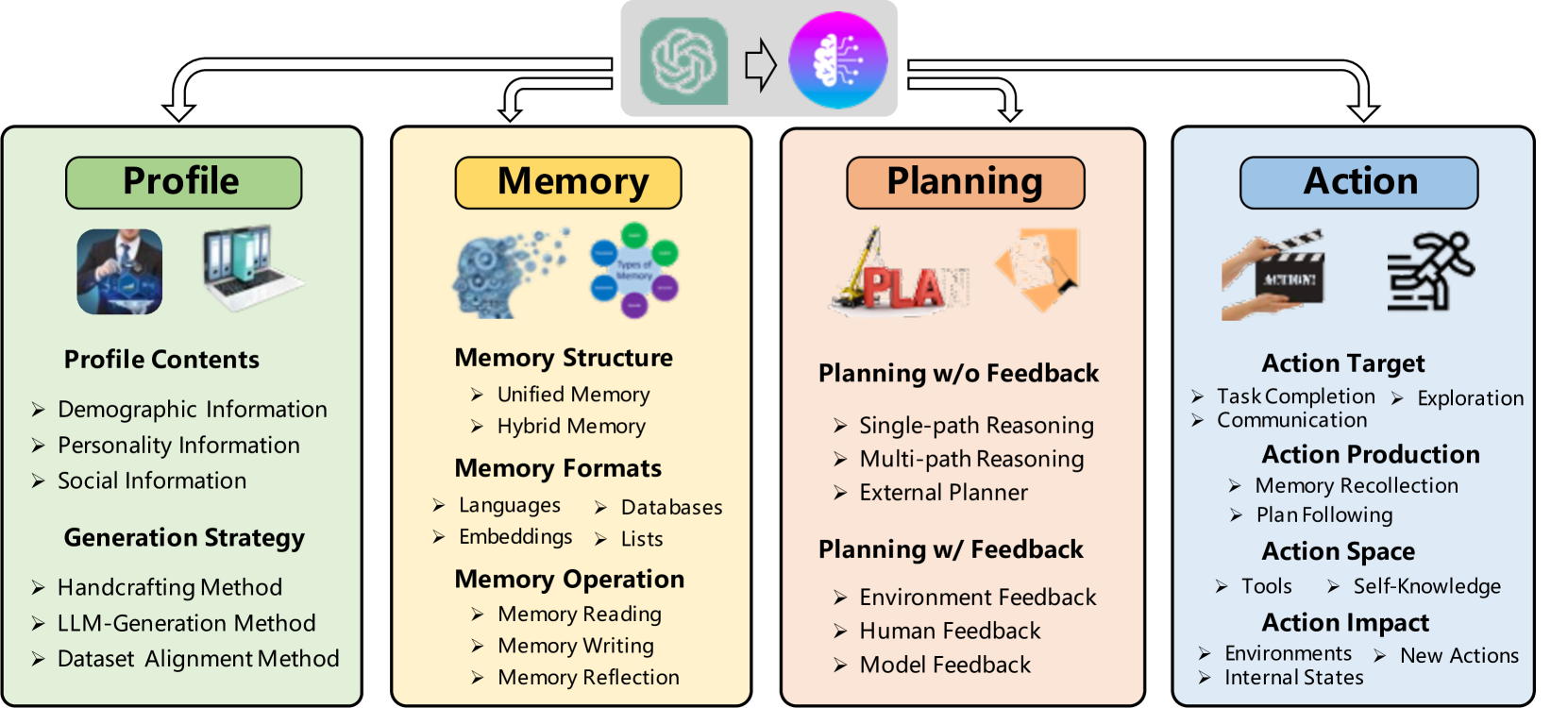
The image depicts a diagram illustrating an agent architecture, broken down into four sequential stages: Profile, Memory, Planning, and Action. Each stage is represented by a colored rectangle containing an illustrative image and a list of associated components. Arrows indicate the flow of information between stages. A visual transition between the Memory and Planning stages is shown with a swirling graphic transforming into a brain-like structure.
### Components/Axes
The diagram consists of four main blocks:
* **Profile** (Green): Focuses on agent characteristics.
* **Memory** (Blue): Focuses on information storage and retrieval.
* **Planning** (Orange): Focuses on decision-making and strategy.
* **Action** (Red): Focuses on execution and impact.
Each block contains two sub-sections:
* **Profile:** Profile Contents & Generation Strategy
* **Memory:** Memory Structure & Memory Formats/Operation
* **Planning:** Planning w/o Feedback & Planning w/ Feedback
* **Action:** Action Target, Action Production, Action Space/Impact
### Detailed Analysis or Content Details
**1. Profile (Green)**
* **Profile Contents:**
* Demographic Information
* Personality Information
* Social Information
* **Generation Strategy:**
* Handcrafting Method
* LLM-Generation Method
* Dataset Alignment Method
**2. Memory (Blue)**
* **Memory Structure:**
* Unified Memory
* Hybrid Memory
* **Memory Formats:**
* Languages
* Databases
* Embeddings
* Lists
* **Memory Operation:**
* Memory Reading
* Memory Writing
* Memory Reflection
**3. Planning (Orange)**
* **Planning w/o Feedback:**
* Single-path Reasoning
* Multi-path Reasoning
* External Planner
* **Planning w/ Feedback:**
* Environment Feedback
* Human Feedback
* Model Feedback
**4. Action (Red)**
* **Action Target:**
* Task Completion
* Exploration
* Communication
* **Action Production:**
* Memory Recollection
* Plan Following
* **Action Space:**
* Tools
* Self-Knowledge
* **Action Impact:**
* Environments
* Internal States
* New Actions
The transition between Memory and Planning is visually represented by a swirling, galaxy-like graphic transforming into a brain-like structure.
### Key Observations
The diagram presents a sequential process, suggesting a pipeline for an intelligent agent. The flow is clearly from Profile to Memory, then to Planning, and finally to Action. The inclusion of "w/o Feedback" and "w/ Feedback" in the Planning stage highlights the importance of incorporating external information into the decision-making process. The Action stage is further broken down into target, production, and impact, indicating a comprehensive view of the agent's behavior.
### Interpretation
This diagram illustrates a conceptual architecture for an intelligent agent. It emphasizes the importance of a well-defined profile, robust memory capabilities, strategic planning, and effective action execution. The agent's ability to learn and adapt is highlighted by the inclusion of feedback mechanisms in the planning stage. The diagram suggests a modular design, where each stage can be independently developed and optimized. The flow from Profile to Action represents the agent's lifecycle, starting with its initial characteristics and culminating in its interaction with the environment. The visual transition between Memory and Planning suggests that memory serves as the foundation for reasoning and decision-making. The breakdown of the Action stage into target, production, and impact provides a framework for evaluating the agent's performance and understanding its consequences.