## Diagram: AI Agent Core Modules Framework
### Overview
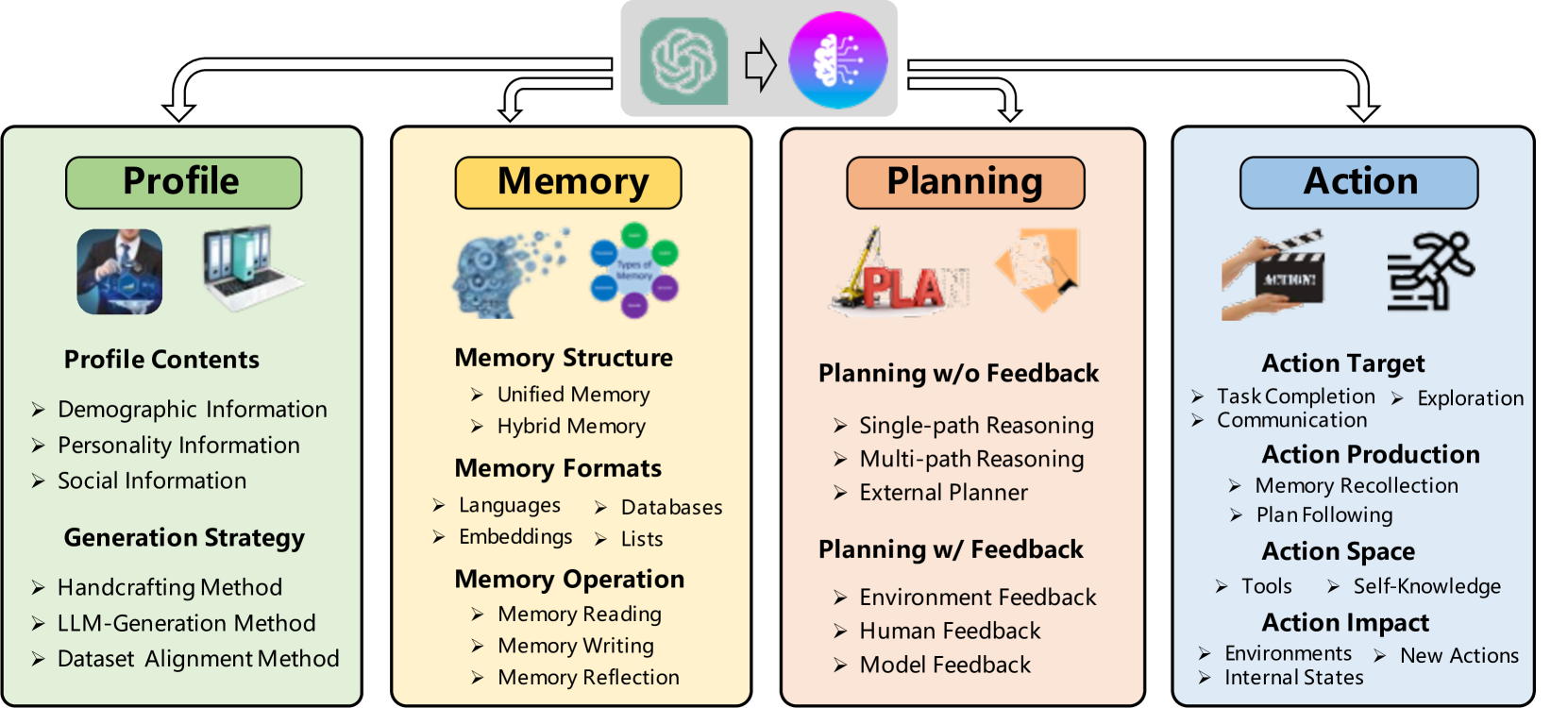
The image is a conceptual diagram illustrating a four-module framework for an AI agent or system. The diagram is structured with two central icons at the top, connected by arrows to four distinct, color-coded rectangular modules below. The overall flow suggests a top-down or central-to-peripheral architecture where a core processing unit interacts with specialized functional components.
### Components & Spatial Layout
1. **Top Central Icons:**
* **Left Icon:** A green square containing a white, stylized brain or network pattern.
* **Right Icon:** A circular icon with a gradient from purple to blue, depicting a brain with radiating nodes or connections.
* **Connection:** A double-headed arrow connects these two icons, indicating bidirectional communication or integration.
* **Flow:** From each of these two top icons, a set of three arrows extends downward, pointing to each of the four main modules below. This visually represents that the core processing (top icons) feeds into or controls all four functional areas.
2. **Four Main Modules (Left to Right):**
* **Module 1 (Profile):** Light green background.
* **Module 2 (Memory):** Light yellow background.
* **Module 3 (Planning):** Light orange/peach background.
* **Module 4 (Action):** Light blue background.
### Content Details: Module Breakdown
#### **Module 1: Profile**
* **Heading:** `Profile` (in a green rounded rectangle).
* **Icons:** A small image of a person in a suit and a laptop.
* **Subsection 1: Profile Contents**
* Demographic Information
* Personality Information
* Social Information
* **Subsection 2: Generation Strategy**
* Handcrafting Method
* LLM-Generation Method
* Dataset Alignment Method
#### **Module 2: Memory**
* **Heading:** `Memory` (in a yellow rounded rectangle).
* **Icons:** A stylized blue brain and a circular diagram labeled "Types of Memory".
* **Subsection 1: Memory Structure**
* Unified Memory
* Hybrid Memory
* **Subsection 2: Memory Formats**
* Languages
* Databases
* Embeddings
* Lists
* **Subsection 3: Memory Operation**
* Memory Reading
* Memory Writing
* Memory Reflection
#### **Module 3: Planning**
* **Heading:** `Planning` (in an orange rounded rectangle).
* **Icons:** A construction crane lifting the word "PLAN" and a folded map.
* **Subsection 1: Planning w/o Feedback**
* Single-path Reasoning
* Multi-path Reasoning
* External Planner
* **Subsection 2: Planning w/ Feedback**
* Environment Feedback
* Human Feedback
* Model Feedback
#### **Module 4: Action**
* **Heading:** `Action` (in a blue rounded rectangle).
* **Icons:** A film clapperboard labeled "ACTION!" and a running stick figure.
* **Subsection 1: Action Target**
* Task Completion
* Exploration
* Communication
* **Subsection 2: Action Production**
* Memory Recollection
* Plan Following
* **Subsection 3: Action Space**
* Tools
* Self-Knowledge
* **Subsection 4: Action Impact**
* Environments
* New Actions
* Internal States
### Key Observations
* **Symmetrical Structure:** The diagram is highly symmetrical, with four equal-sized modules arranged horizontally, suggesting equal importance or a balanced architectural design.
* **Hierarchical Flow:** The arrows establish a clear hierarchy: a central processing core (top icons) governs four distinct but interconnected functional pillars.
* **Comprehensive Taxonomy:** Each module is broken down into a detailed taxonomy of its components (e.g., Memory has Structure, Formats, and Operations), providing a systematic classification of the agent's capabilities.
* **Feedback Integration:** The "Planning" module explicitly distinguishes between planning with and without feedback, highlighting the importance of adaptive, closed-loop control.
* **Action Consequences:** The "Action" module uniquely includes an "Action Impact" category, emphasizing that actions have downstream effects on the environment, the agent's own action repertoire, and its internal state.
### Interpretation
This diagram presents a comprehensive architectural blueprint for an advanced AI agent, likely designed for complex, interactive environments. It moves beyond a simple perception-action loop by incorporating sophisticated internal modules for self-representation (`Profile`), long-term knowledge management (`Memory`), strategic deliberation (`Planning`), and consequential execution (`Action`).
The framework suggests an agent that is not merely reactive but possesses:
1. **Identity and Social Awareness:** Through its `Profile` module.
2. **Persistent and Structured Knowledge:** Through its detailed `Memory` system.
3. **Deliberative and Adaptive Reasoning:** Through its `Planning` module that can incorporate various feedback types.
4. **Goal-Oriented and Impact-Aware Behavior:** Through its `Action` module, which considers targets, production methods, available tools, and the consequences of its deeds.
The connection from the top icons to all modules implies that a central "brain" or orchestrating algorithm manages the flow of information and control across these specialized subsystems. This architecture is indicative of research into creating more human-like, autonomous, and socially integrated artificial agents.