## Diagram: Cognitive/AI System Architecture
### Overview
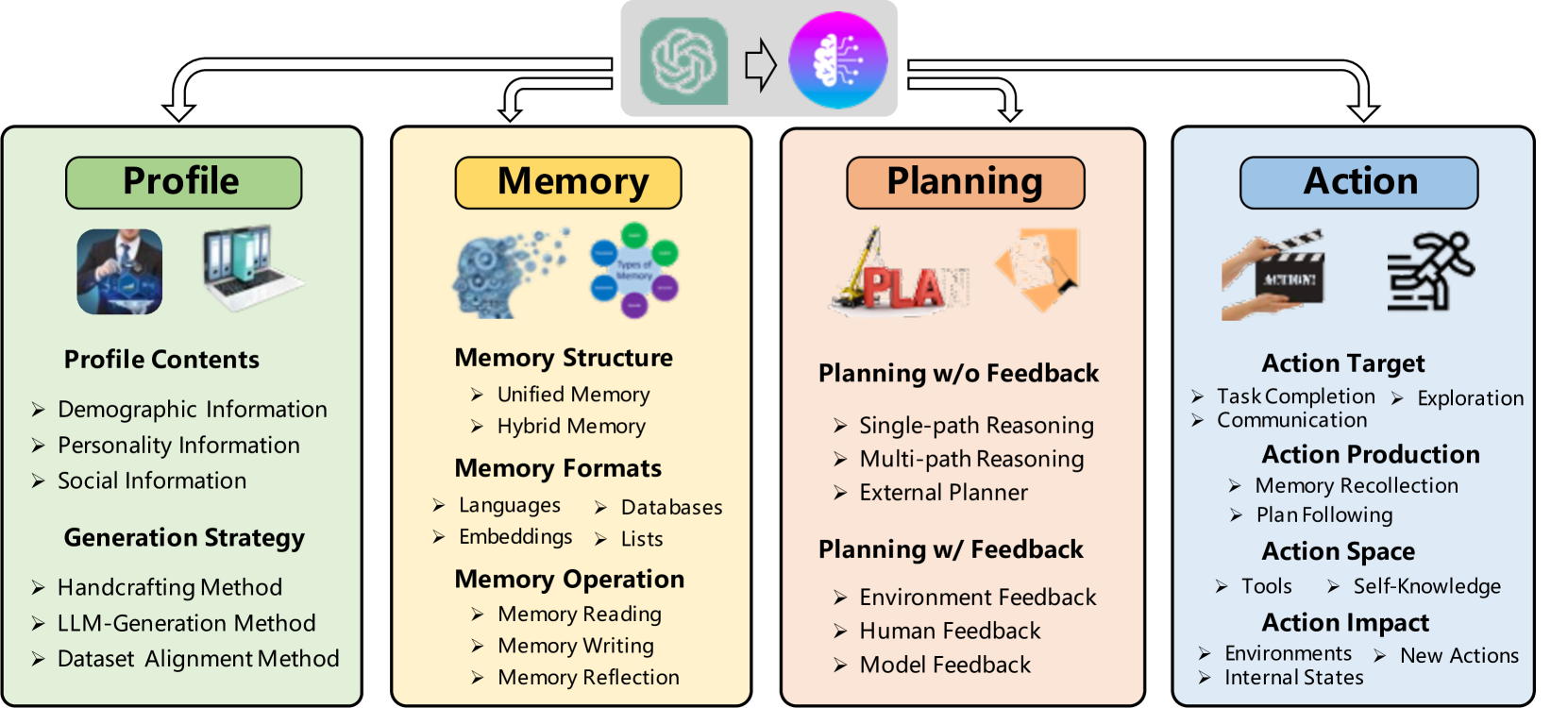
The diagram illustrates a four-stage process flow: **Profile**, **Memory**, **Planning**, and **Action**, interconnected by bidirectional arrows. Central elements include a green icon (likely representing data/network) and a purple icon (likely representing cognition/processing). Arrows indicate directional relationships and feedback loops.
### Components/Axes
1. **Profile** (Leftmost section, green background):
- **Profile Contents**:
- Demographic Information
- Personality Information
- Social Information
- **Generation Strategy**:
- Handcrafting Method
- LLM-Generation Method
- Dataset Alignment Method
2. **Memory** (Second section, yellow background):
- **Memory Structure**:
- Unified Memory
- Hybrid Memory
- **Memory Formats**:
- Languages
- Databases
- Embeddings
- Lists
- **Memory Operation**:
- Memory Reading
- Memory Writing
- Memory Reflection
3. **Planning** (Third section, orange background):
- **Planning w/o Feedback**:
- Single-path Reasoning
- Multi-path Reasoning
- External Planner
- **Planning w/ Feedback**:
- Environment Feedback
- Human Feedback
- Model Feedback
4. **Action** (Rightmost section, blue background):
- **Action Target**:
- Task Completion
- Exploration
- Communication
- **Action Production**:
- Memory Recollection
- Plan Following
- **Action Space**:
- Tools
- Self-Knowledge
- **Action Impact**:
- Environments
- New Actions
- Internal States
### Flow and Relationships
- **Directional Flow**:
- Profile → Memory → Planning → Action (linear progression).
- Feedback loops:
- Action → Planning (via "Environment Feedback," "Human Feedback," "Model Feedback").
- Planning → Memory (via "Memory Reflection").
- Memory → Profile (via "Dataset Alignment Method").
- **Central Icons**:
- Green icon (top-center): Likely represents data integration or network connectivity.
- Purple icon (top-right): Likely represents cognitive processing or decision-making.
### Key Observations
1. **Modular Design**: Each section is self-contained with distinct subcomponents, suggesting a modular system architecture.
2. **Feedback Integration**: Feedback loops emphasize iterative refinement, particularly in Planning and Memory stages.
3. **Hybrid Memory**: Combines structured (Databases, Lists) and unstructured (Languages, Embeddings) data formats.
4. **Action Diversity**: Action Targets span task-oriented (Task Completion), exploratory (Exploration), and communicative (Communication) goals.
### Interpretation
This diagram models a cognitive or AI system where:
- **Profile** acts as the input layer, gathering demographic, personality, and social data through handcrafting, LLM, or dataset alignment methods.
- **Memory** serves as the storage and processing layer, using hybrid structures (Unified/Hybrid Memory) and operations (Reading/Writing/Reflection) to manage diverse data formats.
- **Planning** employs both feedback-driven and non-feedback strategies, balancing adaptability (via feedback) and efficiency (via single/multi-path reasoning).
- **Action** executes tasks while dynamically adjusting based on environmental, human, or model feedback, impacting both external environments and internal states.
The system emphasizes **adaptability** (feedback loops) and **integration** (central icons), suggesting a design optimized for complex, real-world interactions. The absence of explicit numerical data implies a conceptual framework rather than a quantitative model.