\n
## Diagram: AI Decision-Making Process with Blockchain Integration
### Overview
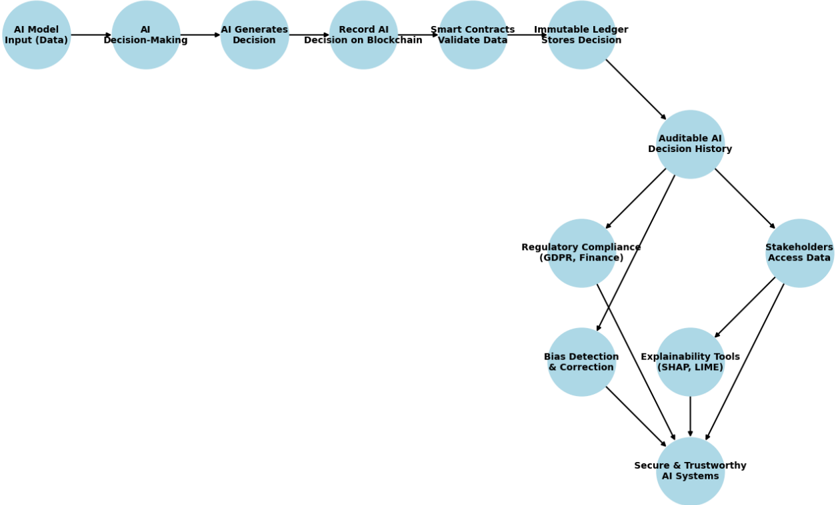
The image is a diagram illustrating a process for secure and trustworthy AI systems, leveraging blockchain technology for auditability and transparency. It depicts a sequential flow starting with AI model input and culminating in secure and trustworthy AI systems, with branching paths for regulatory compliance and stakeholder access. The diagram uses circular nodes connected by arrows to represent the flow of information and processes.
### Components/Axes
The diagram consists of the following components, arranged horizontally and vertically:
* **Horizontal Sequence (Top Row):**
* AI Model Input (Data)
* AI Decision-Making
* AI Generates Decision
* Record AI Decision on Blockchain
* Smart Contracts Validate Data
* Immutable Ledger Stores Decision
* **Vertical Branches:**
* Auditable AI Decision History (branching from Immutable Ledger Stores Decision)
* Regulatory Compliance (GDPR, Finance) (branching from Auditable AI Decision History)
* Stakeholders Access Data (branching from Auditable AI Decision History)
* Bias Detection & Correction (branching from Regulatory Compliance)
* Explainability Tools (SHAP, LIME) (branching from Regulatory Compliance)
* **Final Node:**
* Secure & Trustworthy AI Systems (resulting from Bias Detection & Correction and Explainability Tools)
There are no explicit axes or scales in this diagram. The connections between nodes represent the flow of the process.
### Detailed Analysis or Content Details
The diagram illustrates a process flow as follows:
1. **AI Model Input (Data):** The process begins with input data for an AI model.
2. **AI Decision-Making:** The AI model processes the input data and makes a decision.
3. **AI Generates Decision:** The AI model outputs a decision.
4. **Record AI Decision on Blockchain:** The AI decision is recorded on a blockchain.
5. **Smart Contracts Validate Data:** Smart contracts are used to validate the data.
6. **Immutable Ledger Stores Decision:** The validated decision is stored on an immutable ledger.
7. **Auditable AI Decision History:** The immutable ledger enables an auditable history of AI decisions.
8. **Branching Paths:** From the auditable history, the process branches into two paths:
* **Regulatory Compliance (GDPR, Finance):** This path focuses on meeting regulatory requirements, leading to:
* **Bias Detection & Correction:** Identifying and correcting biases in the AI model.
* **Explainability Tools (SHAP, LIME):** Utilizing tools like SHAP and LIME to explain AI decisions.
* **Stakeholders Access Data:** This path allows stakeholders to access the AI decision data.
9. **Secure & Trustworthy AI Systems:** Both the Bias Detection & Correction and Explainability Tools paths converge to create secure and trustworthy AI systems.
### Key Observations
* The diagram emphasizes the importance of blockchain technology in ensuring the auditability and immutability of AI decisions.
* The branching paths highlight the dual focus on regulatory compliance and stakeholder transparency.
* The use of specific tools like SHAP and LIME demonstrates a commitment to explainable AI (XAI).
* The diagram suggests a holistic approach to AI governance, encompassing security, trust, and ethical considerations.
### Interpretation
The diagram illustrates a proposed architecture for building trustworthy AI systems. The core idea is to leverage the inherent properties of blockchain – immutability, transparency, and auditability – to address concerns surrounding AI decision-making. By recording AI decisions on a blockchain, the system creates a verifiable record that can be used for regulatory compliance, stakeholder transparency, and identifying potential biases. The inclusion of explainability tools further enhances trust by providing insights into how the AI model arrives at its decisions.
The diagram suggests that a key challenge in deploying AI systems is building trust and ensuring accountability. The proposed solution addresses this challenge by creating a transparent and auditable process that can be scrutinized by regulators, stakeholders, and the public. The branching structure indicates that the system is designed to be adaptable to different regulatory environments and stakeholder needs. The convergence of the bias detection and explainability paths towards "Secure & Trustworthy AI Systems" underscores the importance of both fairness and transparency in achieving trustworthy AI.