## Diagram: Blockchain-Enhanced AI Decision Auditability Flowchart
### Overview
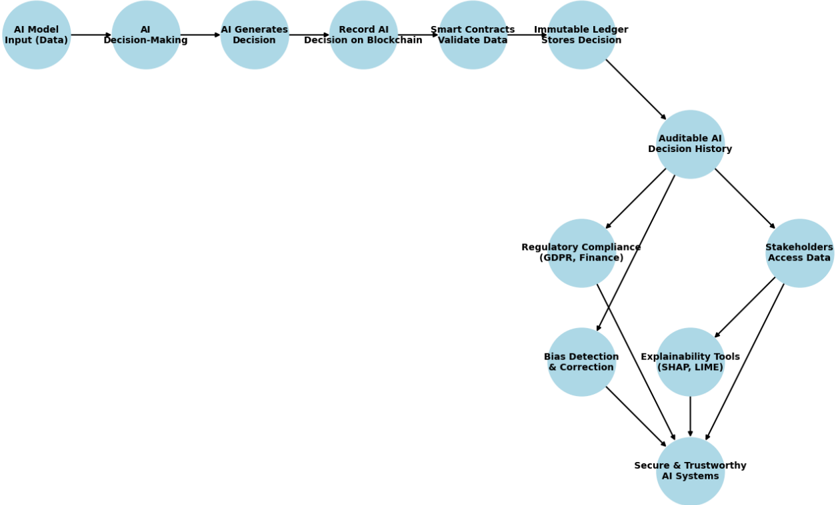
The image displays a flowchart diagram illustrating a process for creating secure, auditable, and trustworthy AI systems. The process begins with an AI model's input and decision-making, which is then recorded and validated on a blockchain. This creates an immutable ledger that enables an auditable history, which in turn supports regulatory compliance, stakeholder access, bias detection, and explainability, culminating in secure AI systems. The diagram uses light blue circular nodes connected by directional arrows to show the flow of data and processes.
### Components/Axes
The diagram is a flowchart with no traditional chart axes. It consists of 12 circular nodes, each containing a text label. The nodes are connected by black arrows indicating the direction of flow or relationship.
**Node Labels (in order of process flow):**
1. AI Model Input (Data)
2. AI Decision-Making
3. AI Generates Decision
4. Record AI Decision on Blockchain
5. Smart Contracts Validate Data
6. Immutable Ledger Stores Decision
7. Auditable AI Decision History
8. Regulatory Compliance (GDPR, Finance)
9. Stakeholders Access Data
10. Bias Detection & Correction
11. Explainability Tools (SHAP, LIME)
12. Secure & Trustworthy AI Systems
**Spatial Layout:**
* **Top Row (Linear Process):** Nodes 1 through 6 are arranged horizontally from left to right, connected sequentially by arrows.
* **Central Hub:** Node 7 ("Auditable AI Decision History") is positioned below and to the right of Node 6, connected by a downward arrow.
* **Branching Network:** From Node 7, arrows branch out to Nodes 8, 9, 10, and 11. These nodes are arranged in a loose cluster below Node 7.
* **Convergence Point:** Nodes 8, 9, 10, and 11 all have arrows pointing downward to Node 12 ("Secure & Trustworthy AI Systems"), which is the final node at the bottom of the diagram.
### Detailed Analysis
The flowchart describes a sequential and then branching process:
1. **Core Decision & Recording Phase (Top Row):**
* The process starts with **AI Model Input (Data)**.
* This feeds into **AI Decision-Making**, which results in **AI Generates Decision**.
* This decision is then **Record[ed] on [the] Blockchain**.
* **Smart Contracts Validate Data** (presumably the input data or the decision process).
* The validated decision is finally stored in an **Immutable Ledger**.
2. **Auditability & Trust Phase (Branching Network):**
* The immutable ledger enables an **Auditable AI Decision History** (Node 7). This is the central node from which multiple benefits flow.
* This auditable history supports:
* **Regulatory Compliance (GDPR, Finance)**: Meeting legal and financial regulatory requirements.
* **Stakeholders Access Data**: Allowing relevant parties to review data and decisions.
* **Bias Detection & Correction**: Identifying and mitigating unfair biases in AI outcomes.
* **Explainability Tools (SHAP, LIME)**: Using specific technical frameworks (SHAP, LIME) to make AI decisions interpretable.
* All four of these supporting functions (Nodes 8, 9, 10, 11) converge to enable the final outcome: **Secure & Trustworthy AI Systems**.
### Key Observations
* **Hybrid Architecture:** The diagram explicitly combines AI processes with blockchain technology (nodes 4, 5, 6) to create a foundation for trust.
* **From Linear to Network:** The process begins as a linear pipeline but transforms into a network where the "Auditable History" enables multiple parallel, reinforcing benefits.
* **Specific Tool Mention:** The diagram names specific explainability tools (SHAP, LIME), indicating a technical, implementation-aware perspective.
* **Convergent Goal:** All branches ultimately lead to the single goal of "Secure & Trustworthy AI Systems," emphasizing that compliance, access, bias correction, and explainability are all necessary components of that goal.
### Interpretation
This diagram presents a conceptual framework for mitigating the "black box" problem and accountability gap in AI systems. It argues that trustworthiness is not a single feature but an emergent property of a system with several key pillars:
1. **Immutability & Provenance:** By recording AI decisions on a blockchain, an unchangeable audit trail is created. This addresses concerns about decision tampering and provides a source of truth.
2. **Multi-Faceted Accountability:** The auditable history is not an end in itself but a tool that enables different forms of accountability: legal (regulatory compliance), social (stakeholder access), ethical (bias detection), and technical (explainability).
3. **Interdependence of Components:** The flowchart suggests these elements are interdependent. For example, effective bias detection likely requires both auditable data (from the ledger) and explainability tools. Regulatory compliance is bolstered by all the other elements.
4. **Proactive vs. Reactive:** The system is designed to be proactive. Smart contracts validate data *before* final storage, and bias detection/correction is integrated as a core function, not an afterthought.
The underlying message is that building trustworthy AI requires a systemic approach that integrates decision-making, immutable record-keeping, and multiple layers of verification and transparency. The inclusion of GDPR and specific tools like SHAP grounds this conceptual model in current real-world challenges and technical practices.