## Screenshot: Component Annotation Interface
### Overview
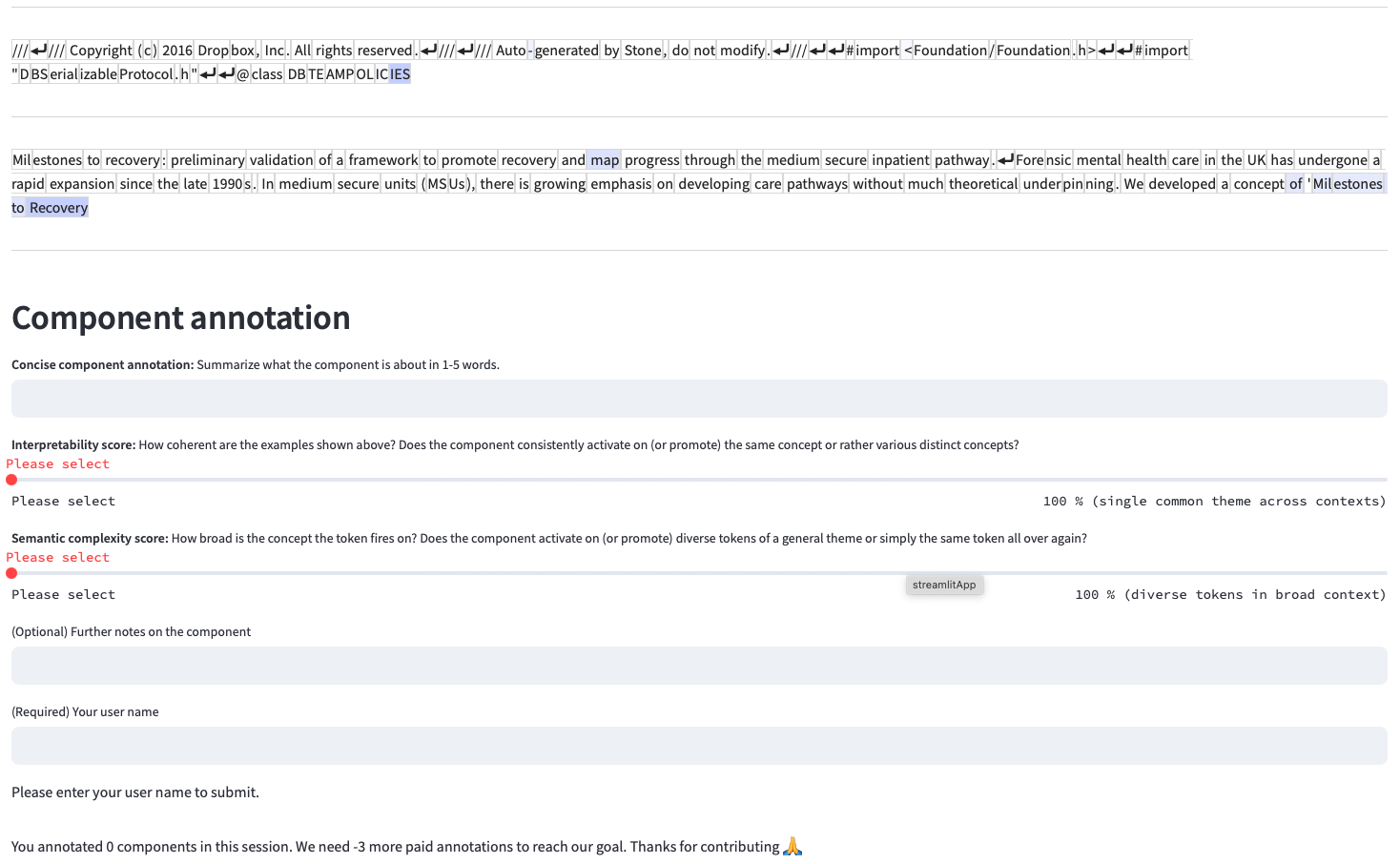
The image shows a web-based interface for annotating components related to forensic mental health care recovery frameworks. The interface includes code snippets, a text passage about mental health care milestones, and a form for component annotation with scoring metrics.
### Components/Axes
1. **Header Section**:
- Copyright notice: "Copyright (c) 2016 Dropbox, Inc. All rights reserved."
- Auto-generated code references:
- `DBSerializableProtocol.h`
- `@class DBTEAMPOLICIES`
- `#import <Foundation/Foundation.h>`
- Highlighted text: "Milestones to Recovery" (blue background)
2. **Main Content**:
- Paragraph about forensic mental health care in the UK:
- Mentions "medium secure inpatient pathway"
- References "Milestones to Recovery" framework
- Notes lack of theoretical underpinning in care pathways
3. **Annotation Form**:
- **Concise Component Annotation**: Text field for 1-5 word summaries
- **Interpretability Score**:
- Label: "How coherent are the examples shown above?"
- Slider with "Please select" (default: 100%)
- Description: "Does the component consistently activate on the same concept?"
- **Semantic Complexity Score**:
- Label: "How broad is the concept the token fires on?"
- Slider with "Please select" (default: 100%)
- Description: "Does the component activate on diverse tokens of a general theme?"
- **Optional Notes**: Text area for additional comments
- **Username Field**: Required input field
- **Submission Button**: "Please enter your user name to submit"
4. **Footer Message**:
- "You annotated 0 components in this session. We need -3 more paid annotations to reach our goal. Thanks for contributing 👍"
### Detailed Analysis
- **Code Snippets**: Technical references suggest integration with Dropbox's codebase, possibly for data serialization or policy management.
- **Highlighted Text**: "Milestones to Recovery" appears twice, emphasizing its importance as a key concept.
- **Scoring Metrics**:
- Both scores default to 100%, but sliders allow adjustment.
- Interpretability focuses on conceptual consistency.
- Semantic Complexity evaluates thematic breadth.
- **Form Requirements**: Username is mandatory for submission.
### Key Observations
- The interface combines technical documentation (code snippets) with user interaction (annotation form).
- The default 100% scores for both metrics suggest optimistic initial assumptions about component quality.
- The negative requirement ("-3 more paid annotations") implies a system tracking annotation quotas.
### Interpretation
This interface appears to be part of a research or quality assurance system for mental health care frameworks. The dual scoring system evaluates both the specificity (interpretability) and generality (semantic complexity) of annotated components. The highlighted "Milestones to Recovery" text indicates this is a central concept being studied. The negative annotation quota suggests either a system error or a counterintuitive gamification element to encourage participation. The integration of code references implies this may be part of a larger software ecosystem requiring precise component documentation.