## Diagram: Cognitive System Architecture for Multimodal AI
### Overview
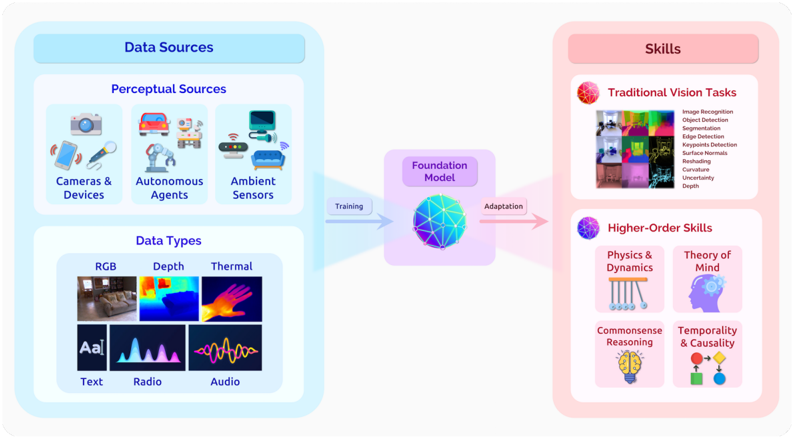
The diagram illustrates a cognitive system architecture for a multimodal AI foundation model, showing the flow from data acquisition to skill development. It emphasizes the integration of diverse data sources, model training/adaptation, and the emergence of both traditional and higher-order cognitive skills.
### Components/Axes
1. **Left Panel: Data Sources**
- **Perceptual Sources** (Top Section):
- Cameras & Devices (camera, microphone icons)
- Autonomous Agents (robot icons)
- Ambient Sensors (thermostat, Wi-Fi router icons)
- **Data Types** (Bottom Section):
- Visual: RGB (room image), Depth (thermal map), Thermal (handprint)
- Multimodal: Text (document), Radio (signal waveform), Audio (soundwave)
2. **Center: Foundation Model**
- Central sphere with geometric patterns
- Arrows labeled "Training" (left) and "Adaptation" (right)
3. **Right Panel: Skills**
- **Traditional Vision Tasks** (Top Section):
- Image Recognition, Object Classification, Segmentation, Pose Estimation, Keypoint Detection, Surface Normals, Reconstruction, Curvature, Uncertainty, Depth
- **Higher-Order Skills** (Bottom Section):
- Physics & Dynamics (pendulum icon)
- Theory of Mind (brain silhouette)
- Commonsense Reasoning (lightbulb)
- Temporality & Causality (arrow/causal link icons)
### Detailed Analysis
- **Data Flow**:
- Perceptual sources feed raw data (RGB, depth, thermal, text, radio, audio) into the foundation model.
- The model undergoes "Training" to process inputs and "Adaptation" to refine outputs.
- **Skill Hierarchy**:
- Traditional vision tasks represent foundational computer vision capabilities.
- Higher-order skills demonstrate advanced cognitive integration (physics, reasoning, temporal awareness).
- **Data Representation**:
- Visual examples show concrete data types (e.g., thermal handprint, radio waveform).
- No numerical values present; focuses on categorical relationships.
### Key Observations
1. **Multimodal Integration**: The system combines visual, textual, and sensory data streams.
2. **Skill Progression**: Traditional tasks form the base for developing abstract reasoning abilities.
3. **Adaptive Learning**: The foundation model's bidirectional arrows suggest continuous improvement through feedback loops.
4. **Cognitive Abstraction**: Higher-order skills incorporate elements of physics, psychology, and causality beyond basic pattern recognition.
### Interpretation
This architecture represents a vision for general-purpose AI systems that:
- Process real-world data through diverse sensors
- Develop foundational perception capabilities
- Evolve toward human-like reasoning through skill composition
- Bridge the gap between raw data processing and abstract understanding
The absence of numerical values suggests this is a conceptual framework rather than an empirical study. The geometric patterns in the foundation model imply complex, interconnected processing mechanisms. The progression from concrete data types to abstract skills mirrors human cognitive development, positioning this as a blueprint for artificial general intelligence (AGI) systems.