\n
## Image: Multiple Choice Question with Visual Elements
### Overview
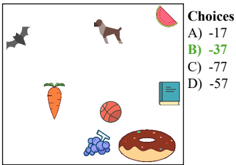
The image presents a multiple-choice question with a series of visual elements (images of objects) and a list of numerical answer choices. The question itself is not explicitly stated, but the format suggests a pattern-recognition or association task. There is no data or chart to analyze, only a visual arrangement of objects and answer options.
### Components/Axes
The image is divided into two main sections:
1. **Visual Elements:** A collection of images depicting a bat, a dog, a watermelon slice, a carrot, a basketball, grapes, a donut, and a book. These are scattered across the image.
2. **Answer Choices:** A list labeled "Choices" with four options:
* A) -17
* B) -37
* C) -77
* D) -57
The "Choices" label is positioned in the top-right corner of the image. The visual elements are distributed throughout the central area.
### Detailed Analysis or Content Details
There is no numerical data or trends to analyze. The image consists solely of visual elements and answer choices. The objects are:
* Bat (grey)
* Dog (brown)
* Watermelon (pink/red)
* Carrot (orange)
* Basketball (orange/brown)
* Grapes (purple)
* Donut (brown)
* Book (blue)
The answer choices are:
* -17
* -37
* -77
* -57
### Key Observations
The image presents a visual puzzle or question. The relationship between the objects and the numerical answer choices is not immediately apparent. The negative signs in the answer choices suggest a possible subtraction or negative correlation.
### Interpretation
The image likely represents a question designed to test a specific type of reasoning or pattern recognition. Without the question prompt, it's impossible to determine the intended logic. The objects could be categorized based on various criteria (e.g., animal vs. food, color, shape), and the answer choices might correspond to a numerical value assigned to each category or object. The negative numbers suggest a possible subtraction or a negative association. The question is likely designed to be ambiguous and require some form of lateral thinking or deduction. It is a visual problem-solving task.