\n
## Line Chart: Model Accuracy vs Number of Operands
### Overview
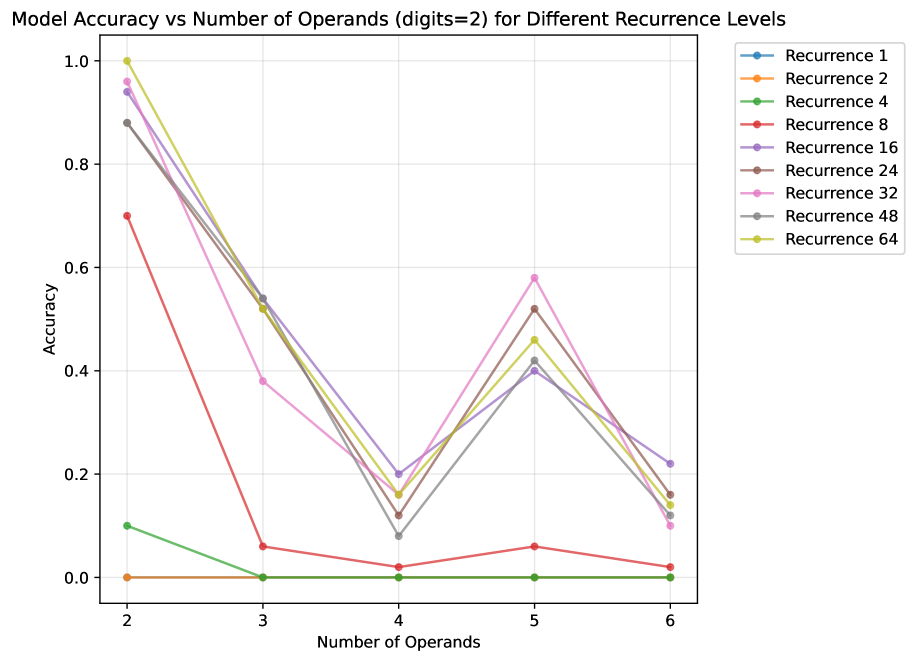
This line chart depicts the relationship between model accuracy and the number of operands, specifically for models with varying levels of recurrence (from 1 to 64). The chart appears to be evaluating performance on a task where the number of operands influences accuracy. The x-axis represents the number of operands, and the y-axis represents the accuracy. The chart is titled "Model Accuracy vs Number of Operands (digits=2) for Different Recurrence Levels".
### Components/Axes
* **Title:** Model Accuracy vs Number of Operands (digits=2) for Different Recurrence Levels
* **X-axis Label:** Number of Operands (ranging from 2 to 6)
* **Y-axis Label:** Accuracy (ranging from 0.0 to 1.0)
* **Legend:** Located in the top-right corner, listing the recurrence levels:
* Recurrence 1 (Blue)
* Recurrence 2 (Orange)
* Recurrence 4 (Green)
* Recurrence 8 (Red)
* Recurrence 16 (Purple)
* Recurrence 24 (Pink)
* Recurrence 32 (Gray)
* Recurrence 48 (Cyan)
* Recurrence 64 (Yellow)
* **Gridlines:** Present to aid in reading values.
### Detailed Analysis
The chart displays nine lines, each representing a different recurrence level.
* **Recurrence 1 (Blue):** The line starts at approximately 0.95 at 2 operands, decreases sharply to around 0.25 at 3 operands, continues to decrease to approximately 0.15 at 4 operands, then rises slightly to around 0.25 at 5 operands, and finally decreases to approximately 0.18 at 6 operands.
* **Recurrence 2 (Orange):** Starts at approximately 0.9 at 2 operands, drops to around 0.1 at 3 operands, remains relatively flat at around 0.05 to 0.1 from 4 to 6 operands.
* **Recurrence 4 (Green):** Starts at approximately 0.05 at 2 operands, drops to approximately 0.01 at 3 operands, remains very close to 0.0 from 4 to 6 operands.
* **Recurrence 8 (Red):** Starts at approximately 0.9 at 2 operands, drops sharply to approximately 0.1 at 3 operands, decreases to approximately 0.05 at 4 operands, rises to approximately 0.15 at 5 operands, and then decreases to approximately 0.1 at 6 operands.
* **Recurrence 16 (Purple):** Starts at approximately 0.95 at 2 operands, decreases to approximately 0.3 at 3 operands, decreases to approximately 0.15 at 4 operands, rises to approximately 0.45 at 5 operands, and then decreases to approximately 0.2 at 6 operands.
* **Recurrence 24 (Pink):** Starts at approximately 0.95 at 2 operands, decreases to approximately 0.3 at 3 operands, decreases to approximately 0.1 at 4 operands, rises to approximately 0.55 at 5 operands, and then decreases to approximately 0.2 at 6 operands.
* **Recurrence 32 (Gray):** Starts at approximately 0.9 at 2 operands, decreases to approximately 0.25 at 3 operands, decreases to approximately 0.1 at 4 operands, rises to approximately 0.4 at 5 operands, and then decreases to approximately 0.15 at 6 operands.
* **Recurrence 48 (Cyan):** Starts at approximately 0.7 at 2 operands, decreases to approximately 0.2 at 3 operands, decreases to approximately 0.05 at 4 operands, rises to approximately 0.3 at 5 operands, and then decreases to approximately 0.15 at 6 operands.
* **Recurrence 64 (Yellow):** Starts at approximately 0.1 at 2 operands, remains relatively flat around 0.0 to 0.1 from 3 to 6 operands.
### Key Observations
* Accuracy generally decreases as the number of operands increases for most recurrence levels.
* Recurrence levels 1, 2, 8, 16, 24, 32, and 48 show a significant drop in accuracy when moving from 2 to 3 operands.
* Recurrence 4 and 64 consistently exhibit very low accuracy across all operand numbers.
* Recurrence 24 and 16 show a peak in accuracy at 5 operands.
* The lines for recurrence levels 1, 2, 8, 16, 24, 32, and 48 exhibit a similar trend, with a sharp initial drop followed by fluctuations.
### Interpretation
The data suggests that increasing the number of operands negatively impacts the model's accuracy, particularly for recurrence levels 1, 2, 8, 16, 24, 32, and 48. The sharp drop in accuracy at 3 operands could indicate a limitation in the model's ability to handle more complex inputs or a need for more sophisticated training data. The consistently low accuracy of recurrence levels 4 and 64 suggests that these levels are not effective for this particular task. The peak in accuracy observed at 5 operands for recurrence levels 16 and 24 might be a result of the model finding a sweet spot in its ability to process that specific number of operands. The "digits=2" in the title suggests the input data consists of two-digit numbers, and the model's performance is being evaluated based on its ability to process these numbers with varying operand counts. The chart highlights the importance of selecting an appropriate recurrence level and understanding the impact of input complexity on model accuracy. The data suggests that there is a trade-off between recurrence level and the number of operands, and the optimal configuration depends on the specific task and data characteristics.