TECHNICAL ASSET FINGERPRINT
a463283c63a4c6c618251b3b
Click to view fullscreen
Press ESC or click to close
FOUND IN PAPERS
EXPERT: gemini-2.0-flash VERSION 1
RUNTIME: nugit/gemini/gemini-2.0-flash
INTEL_VERIFIED
## Line Charts: Network Analysis Metrics vs. Iteration
### Overview
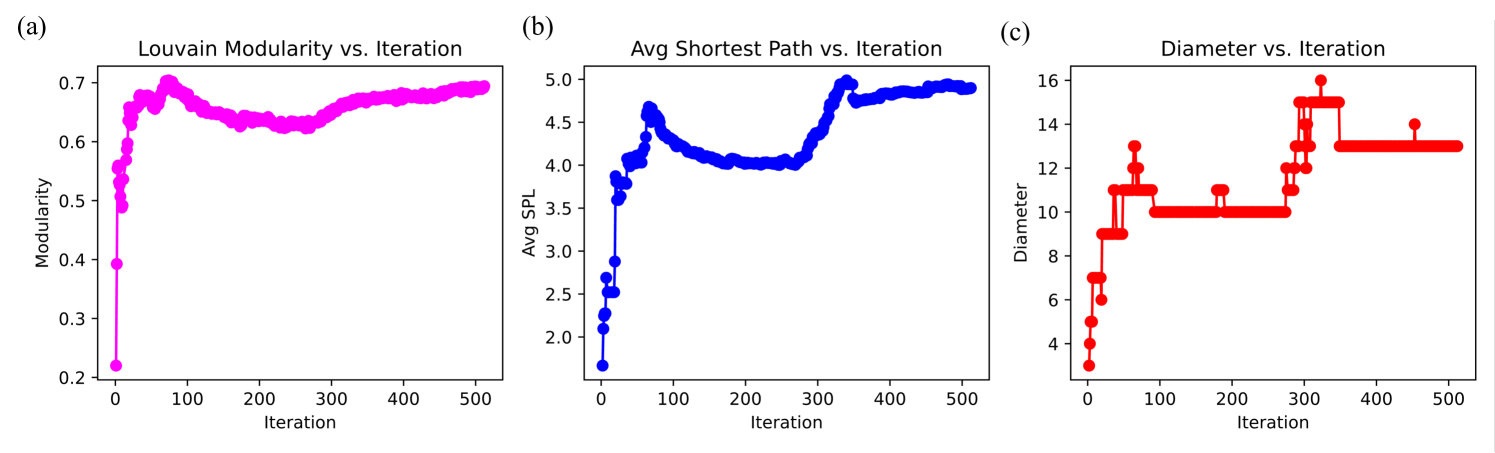
The image presents three line charts, each displaying a different network analysis metric (Louvain Modularity, Average Shortest Path Length, and Diameter) plotted against the number of iterations. The charts are arranged horizontally, labeled (a), (b), and (c) respectively.
### Components/Axes
**Chart (a): Louvain Modularity vs. Iteration**
* **Title:** Louvain Modularity vs. Iteration
* **Y-axis:** Modularity, ranging from 0.2 to 0.7
* **X-axis:** Iteration, ranging from 0 to 500
* **Data Series:** A single magenta line representing the Louvain Modularity.
**Chart (b): Avg Shortest Path vs. Iteration**
* **Title:** Avg Shortest Path vs. Iteration
* **Y-axis:** Avg SPL (Average Shortest Path Length), ranging from 2.0 to 5.0
* **X-axis:** Iteration, ranging from 0 to 500
* **Data Series:** A single blue line representing the Average Shortest Path Length.
**Chart (c): Diameter vs. Iteration**
* **Title:** Diameter vs. Iteration
* **Y-axis:** Diameter, ranging from 4 to 16
* **X-axis:** Iteration, ranging from 0 to 500
* **Data Series:** A single red line representing the Diameter.
### Detailed Analysis
**Chart (a): Louvain Modularity vs. Iteration**
* **Trend:** The magenta line initially increases sharply, reaching a peak around iteration 100, then decreases slightly before stabilizing around a value of approximately 0.68.
* **Data Points:**
* Iteration 0: Modularity ≈ 0.22
* Iteration 100: Modularity ≈ 0.70
* Iteration 500: Modularity ≈ 0.69
**Chart (b): Avg Shortest Path vs. Iteration**
* **Trend:** The blue line initially increases sharply, reaching a peak around iteration 50, then decreases to a local minimum around iteration 250, before increasing again and stabilizing around a value of approximately 4.9.
* **Data Points:**
* Iteration 0: Avg SPL ≈ 1.7
* Iteration 50: Avg SPL ≈ 4.7
* Iteration 250: Avg SPL ≈ 4.0
* Iteration 500: Avg SPL ≈ 4.9
**Chart (c): Diameter vs. Iteration**
* **Trend:** The red line shows a step-wise increase, with plateaus at different diameter values. It increases rapidly in the beginning, then plateaus around 10, then increases again and plateaus around 13.
* **Data Points:**
* Iteration 0: Diameter ≈ 3
* Iteration 50: Diameter ≈ 10
* Iteration 300: Diameter ≈ 15
* Iteration 500: Diameter ≈ 13
### Key Observations
* The Louvain Modularity (magenta line) reaches a relatively stable value after an initial increase.
* The Average Shortest Path Length (blue line) shows more fluctuation, with an initial increase, a decrease, and then a final increase to a stable value.
* The Diameter (red line) increases in discrete steps, indicating changes in the network's overall size or connectivity.
### Interpretation
The charts illustrate how different network properties evolve as the Louvain community detection algorithm iterates. The Louvain Modularity, which measures the quality of the community structure, quickly reaches a high value, suggesting that the algorithm effectively identifies communities early on. The Average Shortest Path Length and Diameter, which reflect the network's connectivity and size, exhibit more complex behavior, indicating that the network's structure is still evolving even after the community structure has stabilized. The step-wise increase in diameter suggests that the network is growing or becoming more interconnected in discrete stages.
DECODING INTELLIGENCE...
EXPERT: gemini-3.1-flash-lite-preview-free VERSION 1
RUNTIME: google-free/gemini-3.1-flash-lite-preview
INTEL_VERIFIED
## Charts: Network Metric Evolution vs. Iteration
### Overview
The image displays three line charts, labeled (a), (b), and (c), arranged horizontally. Each chart tracks a specific network metric against the number of iterations (0 to 500). The charts illustrate the evolution of network properties during an optimization process, likely related to community detection or network clustering.
### Components/Axes
All three charts share the same X-axis:
* **X-Axis:** "Iteration", ranging from 0 to 500, with major ticks at 0, 100, 200, 300, 400, and 500.
**Chart (a) - Left:**
* **Title:** "Louvain Modularity vs. Iteration"
* **Y-Axis:** "Modularity", ranging from 0.2 to 0.7.
* **Data Series:** Magenta line with circular markers.
**Chart (b) - Center:**
* **Title:** "Avg Shortest Path vs. Iteration"
* **Y-Axis:** "Avg SPL", ranging from 2.0 to 5.0.
* **Data Series:** Blue line with circular markers.
**Chart (c) - Right:**
* **Title:** "Diameter vs. Iteration"
* **Y-Axis:** "Diameter", ranging from 4 to 16.
* **Data Series:** Red line with circular markers.
---
### Detailed Analysis
#### Chart (a): Louvain Modularity
* **Trend:** The line starts at ~0.22 at iteration 0, rises sharply to ~0.65 by iteration 50, and reaches a peak of ~0.70 at iteration 80. Following this, there is a gradual decline to ~0.62 at iteration 250. From iteration 250 to 500, the trend is a steady, gradual increase, ending at ~0.69.
* **Key Data Points:**
* Start: (0, ~0.22)
* Peak: (~80, ~0.70)
* Local Minimum: (~250, ~0.62)
* End: (500, ~0.69)
#### Chart (b): Avg Shortest Path (SPL)
* **Trend:** The line starts at ~1.7 at iteration 0, rises sharply to a peak of ~4.7 at iteration 70. It then undergoes a decline to ~4.0 at iteration 250. Following this, it rises again to ~5.0 at iteration 350, before slightly declining and plateauing around ~4.9 for the remainder of the iterations.
* **Key Data Points:**
* Start: (0, ~1.7)
* First Peak: (~70, ~4.7)
* Local Minimum: (~250, ~4.0)
* Second Peak: (~350, ~5.0)
* End: (500, ~4.9)
#### Chart (c): Diameter
* **Trend:** This chart exhibits a step-function behavior rather than a smooth curve. The diameter increases in discrete jumps.
* **Key Data Points/Steps:**
* Start: (0, 3)
* Rapid growth: Increases to 7, 9, and 11 within the first 50 iterations.
* Plateau/Dip: Drops to 10 at iteration 100 and remains at 10 until iteration 250.
* Growth: Increases to 12 at iteration 250, then to 15 at iteration 300.
* Outlier: A distinct spike to 16 at iteration 350.
* Final Plateau: Drops to 13 at iteration 350 and remains constant at 13 until iteration 500.
---
### Key Observations
* **Correlation:** There is a strong correlation between the Modularity (a) and Avg SPL (b) charts. Both metrics experience a significant peak around iteration 70-80, a subsequent dip around iteration 250, and a secondary rise/recovery phase after iteration 250.
* **Step-Function Nature:** The Diameter (c) chart is distinct in its "staircase" appearance, suggesting that the network diameter changes only when specific structural reconfigurations occur, rather than fluctuating continuously like the other two metrics.
* **Outlier:** In chart (c), there is a clear outlier at iteration 350 where the diameter spikes to 16 before immediately dropping back to 13.
### Interpretation
The data suggests the observation of a network optimization algorithm (likely the Louvain method for community detection) as it iteratively restructures a graph.
1. **Initial Phase (0-100 iterations):** The algorithm is rapidly organizing the network. The sharp rise in modularity indicates the successful identification of community structures. The simultaneous rise in Avg SPL and Diameter suggests that as communities form, the "distance" between nodes increases, potentially because the network is becoming more sparse or hierarchical.
2. **Middle Phase (100-300 iterations):** The dip in all three metrics suggests a period of structural instability or "re-shuffling," where the algorithm might be merging or splitting communities, leading to a temporary decrease in modularity and connectivity metrics.
3. **Final Phase (300-500 iterations):** The system reaches a refined state. Modularity recovers to near-peak levels, while the Diameter stabilizes at a higher value (13) compared to the initial phase, indicating a more mature, perhaps more complex, final network topology. The outlier at iteration 350 in the Diameter chart likely represents a transient, unstable state during the final convergence of the algorithm.
DECODING INTELLIGENCE...
EXPERT: gemini-3.1-pro-preview VERSION 1
RUNTIME: gemini/gemini-3.1-pro-preview
INTEL_VERIFIED
## Multi-Panel Line Chart: Network Topology Metrics over Iterations
### Overview
This image contains three side-by-side line charts, labeled (a), (b), and (c) from left to right. The charts display the progression of three different network topology metrics—Louvain Modularity, Average Shortest Path Length (Avg SPL), and Diameter—over a series of iterations. All text in the image is in English.
### Components/Axes
**Global Elements (Shared across all charts):**
* **X-axis (Bottom):** Labeled "Iteration" on all three charts. The scale is linear, with major tick marks and labels at `0`, `100`, `200`, `300`, `400`, and `500`. The data extends slightly past the 500 mark (approximately to iteration 510-520).
**Chart (a) - Left Panel:**
* **Spatial Position:** Leftmost chart.
* **Panel Label:** "(a)" located in the top-left corner outside the chart area.
* **Title:** "Louvain Modularity vs. Iteration" located top-center above the chart.
* **Y-axis (Left):** Labeled "Modularity". The scale is linear, with major tick marks and labels at `0.2`, `0.3`, `0.4`, `0.5`, `0.6`, and `0.7`.
* **Data Series:** A single line with circular markers, colored magenta/pink.
**Chart (b) - Center Panel:**
* **Spatial Position:** Center chart.
* **Panel Label:** "(b)" located in the top-left corner outside the chart area.
* **Title:** "Avg Shortest Path vs. Iteration" located top-center above the chart.
* **Y-axis (Left):** Labeled "Avg SPL". The scale is linear, with major tick marks and labels at `2.0`, `2.5`, `3.0`, `3.5`, `4.0`, `4.5`, and `5.0`.
* **Data Series:** A single line with circular markers, colored blue.
**Chart (c) - Right Panel:**
* **Spatial Position:** Rightmost chart.
* **Panel Label:** "(c)" located in the top-left corner outside the chart area.
* **Title:** "Diameter vs. Iteration" located top-center above the chart.
* **Y-axis (Left):** Labeled "Diameter". The scale is linear, with major tick marks and labels at `4`, `6`, `8`, `10`, `12`, `14`, and `16`.
* **Data Series:** A single line with circular markers, colored red.
---
### Detailed Analysis
#### Chart (a): Louvain Modularity vs. Iteration
* **Trend Verification:** The magenta line exhibits a rapid initial ascent, reaches an early peak, experiences a shallow, prolonged dip, and then gradually climbs to a stable plateau.
* **Data Points (Approximate):**
* **Start:** At Iteration 0, the modularity starts at its lowest point, ~0.22.
* **Initial Climb:** Between iterations 0 and ~20, there is a near-vertical spike, reaching ~0.65.
* **First Peak:** The metric hits a global maximum of ~0.70 around iteration 75.
* **Trough:** From iteration 75 to ~250, the modularity slowly declines to a local minimum of ~0.62.
* **Recovery & Plateau:** From iteration 250 to 400, it climbs back up to ~0.68. From iteration 400 to the end (~510), the line plateaus, remaining highly stable just below 0.70 (approx. 0.69).
#### Chart (b): Avg Shortest Path vs. Iteration
* **Trend Verification:** The blue line shows a volatile early phase with sharp spikes and drops, followed by a gradual decline, a secondary sharp spike to a global maximum, and finally a high-level plateau.
* **Data Points (Approximate):**
* **Start:** At Iteration 0, the Avg SPL is at its lowest, ~1.7.
* **First Spike:** It rises sharply to ~3.9 around iteration 20, dips briefly to ~3.6 at iteration 30, and then spikes again to a local peak of ~4.7 around iteration 70.
* **Decline:** Between iterations 70 and 250, the Avg SPL gradually decreases, forming a shallow bowl shape that bottoms out at ~4.0.
* **Second Spike:** Between iterations 250 and 300, there is a steep climb to the global maximum of ~5.0.
* **Plateau:** After a brief drop to ~4.7 at iteration 310, the metric slowly rises and stabilizes, plateauing around ~4.9 from iteration 400 to the end (~510).
#### Chart (c): Diameter vs. Iteration
* **Trend Verification:** The red line behaves like a step function, indicating discrete integer values. It steps up rapidly, holds steady, experiences mid-iteration volatility with sharp spikes, and eventually settles into a flat plateau.
* **Data Points (Approximate):**
* **Start:** At Iteration 0, the diameter is 3.
* **Initial Steps:** Between iterations 0 and 30, it steps up rapidly through values 4, 5, 6, 7, and 9.
* **First Plateau:** It holds at 9 until iteration 50.
* **Volatility:** Around iteration 60-70, it spikes to 13, drops to 11, and holds at 11 until iteration 100.
* **Second Plateau:** From iteration 100 to ~270, it drops to and holds steady at 10 (with one brief, single-point spike to 11 around iteration 180).
* **Late Spikes:** Between iterations 270 and 320, it steps up to 11, 12, 13, spikes to 15, drops to 14, and hits a global maximum of 16.
* **Final Plateau:** It holds at 15 until iteration 350, then drops to 13. From iteration 350 to the end (~510), it forms a solid plateau at 13 (with one brief, single-point spike to 14 around iteration 450).
---
### Key Observations
1. **Convergence:** All three metrics show significant volatility in the first 350 iterations but reach a state of equilibrium or plateau between iterations 350 and 500.
2. **Correlated Volatility:** The major shifts in the network occur in similar phases. For example, around iteration 250-300, Modularity begins to recover (Chart a), Avg SPL spikes dramatically (Chart b), and Diameter experiences its highest volatility and peak (Chart c).
3. **Discrete vs. Continuous:** While Modularity and Avg SPL are continuous floating-point metrics (showing smooth curves between points), Diameter is strictly an integer metric, resulting in the rigid, stepped visual appearance of Chart (c).
### Interpretation
These charts likely represent the evolution of a network graph undergoing an iterative algorithm, such as a community detection process (explicitly named "Louvain" in chart a), a network pruning process, or a generative growth model.
* **Modularity (Chart a):** The rapid increase in modularity indicates that the algorithm is successfully finding and isolating dense communities (clusters) within the network. The high final plateau (~0.69) suggests a network with very strong community structure (dense internal connections, sparse external connections).
* **Avg Shortest Path & Diameter (Charts b & c):** As the network becomes more modular, the average distance between any two random nodes (Avg SPL) and the maximum distance between the two furthest nodes (Diameter) both increase significantly.
* **Synthesis:** Reading between the lines, the data demonstrates a structural trade-off. As the algorithm forces the network into distinct, tight-knit communities (high modularity), it likely removes or stretches the "bridge" edges that connect these different communities. Consequently, traversing the network from one community to another takes more steps, driving up both the average shortest path and the overall diameter of the graph. The stabilization of all three metrics after iteration 350 indicates that the algorithm has converged on a final, optimized network topology.
DECODING INTELLIGENCE...
EXPERT: nemotron-free VERSION 1
RUNTIME: free/nvidia/nemotron-nano-12b-v2-vl:free
INTEL_VERIFIED
## Line Graphs: Metric Evolution vs. Iteration
### Overview
The image contains three vertically stacked line graphs (a, b, c) depicting the evolution of three network metrics (Louvain Modularity, Average Shortest Path Length, and Diameter) across 500 iterations. Each graph uses a distinct color-coded line to represent its metric.
### Components/Axes
**Subplot (a): Louvain Modularity vs. Iteration**
- **Y-axis**: Modularity (0.2–0.7, increments of 0.1)
- **X-axis**: Iteration (0–500, increments of 100)
- **Legend**: Magenta line labeled "Modularity"
**Subplot (b): Avg Shortest Path vs. Iteration**
- **Y-axis**: Avg SSPL (2.0–5.0, increments of 0.5)
- **X-axis**: Iteration (0–500, increments of 100)
- **Legend**: Blue line labeled "Avg SSPL"
**Subplot (c): Diameter vs. Iteration**
- **Y-axis**: Diameter (4–16, increments of 2)
- **X-axis**: Iteration (0–500, increments of 100)
- **Legend**: Red line labeled "Diameter"
### Detailed Analysis
**Subplot (a) Trends**:
- Modularity starts at ~0.2 (iteration 0), spikes to ~0.7 by iteration 50, then fluctuates between ~0.6–0.7 until iteration 500.
- Sharp initial increase suggests rapid community structure formation, followed by stabilization.
**Subplot (b) Trends**:
- Avg SSPL begins at ~4.5 (iteration 0), drops to ~3.0 by iteration 100, rises to ~4.5 by iteration 300, then stabilizes near ~4.8.
- U-shaped pattern indicates initial network fragmentation, followed by community-driven connectivity.
**Subplot (c) Trends**:
- Diameter starts at ~4 (iteration 0), increases to ~12 by iteration 100, drops to ~10 by iteration 200, spikes to ~16 by iteration 300, then declines to ~12 by iteration 500.
- Volatile pattern reflects temporary network expansion/contraction during community optimization.
### Key Observations
1. **Modularity Stabilization**: Modularity plateaus after iteration 100, suggesting convergence of community detection.
2. **SSPL-U Pattern**: Avg SSPL’s U-shape implies initial network disintegration followed by community-driven reconnection.
3. **Diameter Peaks**: Diameter’s peak at iteration 300 (~16) indicates a temporary maximum network spread before stabilization.
### Interpretation
The graphs collectively illustrate the dynamic behavior of a network optimization process:
- **Louvain Modularity**’s rapid rise and stabilization demonstrate effective community detection, with diminishing returns after iteration 100.
- **Avg SSPL**’s U-shaped curve suggests the network initially becomes more fragmented (lower SSPL) as communities form, then reconnects via community-level links (higher SSPL).
- **Diameter**’s volatility highlights transient network expansion/contraction, with the largest spread occurring at iteration 300. This could reflect temporary community boundary adjustments before final stabilization.
The metrics are inversely related: high modularity (a) correlates with lower Avg SSPL (b) and smaller diameter (c), consistent with community-driven network compaction. The iteration 300 peak in diameter may indicate a transitional phase where community structures are reorganizing before settling into a stable configuration.
DECODING INTELLIGENCE...