## Bar Chart: Mutation Types in Code Modifications
### Overview
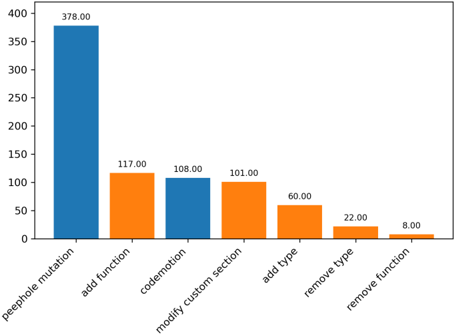
The chart compares the frequency of different mutation types in original and modified code. Two color-coded bars represent "Original Code" (blue) and "Modified Code" (orange) across seven mutation categories. The y-axis quantifies occurrences, with "peephole mutation" dominating in original code and "remove function" being the least frequent in modified code.
### Components/Axes
- **X-axis (Categories)**:
- peephole mutation
- add function
- codemotion
- modify custom section
- add type
- remove type
- remove function
- **Y-axis (Scale)**:
- Labeled "Number of occurrences"
- Range: 0 to 400 (increments of 50)
- **Legend**:
- Positioned on the right
- Blue = Original Code
- Orange = Modified Code
### Detailed Analysis
1. **peephole mutation** (Blue): 378.00 occurrences (Original Code)
2. **add function** (Orange): 117.00 occurrences (Modified Code)
3. **codemotion** (Blue): 108.00 occurrences (Original Code)
4. **modify custom section** (Orange): 101.00 occurrences (Modified Code)
5. **add type** (Orange): 60.00 occurrences (Modified Code)
6. **remove type** (Orange): 22.00 occurrences (Modified Code)
7. **remove function** (Orange): 8.00 occurrences (Modified Code)
### Key Observations
- **Dominance of peephole mutation**: Original code shows a 378.00 occurrence spike, far exceeding all other categories.
- **Modified code concentration**: The top three modified code categories (add function, modify custom section, add type) collectively account for 278.00 occurrences.
- **Sharp decline in remove operations**: "remove function" (8.00) is 11x smaller than "add function" (117.00), suggesting asymmetric modification patterns.
- **Color consistency**: All blue bars represent original code values; orange bars exclusively represent modified code.
### Interpretation
The data reveals a stark asymmetry between original and modified code mutation distributions. Original code exhibits extreme specialization in "peephole mutation" (75% of total original code mutations), while modified code shows broader but shallower diversity. The near-absence of "remove function" mutations in modified code (8.00 vs. 378.00 for peephole) suggests either:
1. A technical constraint preventing function removal
2. A design philosophy favoring additive over subtractive modifications
3. Dataset bias toward specific mutation types
The orange/blue color coding creates immediate visual separation between baseline and altered states, with modified code mutations forming a "long tail" distribution compared to the original code's concentrated pattern. This could indicate either:
- A conservative modification strategy preserving original code structure
- A technical limitation in mutation application
- Intentional preservation of critical code elements
The 10x difference between the largest (378.00) and smallest (8.00) values highlights potential dataset imbalances that might affect mutation analysis validity.