\n
## Diagram: Grid-Based Pattern
### Overview
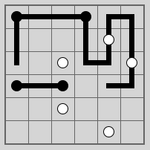
The image depicts a grid-based pattern consisting of black lines connecting black circles and white circles scattered across a gray grid. The grid appears to be approximately 8x8. There are no explicit labels or axes. The diagram appears to be a visual puzzle or a representation of a network.
### Components/Axes
The diagram consists of:
* **Grid:** A gray grid providing the background structure. The grid lines are faint but visible.
* **Black Lines:** Thick black lines connecting black circles. These lines form several distinct shapes.
* **Black Circles:** Solid black circles, appearing as nodes or endpoints of the black lines. There are 5 black circles.
* **White Circles:** Hollow white circles, scattered throughout the grid. There are 5 white circles.
### Detailed Analysis or Content Details
The black lines and circles form the following shapes:
1. **Top-Left:** A 'U' shape with a horizontal line extending from the right side of the 'U'. The 'U' is open at the bottom.
2. **Center-Left:** A short horizontal line connecting two black circles.
3. **Top-Right:** A zig-zag pattern, resembling a simplified 'Z' or 'N' shape.
4. **Bottom-Right:** A short zig-zag pattern, similar to the top-right, but shorter.
The white circles are positioned as follows:
1. **Center-Top:** Approximately in the center of the top half of the grid.
2. **Center-Left:** Slightly below the center, to the left of the grid.
3. **Bottom-Center:** Approximately in the center of the bottom half of the grid.
4. **Bottom-Right:** Near the bottom-right corner of the grid.
5. **Top-Right:** Near the top-right corner of the grid.
There is no numerical data present in the image. The arrangement of the shapes and circles is the primary information.
### Key Observations
* The black lines create closed or partially closed shapes.
* The white circles are not connected by any lines.
* The distribution of white circles appears somewhat random, but they are generally spaced out across the grid.
* The black circles are always endpoints of the black lines.
### Interpretation
The diagram likely represents a puzzle or a network with specific constraints. The black lines could represent paths or connections, while the white circles might represent destinations or obstacles. The arrangement suggests a problem where one needs to connect the black circles using the provided lines, potentially avoiding or interacting with the white circles. The lack of labels or context makes it difficult to determine the exact nature of the puzzle or network. It could be a simplified representation of a maze, a circuit diagram, or a game board. The image is a visual representation of relationships and spatial arrangement, rather than a quantitative dataset. It is a problem-solving visual.